Exodus 3
LXX2012: Septuagint in British/International English 2012 · Tap a verse to see its cross-references.
Moses at the Burning Bush
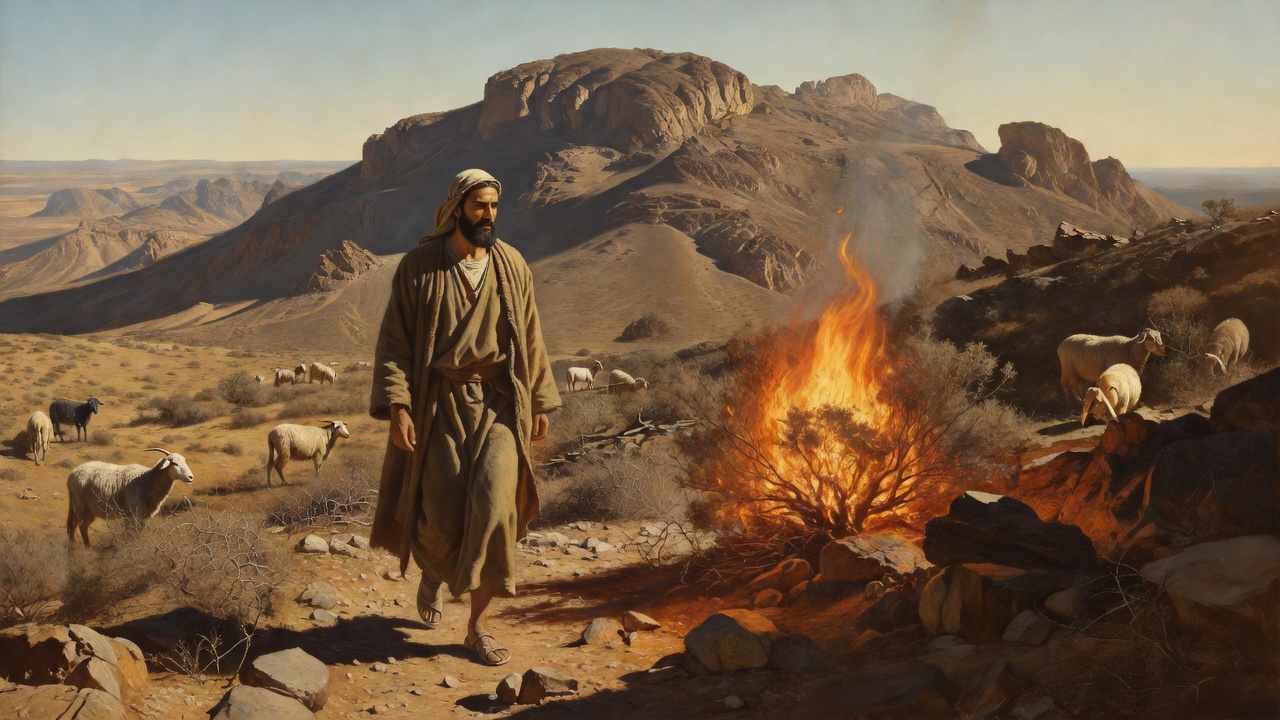
1And Moses was feeding the flock of Jothor his father-in-law, the priest of Madiam; and he brought the sheep near to the wilderness, and came to the mount of Choreb. 2And an angel of the Lord appeared to him in flaming fire out of the bush, and he sees that the bush burns with fire, —but the bush was not consumed. 3And Moses said, I will go near and see this great sight, why the bush is not consumed. 4And when the Lord saw that he drew near to see, the Lord called him out of the bush, saying, Moses, Moses; and he said, What is it? 5And he said, Draw not near hither: loose your sandals from off your feet, for the place whereon you stand is holy ground. 6And he said, I am the God of your father, the God of Abraam, and the God of Isaac, and the God of Jacob; and Moses turned away his face, for he was afraid to gaze at God. 7And the Lord said to Moses, I have surely seen the affliction of my people that is in Egypt, and I have heard their cry caused by their taskmasters; for I know their affliction. 8And I have come down to deliver them out of the hand of the Egyptians, and to bring them out of that land, and to bring them into a good and wide land, into a land flowing with milk and honey, into the place of the Chananites, and the Chettites, and Amorites, and Pherezites, and Gergesites, and Evites, and Jebusites. 9And now, behold, the cry of the children of Israel is come to me, and I have seen the affliction with which the Egyptians afflict them. 10And now come, I will send you to Pharao king of Egypt, and you shall bring out my people the children of Israel from the land of Egypt. 11And Moses said to God, Who am I, that I should go to Pharao king of Egypt, and that I should bring out the children of Israel from the land of Egypt? 12And God spoke to Moses, saying, I will be with you, and this shall be the sign to you that I shall send you forth, —when you bring out my people out of Egypt, then you⌃ shall serve God in this mountain. 13And Moses said to God, Behold, I shall go forth to the children of Israel, and shall say to them, The God of our fathers has sent me to you; and they will ask me, What is his name? What shall I say to them? 14And God spoke to Moses, saying, I am THE BEING; and he said, Thus shall you⌃ say to the children of Israel, THE BEING has sent me to you. 15And God said again to Moses, Thus shall you say to the sons of Israel, The Lord God of our fathers, the God of Abraam, and God of Isaac, and God of Jacob, has sent me to you: this is my name for ever, and my memorial to generations of generations. 16Go then and gather the elders of the children of Israel, and you shall say to them, The Lord God of our fathers has appeared to me, the God of Abraam, and God of Isaac, and God of Jacob, saying, I have surely looked upon you, and upon all the things which have happened to you in Egypt. 17And he said, I will bring you up out of the affliction of the Egyptians to the land of the Chananites and the Chettites, and Amorites and Pherezites, and Gergesites, and Evites, and Jebusites, to a land flowing with milk and honey. 18And they shall listen to your voice, and you and the elders of Israel shall go in to Pharao king of Egypt, and you shall say to him, The God of the Hebrews has called us; we will go then a journey of three days into the wilderness, that we may sacrifice to our God. 19But I know that Pharao king of Egypt will not let you go, save with a mighty hand; 20and I will stretch out my hand, and strike the Egyptians with all my wonders, which I shall work amongst them, and after that he will send you forth. 21And I will give this people favour in the sight of the Egyptians, and whenever you⌃ shall escape, you⌃ shall not depart empty. 22But every woman shall ask of her neighbour and fellow lodger, articles of gold and silver, and apparel; and you⌃ shall put them upon your sons and upon your daughters, —and spoil you⌃ the Egyptians.
Did you know?
The Call of Moses at the Burning Bush
- Moses is shepherding in Midian when this chapter begins. The Midianites were a nomadic Arabian tribe descended from Midian, Abraham's fourth son by Keturah, whose name is explained as strife. They lived chiefly in the desert north of Arabia, and the Sinai peninsula was grazing land for their flocks; it was there, after fleeing Egypt, that Moses became a servant and then the priest's son-in-law.Sources: the Bible text itself · Midian · Midian
- His father-in-law is Jethro, called the priest of Midian. Easton's Bible Dictionary (1897) equates that priest with Raguel and says that, if the two names belong to one man, Raguel may be regarded as his personal name and Jethro, meaning excellency, as an official title.Sources: the Bible text itself · Jethro
- Moses leads the flock to Horeb, the mountain of God. The name is explained as desert, or mountain, of the dried-up ground, a general term for the whole range of which Sinai was one summit; Easton's Bible Dictionary (1897) gives the modern name of the range as Jebel Musa and describes a huge block about two miles long and about one mile wide, with a very spacious plain called Er Rahah at its north-east end, where the Israelites later camped for nearly a year.Sources: the Bible text itself · Horeb
Notes written with AI assistance from open sources (Theographic Bible Metadata, CC BY-SA 4.0; Easton’s Bible Dictionary, public domain) and reviewed before publishing.
Places in this chapter
- Midian · 28.495, 35.012 · verse 1
- Mount Horeb · Today: Jebel Musa · 28.540, 33.973 · verse 1
- Egypt · 30.129, 31.308 · verses 7, 8, 10, 11, 12, 16, 17, 18, 19, 20, 22
Only places identified with high confidence are shown (90% or more according to the scholarly sources compiled by OpenBible). Period map: DARE (Digital Atlas of the Roman Empire), CC BY 4.0; modern map: © OpenStreetMap contributors; places: OpenBible.info (CC BY 4.0).
Credits and license for this translation
LXX2012: Septuagint in British/International English 2012
The Septuagint with Apocrypha, translated from Greek to English by Sir Lancelot C. L. Brenton and published in 1885, with some language updates (British/International English)
Public Domain
Language: English
Dialect (if applicable): British
Language in English: English
Translation by: Sir Lancelot Charles Lee Breton
LXX2012: Septuagint in English 2012, British/International English Edition
This is a translation of the Old Testament and Apocrypha/Deuterocanon from Hebrew to Greek to 19th Century British English, with some updates of spelling and word usage to contemporary British/International English. The original English translation was done by Sir Lancelot Charles Lee Brenton and published by Samuel Bagster & Sons, Ltd., in London in 1851. It has entered the Public Domain due to the passage of sufficient time. In the process of scanning and typing the text, the original poetry and prose formatting, as well as peripheral material like introductions and notes, have been omitted.
This edition of the Septuagint has some language updates. Brenton's word order and punctuation has been mostly retained, meaning that quotation marks are not used, and sentences within quotes may not start with capital letters, as was standard usage in 1851. Names transliterated from Greek to those transliterated from Hebrew in the common English Bibles often differ. These language updates are dedicated to the Public Domain by the author of those edits, Michael Paul Johnson. Therefore this edition may be freely copied, published, etc.
Before considering making changes to the text of this work, I recommend that you consult with God, because this is really His Book.
If you find errors in the text, please report them so that we can correct them.
Donations to help with the expenses of operating this web site and thus help others have free access to the Word of God may be made to us, but are not required. Please see http://MLJohnson.org/partner/ for more about that.
Section headings adapted from the Berean Standard Bible (public domain); they are not part of this translation’s text.
Source: http://ebible.org/eng-uk-lxx2012/ · eBible.org