Exodus 2
LXX2012: Septuagint in British/International English 2012 · Tap a verse to see its cross-references.
The Birth and Adoption of Moses
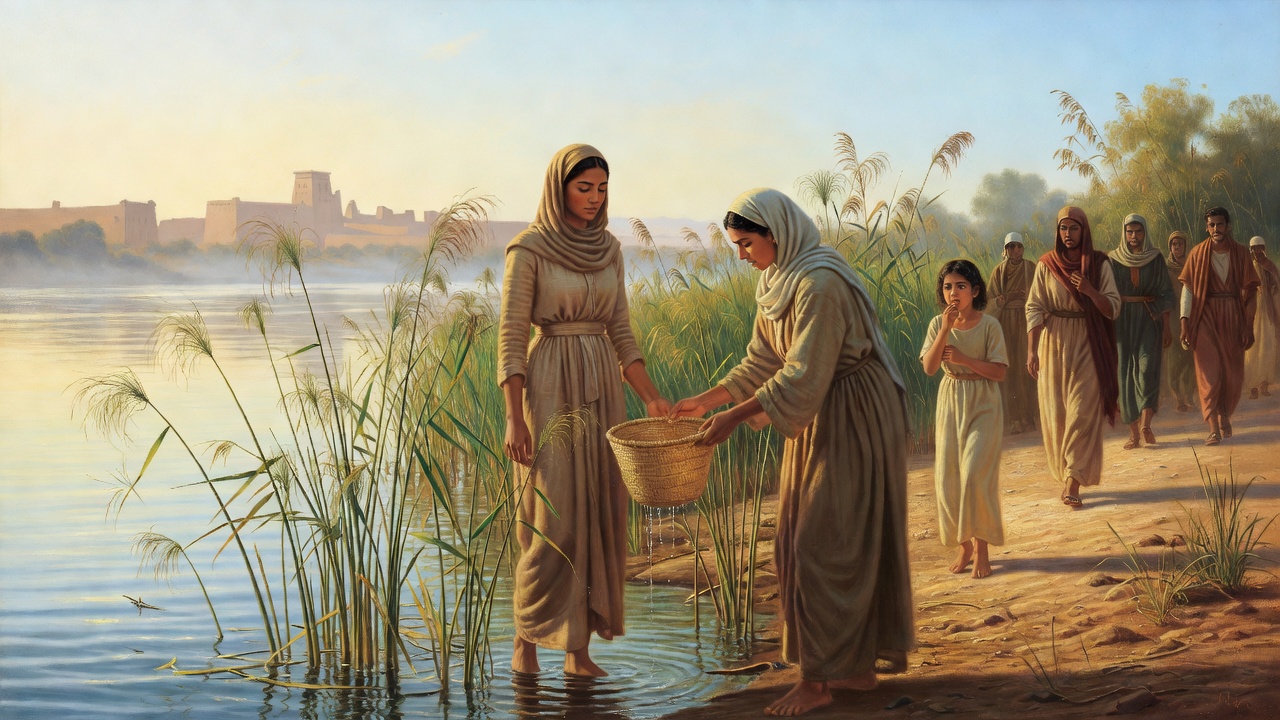
1And there was a certain man of the tribe of Levi, who took as wife one of the daughters of Levi. 2And she conceived, and bore a male child; and having seen that he was fair, they hid him three months. 3And when they could no longer hide him, his mother took for him an ark, and besmeared it with bitumen, and cast the child into it, and put it in the ooze by the river. 4And his sister was watching from a distance, to learn what would happen to him. 5And the daughter of Pharao came down to the river to bathe; and her maids walked by the river's side, and having seen the ark in the ooze, she sent her maid, and took it up. 6And having opened it, she sees the babe weeping in the ark: and the daughter of Pharao had compassion on it, and said, This is one of the Hebrew's children. 7And his sister said to the daughter of Pharao, Will you that I call to you a nurse of the Hebrews, and shall she suckle the child for you? 8And the daughter of Pharao said, Go: and the young woman went, and called the mother of the child. 9And the daughter of Pharao said to her, Take care of this child, and suckled it for me, and I will give you the wages; and the woman took the child, and suckled it. 10And when the boy was grown, she brought him to the daughter of Pharao, and he became her son; and she called his name, Moses, saying, I took him out of the water.
The Rejection and Flight of Moses
11And it came to pass in that length of time, that Moses having grown, went out to his brethren the sons of Israel: and having noticed their distress, he sees an Egyptian striking a certain Hebrew of his brethren the children of Israel. 12And having looked round this way and that way, he sees no one; and he struck the Egyptian, and hid him in the sand. 13And having gone out the second day he sees two Hebrew men fighting; and he says to the injurer, Therefore smite you your neighbour? 14And he said, Who made you a ruler and a judge over us? will you kill me as you yesterday killed the Egyptian? Then Moses was alarmed, and said, If it be thus, this matter has become known. 15And Pharao heard this matter, and sought to kill Moses; and Moses departed from the presence of Pharao, and lived in the land of Madiam; and having come into the land of Madiam, he sat on the well. 16And the priest of Madiam had seven daughters, feeding the flock of their father Jothor; and they came and drew water until they filled their pitchers, to water the flock of their father Jothor. 17And the shepherds came, and were driving them away; and Moses rose up and rescued them, and drew water for them, and watered their sheep. 18And they came to Raguel their father; and he said to them, Why have you⌃ come so quickly today? 19And they said, An Egyptian delivered us from the shepherds, and drew water for us and watered our sheep. 20And he said to his daughters, And where is he? and why have you⌃ left the man? call him therefore, that he may eat bread. 21And Moses was established with the man, and he gave Sepphora his daughter to Moses to wife. 22And the woman conceived and bore a son, and Moses called his name Gersam, saying, I am a sojourner in a strange land.
God Hears the Cry of the Israelites
23And in those days after a length of time, the king of Egypt died; and the children of Israel groaned because of their tasks, and cried, and their cry because of their tasks went up to God. 24And God heard their groanings, and God remembered his covenant made with Abraam and Isaac and Jacob. 25And God looked upon the children of Israel, and was made known to them.
Did you know?
The birth and flight of Moses
- Pharaoh’s daughter named the child Moses, explaining that she had drawn him out of the water. Easton's Bible Dictionary (1897) links his name with “drawn,” or with the Egyptian word mesu, “son”—the element from which the dictionary also explains Rameses as “royal son.”Sources: the Bible text itself · Moses
- In Exodus 2 a daughter of Levi hides her son for three months, and Pharaoh’s daughter, finding him among the Nile reeds, recognizes a Hebrew child. Easton's Bible Dictionary (1897) links the Israelites’ affliction to “the new king who knew not Joseph,” long supposed to be Aahmes I, called Amosis by Josephus, though the dictionary, citing discoveries then recent, names Seti instead. Their hardship, it says, began after the Hyksos, masters of Egypt for some five centuries, were driven out and the old dynasty restored.Sources: the Bible text itself · Pharaoh
- After Pharaoh sought to kill him, Moses fled to Midian and sat down beside a well; he later married Zipporah, one of the seven daughters of the priest of Midian. The Midianites were nomadic Arabians descended from Midian, Abraham’s fourth son by Keturah, and they pastured their flocks in the Sinai peninsula and in the desert north of the Arabian peninsula. This chapter calls the priest Reuel, whom Easton's Bible Dictionary (1897) names Raguel, regarding that form as his personal name and Jethro—“excellency”—as an official title if the two are identified.Sources: the Bible text itself · Midian · Midian · Jethro
Notes written with AI assistance from open sources (Theographic Bible Metadata, CC BY-SA 4.0; Easton’s Bible Dictionary, public domain) and reviewed before publishing.
Places in this chapter
- Nile · Today: Nile River · 31.465, 30.367 · verses 3, 5
- Midian · 28.495, 35.012 · verses 15, 16
- Egypt · 30.129, 31.308 · verse 23
Only places identified with high confidence are shown (90% or more according to the scholarly sources compiled by OpenBible). Period map: DARE (Digital Atlas of the Roman Empire), CC BY 4.0; modern map: © OpenStreetMap contributors; places: OpenBible.info (CC BY 4.0).
Credits and license for this translation
LXX2012: Septuagint in British/International English 2012
The Septuagint with Apocrypha, translated from Greek to English by Sir Lancelot C. L. Brenton and published in 1885, with some language updates (British/International English)
Public Domain
Language: English
Dialect (if applicable): British
Language in English: English
Translation by: Sir Lancelot Charles Lee Breton
LXX2012: Septuagint in English 2012, British/International English Edition
This is a translation of the Old Testament and Apocrypha/Deuterocanon from Hebrew to Greek to 19th Century British English, with some updates of spelling and word usage to contemporary British/International English. The original English translation was done by Sir Lancelot Charles Lee Brenton and published by Samuel Bagster & Sons, Ltd., in London in 1851. It has entered the Public Domain due to the passage of sufficient time. In the process of scanning and typing the text, the original poetry and prose formatting, as well as peripheral material like introductions and notes, have been omitted.
This edition of the Septuagint has some language updates. Brenton's word order and punctuation has been mostly retained, meaning that quotation marks are not used, and sentences within quotes may not start with capital letters, as was standard usage in 1851. Names transliterated from Greek to those transliterated from Hebrew in the common English Bibles often differ. These language updates are dedicated to the Public Domain by the author of those edits, Michael Paul Johnson. Therefore this edition may be freely copied, published, etc.
Before considering making changes to the text of this work, I recommend that you consult with God, because this is really His Book.
If you find errors in the text, please report them so that we can correct them.
Donations to help with the expenses of operating this web site and thus help others have free access to the Word of God may be made to us, but are not required. Please see http://MLJohnson.org/partner/ for more about that.
Section headings adapted from the Berean Standard Bible (public domain); they are not part of this translation’s text.
Source: http://ebible.org/eng-uk-lxx2012/ · eBible.org