Deuteronomy 24
LXX2012: Septuagint in British/International English 2012 · Tap a verse to see its cross-references.
Marriage and Divorce Laws
1And if you should go into the corn field of your neighbour, then you may gather the ears with your hands; but you shall not put the sickle to your neighbour's corn. 2And if you should go into the vineyard of your neighbour, you shall eat grapes sufficient to satisfy your desire; but you may not put them into a vessel. 3And if any one should take a wife, and should dwell with her, then it shall come to pass if she should not have found favour before him, because he has found some unbecoming thing in her, that he shall write for her a bill of divorcement, and give it into her hands, and he shall send her away out of his house. 4And if she should go away and be married to another man; 5and the last husband should hate her, and write for her a bill of divorcement; and should give it into her hands, and send her away out of his house, and the last husband should die, who took her to himself for a wife;
Additional Laws
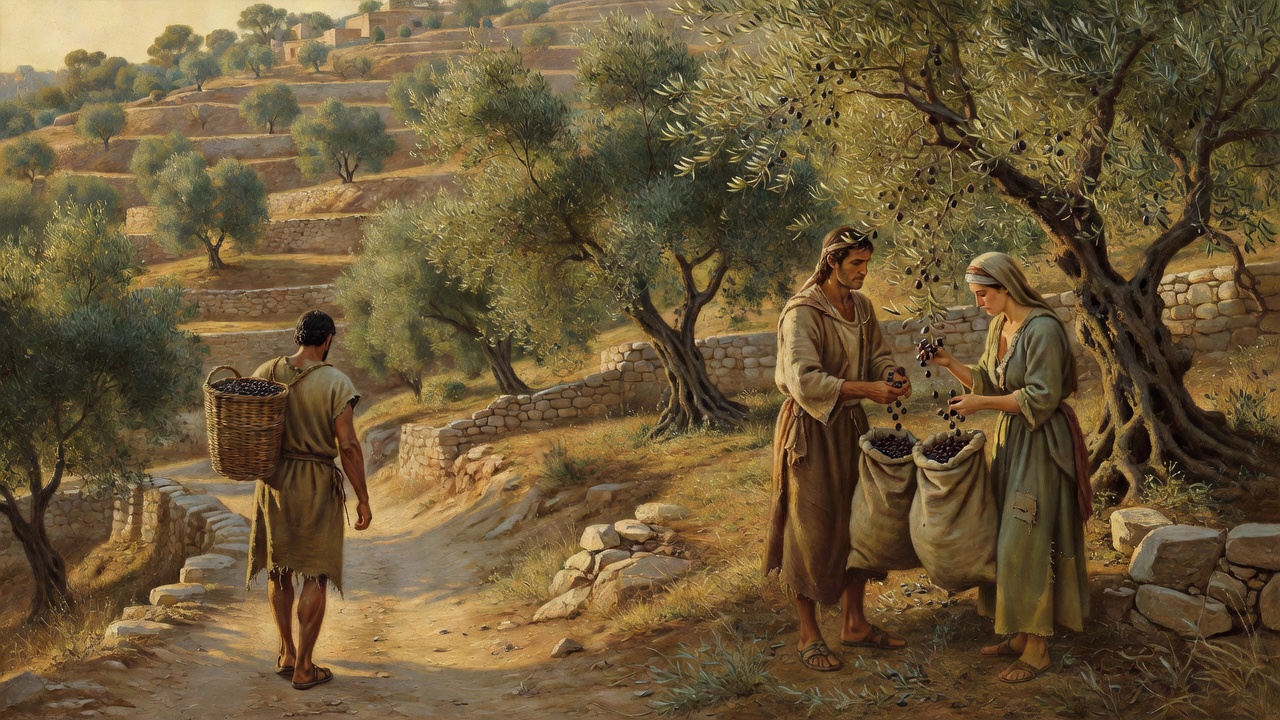
6the former husband who sent her away shall not be able to return and take her to himself for a wife, after she has been defiled; because it is an abomination before the Lord your God, and you⌃ shall not defile the land, which the Lord your God gives you to inherit. 7And if any one should have recently taken a wife, he shall not go out to war, neither shall any thing be laid upon him; he shall be free in his house; for one year he shall cheer his wife whom he has taken. 8You shall not take for a pledge the under millstone, nor the upper millstone; for he who does so takes life for a pledge. 9And if a man should be caught stealing one of his brethren of the children of Israel, and having overcome him he should sell him, that thief shall die; so shall you remove that evil one from yourselves. 10Take heed to yourself in regard of the plague of leprosy: you shall take great heed to do according to all the law, which the priests the Levites shall report to you; take heed to do, as I have charged you. 11Remember all that the Lord your God did to Mariam in the way, when you⌃ were going out of Egypt. 12If your neighbour owe you a debt, any debt whatever, you shall not go into his house to take his pledge: 13you shall stand without, and the man who is in your debt shall bring the pledge out to you. 14And if the man be poor, you shall not sleep with his pledge. 15You shall surely restore his pledge at sunset, and he shall sleep in his garment, and he shall bless you; and it shall be mercy to you before the Lord your God. 16You shall not unjustly withhold the wages of the poor and needy of your brethren, or of the strangers who are in your cities. 17You shall pay him his wages the same day, the sun shall not go down upon it, because he is poor and he trusts in it; and he shall cry against you to the Lord, and it shall be sin in you. 18The fathers shall not be put to death for the children, and the sons shall not be put to death for the fathers; every one shall be put to death for his own sin. 19You shall not wrest the judgement of the stranger and the fatherless, and widow; you shall not take the widow's garment for a pledge. 20And you shall remember that you were a bondman in the land of Egypt, and the Lord your God redeemed you from thence; therefore I charge you to do this thing. 21And when you shall have reaped corn in your field, and shall have forgotten a sheaf in your field, you shall not return to take it; it shall be for the stranger, and the orphan, and the widow, that the Lord your God may bless you in all the works of your hands. 22And if you should gather your olives, you shall not return to collect the remainder; it shall be for the stranger, and the fatherless, and the widow, and you shall remember that you were a bondman in the land of Egypt; therefore I command you to do this thing. 23And when soever you shall gather the grapes of your vineyard, you shall not glean what you have left; it shall be for the stranger, and the orphan, and the widow: 24and you shall remember that you were a bondman in the land of Egypt; therefore I command you to do this thing.
Did you know?
Laws of Compassion, Justice, and Social Protection
- Israelite harvesting laws required landowners to leave behind forgotten sheaves of grain, leftover olives, and grape gleanings for vulnerable groups: the resident foreigner, the orphan, and the widow. This social welfare system was grounded in the collective memory that the Israelites had once been oppressed slaves in Egypt.Sources: the Bible text itself · Egypt
- Debtors and hired workers were protected by explicit legal limits. Creditors were forbidden from entering a debtor's house to seize a pledge, taking essential millstones that provided a household's daily bread, or keeping an impoverished person's sleeping cloak past sunset, and day laborers had to be paid before nightfall.Sources: the Bible text itself
- When giving instructions concerning infectious skin diseases and the guidance of Levitical priests, the text points back to the affliction of Miriam, the sister of Moses and Aaron, during the wilderness journey following the Exodus from Egypt.Sources: the Bible text itself · Miriam · Egypt
Notes written with AI assistance from open sources (Theographic Bible Metadata, CC BY-SA 4.0; Easton’s Bible Dictionary, public domain) and reviewed before publishing.
Places in this chapter
Only places identified with high confidence are shown (90% or more according to the scholarly sources compiled by OpenBible). Period map: DARE (Digital Atlas of the Roman Empire), CC BY 4.0; modern map: © OpenStreetMap contributors; places: OpenBible.info (CC BY 4.0).
Credits and license for this translation
LXX2012: Septuagint in British/International English 2012
The Septuagint with Apocrypha, translated from Greek to English by Sir Lancelot C. L. Brenton and published in 1885, with some language updates (British/International English)
Public Domain
Language: English
Dialect (if applicable): British
Language in English: English
Translation by: Sir Lancelot Charles Lee Breton
LXX2012: Septuagint in English 2012, British/International English Edition
This is a translation of the Old Testament and Apocrypha/Deuterocanon from Hebrew to Greek to 19th Century British English, with some updates of spelling and word usage to contemporary British/International English. The original English translation was done by Sir Lancelot Charles Lee Brenton and published by Samuel Bagster & Sons, Ltd., in London in 1851. It has entered the Public Domain due to the passage of sufficient time. In the process of scanning and typing the text, the original poetry and prose formatting, as well as peripheral material like introductions and notes, have been omitted.
This edition of the Septuagint has some language updates. Brenton's word order and punctuation has been mostly retained, meaning that quotation marks are not used, and sentences within quotes may not start with capital letters, as was standard usage in 1851. Names transliterated from Greek to those transliterated from Hebrew in the common English Bibles often differ. These language updates are dedicated to the Public Domain by the author of those edits, Michael Paul Johnson. Therefore this edition may be freely copied, published, etc.
Before considering making changes to the text of this work, I recommend that you consult with God, because this is really His Book.
If you find errors in the text, please report them so that we can correct them.
Donations to help with the expenses of operating this web site and thus help others have free access to the Word of God may be made to us, but are not required. Please see http://MLJohnson.org/partner/ for more about that.
Section headings adapted from the Berean Standard Bible (public domain); they are not part of this translation’s text.
Source: http://ebible.org/eng-uk-lxx2012/ · eBible.org