1 Chronicles 20
LXX2012: Septuagint in British/International English 2012 · Tap a verse to see its cross-references.
The Capture of Rabbah
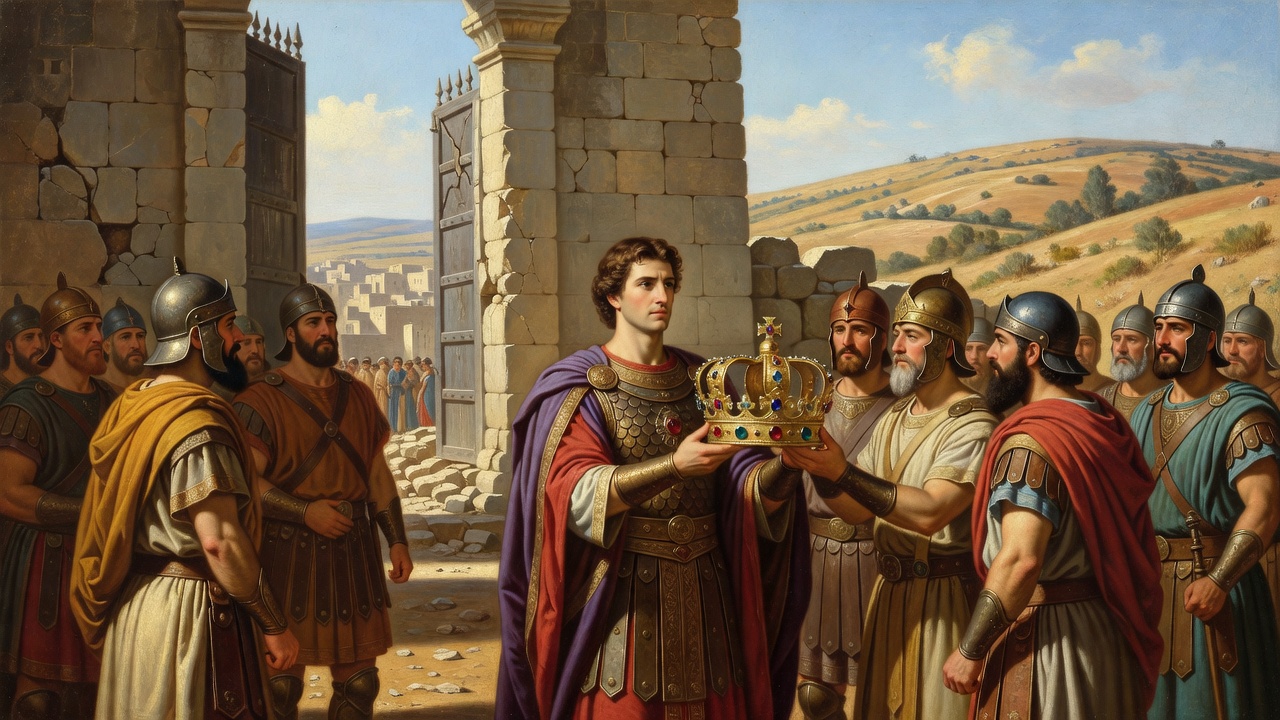
1And it came to pass at the return of the year, at the time of the going forth of kings to war, that Joab gathered the whole force of the army, and they ravaged the land of the children of Ammon; and he came and besieged Rabba. But David abode in Jerusalem. And Joab struck Rabba and destroyed it. 2And David took the crown of Molchom their king off his head, and the weight of it was found to be a talent of gold, and on it were precious stones; and it was placed on the head of David: and he brought out the spoils of the city which were very great. 3And he brought out the people that were in it, and sawed them asunder with saws, and cut them with iron axes, and with harrows: and thus David did to all the children of Ammon. And David and all his people returned to Jerusalem.
Battles against the Philistines
4And it came to pass afterward that there was again war with the Philistines in Gazer: then Sobochai the Sosathite struck Saphut of the sons of the giants, and laid him low. 5And there was war again with the Philistines; and Eleanan the son of Jair struck Lachmi the brother of Goliath the Gittite, and the wood of his spear was as a weavers' beam. 6And there was again war in Geth, and there was a man of extraordinary size, and his fingers and toes were six on each hand and foot, four and twenty; and he was descended from the giants. 7And he defied Israel, and Jonathan the son of Samaa the brother of David killed him. 8These were born to Rapha in Geth; all four were giants, and they fell by the hand of David, and by the hand of his servants.
Did you know?
The Conquest of Rabbah and the Fall of Giants
- Rabbah was the chief city of the Ammonites, located among the hills east of the Jordan River. Joab led David's army to lay siege to the fortified city in the spring, which was the customary time of year for military campaigns.Sources: Rabbah · Joab · the Bible text itself
- The Philistine city of Gath, renowned in biblical accounts as the hometown of Goliath, was linked to several formidable warriors. The text describes multiple battles where David's men defeated descendants of Rapha, including Lahmi and an unnamed warrior with twenty-four digits.Sources: Gath · Goliath · the giant in Gath · the Bible text itself
Notes written with AI assistance from open sources (Theographic Bible Metadata, CC BY-SA 4.0; Easton’s Bible Dictionary, public domain) and reviewed before publishing.
Places in this chapter
- Ammon · 31.955, 35.934 · verses 1, 3
- Jerusalem · 31.777, 35.234 · verses 1, 3
- Rabbah · Today: Amman · 31.955, 35.934 · verses 1, 2, 3
- Gezer · Today: Tel Gezer · 31.859, 34.919 · verse 4
Only places identified with high confidence are shown (90% or more according to the scholarly sources compiled by OpenBible). Period map: DARE (Digital Atlas of the Roman Empire), CC BY 4.0; modern map: © OpenStreetMap contributors; places: OpenBible.info (CC BY 4.0).
Credits and license for this translation
LXX2012: Septuagint in British/International English 2012
The Septuagint with Apocrypha, translated from Greek to English by Sir Lancelot C. L. Brenton and published in 1885, with some language updates (British/International English)
Public Domain
Language: English
Dialect (if applicable): British
Language in English: English
Translation by: Sir Lancelot Charles Lee Breton
LXX2012: Septuagint in English 2012, British/International English Edition
This is a translation of the Old Testament and Apocrypha/Deuterocanon from Hebrew to Greek to 19th Century British English, with some updates of spelling and word usage to contemporary British/International English. The original English translation was done by Sir Lancelot Charles Lee Brenton and published by Samuel Bagster & Sons, Ltd., in London in 1851. It has entered the Public Domain due to the passage of sufficient time. In the process of scanning and typing the text, the original poetry and prose formatting, as well as peripheral material like introductions and notes, have been omitted.
This edition of the Septuagint has some language updates. Brenton's word order and punctuation has been mostly retained, meaning that quotation marks are not used, and sentences within quotes may not start with capital letters, as was standard usage in 1851. Names transliterated from Greek to those transliterated from Hebrew in the common English Bibles often differ. These language updates are dedicated to the Public Domain by the author of those edits, Michael Paul Johnson. Therefore this edition may be freely copied, published, etc.
Before considering making changes to the text of this work, I recommend that you consult with God, because this is really His Book.
If you find errors in the text, please report them so that we can correct them.
Donations to help with the expenses of operating this web site and thus help others have free access to the Word of God may be made to us, but are not required. Please see http://MLJohnson.org/partner/ for more about that.
Section headings adapted from the Berean Standard Bible (public domain); they are not part of this translation’s text.
Source: http://ebible.org/eng-uk-lxx2012/ · eBible.org