1 Chronicles 19
LXX2012: Septuagint in British/International English 2012 · Tap a verse to see its cross-references.
David’s Messengers Disgraced
1And it came to pass after this, that Naas the king of the children of Ammon died, and Anan his son reigned in his stead. 2And David said, I will act kindly towards Anan the son of Naas, as his father acted kindly towards me. And David sent messengers to condole with him on the death of his father. So the servants of David came into the land of the children of Ammon to Anan, to comfort him. 3And the chiefs of the children of Ammon said to Anan, Is it to honour your father before you, that David has sent comforters to you? Have not his servants come to you that they might search the city, and to spy out the land? 4And Anan took the servants of David, and shaved them, and cut off the half of their garments as far as their tunic, and sent them away. 5And there came men to report to David concerning the men: and he sent to meet them, for they were greatly disgraced: and the king said, Dwell in Jericho until your beards have grown, and return. 6And the children of Ammon saw that the people of David were ashamed, and Anan and the children of Ammon sent a thousand talents of silver to hire for themselves chariots and horsemen out of Syria of Mesopotamia, and out of Syria Maacha, and from Sobal. 7And they hired for themselves two and thirty thousand chariots, and the king of Maacha and his people; and they came and encamped before Medaba: and the children of Ammon assembled out of their cities, and came to fight. 8And David heard, and sent Joab and all the host of mighty men. 9And the children of Ammon came forth, and set themselves in array for battle by the gate of the city: and the kings that were come forth encamped by themselves in the plain.
David Defeats Ammon and Aram
10And Joab saw that they were fronting him to fight against him before and behind, and he chose some out of all the young men of Israel, and they set themselves in array against the Syrian. 11And the rest of the people he gave into the hand of his brother Abesai, and they set themselves in array against the children of Ammon. 12And he said, If the Syrian should prevail against me, then shall you deliver me: and if the children of Ammon should prevail against you, then will I deliver you. 13Be of good courage, and let us be strong, for our people, and for the cities of our God: and the Lord shall do what is good in his eyes. 14So Joab and the people that were with him set themselves in battle array against the Syrians, and they fled from them. 15And the children of Ammon saw that the Syrians fled, and they also fled from before Abesai, and from before Joab his brother, and they came to the city: and Joab came to Jerusalem. 16And the Syrian saw that Israel had defeated him, and he sent messengers, and they brought out the Syrians from beyond the river; and Sophath the commander-in-chief of the forces of Adraazar was before them. 17And it was told David; and he gathered all Israel, and crossed over Jordan, and came upon them, and set the battle in array against them. So David set his army in array to fight against the Syrians, and they fought against him. 18And the Syrians fled from before Israel; and David killed of the Syrians seven thousand riders in chariots, and forty thousand infantry, and he killed Sophath the commander-in-chief of the forces. 19And the servants of Adraazar saw that they were defeated before Israel, and they made peace with David and served him: and the Syrians would not any more help the children of Ammon.
Did you know?
War with Ammon and the Arameans
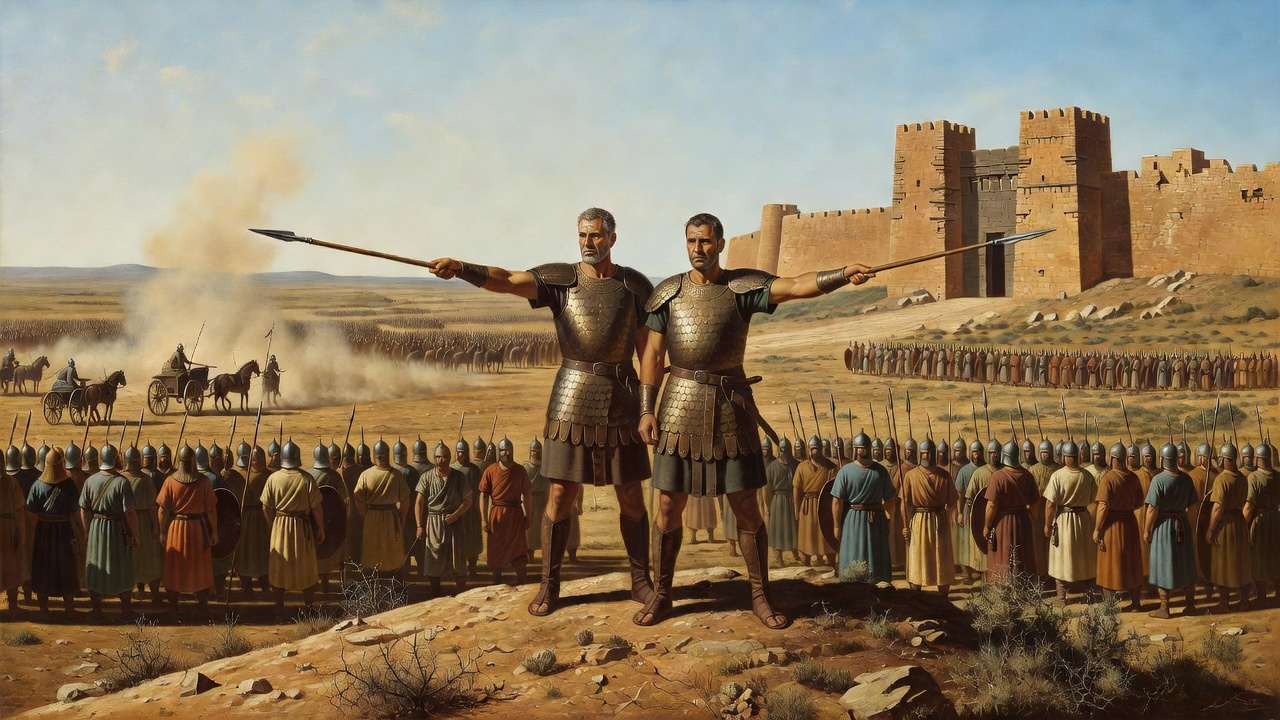
- When Hanun king of the Ammonites suspected David's envoys of espionage, he publicly humiliated them by shaving their beards and cutting their garments. To spare them further shame, David instructed the men to stay at the oasis city of Jericho until their beards grew back.Sources: the Bible text itself · Jericho
- Facing war with Israel, the Ammonites spent one thousand talents of silver to hire chariots and horsemen from Aramean kingdoms such as Zobah, Aram-naharaim, and Maacah. Faced with a two-front battle near Medeba, Joab divided the Israelite forces, leading elite troops against the Arameans while his brother Abishai engaged the Ammonites.Sources: the Bible text itself · Joab · Abishai · Medeba
- After their initial retreat, the Arameans summoned reinforcements from across the Euphrates River led by Shophach, the general of King Hadadezer of Zobah. David personally crossed the Jordan to defeat them, prompting Hadadezer's vassals to make peace and end their support for Ammon.Sources: the Bible text itself · Hadarezer · Shobach · Zobah
Notes written with AI assistance from open sources (Theographic Bible Metadata, CC BY-SA 4.0; Easton’s Bible Dictionary, public domain) and reviewed before publishing.
Places in this chapter
- Ammon · 31.955, 35.934 · verses 1, 2, 3, 6, 7, 9, 11, 12, 15, 19
- Jericho · Today: Tell es Sultan · 31.872, 35.445 · verse 5
- Maacah · 33.258, 35.581 · verses 6, 7
- Mesopotamia · Today: Aram-naharaim · 36.864, 39.033 · verse 6
- Zobah · 33.935, 36.151 · verse 6
- Medeba · Today: Madaba · 31.716, 35.795 · verse 7
- Syria · Today: Aram · 33.511, 36.306 · verses 10, 12, 14, 15, 16, 17, 18, 19
- Jerusalem · 31.777, 35.234 · verse 15
- Euphrates · Today: Euphrates River · 31.004, 47.442 · verse 16
- Jordan · Today: Jordan River · 31.761, 35.558 · verse 17
Only places identified with high confidence are shown (90% or more according to the scholarly sources compiled by OpenBible). Period map: DARE (Digital Atlas of the Roman Empire), CC BY 4.0; modern map: © OpenStreetMap contributors; places: OpenBible.info (CC BY 4.0).
Credits and license for this translation
LXX2012: Septuagint in British/International English 2012
The Septuagint with Apocrypha, translated from Greek to English by Sir Lancelot C. L. Brenton and published in 1885, with some language updates (British/International English)
Public Domain
Language: English
Dialect (if applicable): British
Language in English: English
Translation by: Sir Lancelot Charles Lee Breton
LXX2012: Septuagint in English 2012, British/International English Edition
This is a translation of the Old Testament and Apocrypha/Deuterocanon from Hebrew to Greek to 19th Century British English, with some updates of spelling and word usage to contemporary British/International English. The original English translation was done by Sir Lancelot Charles Lee Brenton and published by Samuel Bagster & Sons, Ltd., in London in 1851. It has entered the Public Domain due to the passage of sufficient time. In the process of scanning and typing the text, the original poetry and prose formatting, as well as peripheral material like introductions and notes, have been omitted.
This edition of the Septuagint has some language updates. Brenton's word order and punctuation has been mostly retained, meaning that quotation marks are not used, and sentences within quotes may not start with capital letters, as was standard usage in 1851. Names transliterated from Greek to those transliterated from Hebrew in the common English Bibles often differ. These language updates are dedicated to the Public Domain by the author of those edits, Michael Paul Johnson. Therefore this edition may be freely copied, published, etc.
Before considering making changes to the text of this work, I recommend that you consult with God, because this is really His Book.
If you find errors in the text, please report them so that we can correct them.
Donations to help with the expenses of operating this web site and thus help others have free access to the Word of God may be made to us, but are not required. Please see http://MLJohnson.org/partner/ for more about that.
Section headings adapted from the Berean Standard Bible (public domain); they are not part of this translation’s text.
Source: http://ebible.org/eng-uk-lxx2012/ · eBible.org