Psalms 74
Translation for Translators · Tap a verse to see its cross-references.
A psalm written by Asaph
1God, why have you abandoned/rejected us?
Will you keep rejecting us forever [RHQ]?
Why are you angry with us,
since we are like sheep in your pasture and you are like our shepherd? [MET, RHQ]
2Do not forget your people whom you chose long ago,
the people whom you freed from being slaves in Egypt and caused to become your tribe.
Do not forget Jerusalem, which was ◄your home/where you dwelt► on this earth.
3Walk along and see where everything has been totally ruined;
our enemies have destroyed everything in the sacred temple.
4Your enemies shouted triumphantly in this sacred place;
they erected their banners to show they had defeated us.
5They cut down all the engraved objects in the temple like woodsmen cut down trees.
6Then they smashed all the carved wood with their axes and hammers.
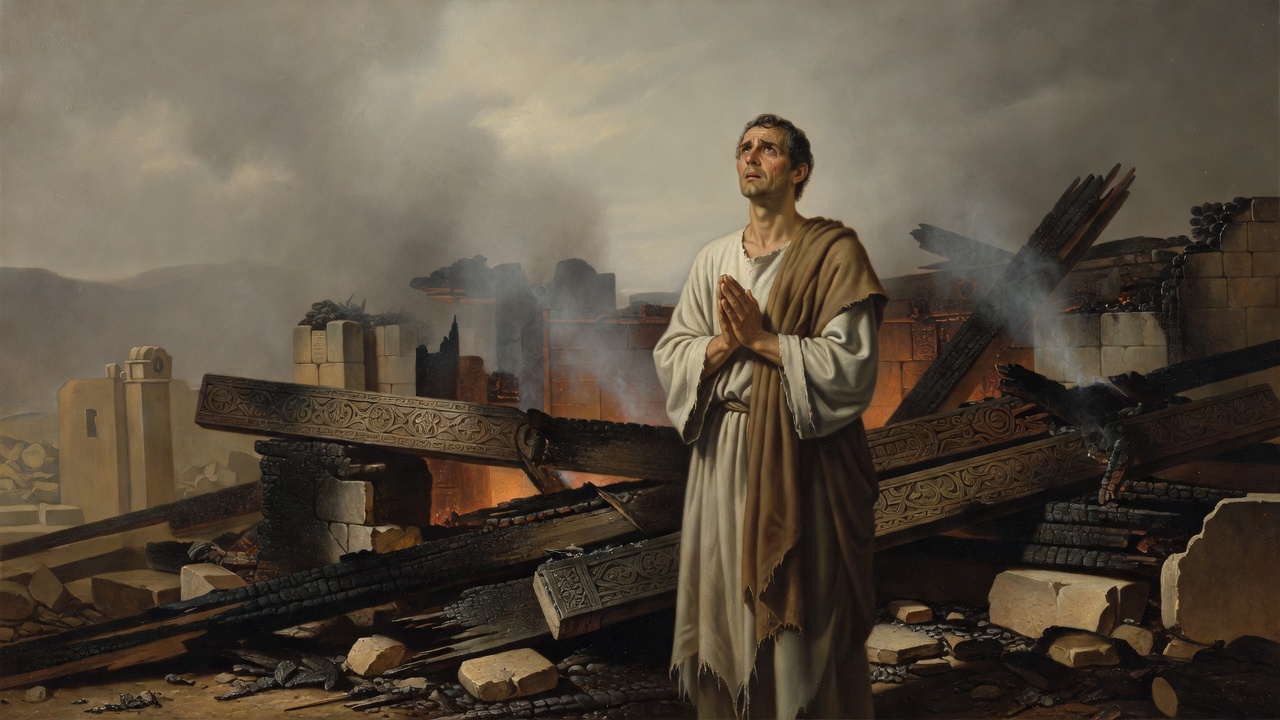
7Then they burned your temple to the ground;
they caused that place where you were worshiped to be unfit for people to worship in.
8They said to themselves, “We will destroy the Israelis completely,”
and they also burned down all the other places where we gathered to worship God.
9All our sacred symbols (OR, miracles) are gone;
there are no prophets now/any more,
and no one knows how long this situation will continue.
10God, how long will our enemies make fun of you [RHQ]?
Will they insult you [MTY] forever [RHQ]?
11Why do you refuse to help [MTY, RHQ] us?
Why do you keep your hand inside your cloak instead of using it to destroy our enemies [RHQ]?
12God, you have been our king all the time since we came out of Egypt [HYP],
and you have enabled us to defeat our enemies in the land of Israel.
13By your power you caused the Red Sea to divide;
it was as though you smashed the heads of the rulers of Egypt who were like huge sea dragons [MET].
14It was as though you crushed the head of the king of Egypt [MET]
and gave his body to the animals in the desert to eat.
15You caused springs and streams to flow,
and you also dried up rivers that had never dried up previously.
16You created the days and the nights,
and you put the sun and the moon in their places.
17You determined where the oceans end and the land begins,
and you created the summer/hot season and the winter/cold season.
18Yahweh, do not forget that your enemies laugh at you,
and that it is foolish people who despise you [MTY].
19Do not let your helpless people [MET] fall into the hands of their cruel enemies;
do not forget your suffering/persecuted people.
20Do not forget the agreement that you made with us;
remember that there are violent people in every dark place on the earth.
21Do not allow your oppressed people to be disgraced;
help those poor and needy people in order that they will again praise you [MTY].
22God, arise and defend yourself by defending your people!
Do not forget that foolish people laugh at you ◄all day long/continually►!
23Do not forget that your enemies shout angrily at you;
the uproar that they make while they oppose you never stops.
Did you know?
Lament over the Destroyed Sanctuary
- Psalms 73 through 83 are attributed to Asaph, a Levite musician and leader of David's choir. Because Psalm 74 laments the burning and total destruction of the sanctuary, many scholars connect it with the later "sons of Asaph," a guild of poets and singers who preserved his tradition.Sources: Asaph (Levite) · the Bible text itself
- The psalm appeals to God to remember Mount Zion, a prominent hill in Jerusalem where David established his citadel and where the sanctuary stood as the dwelling place of God's name.Sources: Mount Zion · the Bible text itself
- The destruction of the sanctuary is vividly described using the metaphor of woodcutters felling trees, as invaders smashed the intricate carved woodwork with axes and picks before burning the holy place to the ground.Sources: the Bible text itself
Notes written with AI assistance from open sources (Theographic Bible Metadata, CC BY-SA 4.0; Easton’s Bible Dictionary, public domain) and reviewed before publishing.
Places in this chapter
- Mount Zion · 31.772, 35.229 · verse 2
Only places identified with high confidence are shown (90% or more according to the scholarly sources compiled by OpenBible). Period map: DARE (Digital Atlas of the Roman Empire), CC BY 4.0; modern map: © OpenStreetMap contributors; places: OpenBible.info (CC BY 4.0).
Credits and license for this translation
Translation for Translators
A Bible Translation for Bible Translators which makes implied information explicit in the text as an aid to the translator who may need that information to correctly translate into a particular language.
Copyright © 2008-2017 Ellis W. Deibler, Jr.
Language: English
Dialect: American
This translation is made available to you under the terms of the
Creative Commons Attribution Share-Alike license 4.0.
You have permission to share and redistribute this Bible translation in any format and to make reasonable revisions and adaptations of this translation, provided that:
You include the above copyright and source information.
If you make any changes to the text, you must indicate that you did so in a way that makes it clear that the original licensor is not necessarily endorsing your changes.
If you redistribute this text, you must distribute your contributions under the same license as the original.
Pictures included with Scriptures and other documents on this site are licensed just for use with those Scriptures and documents.
For other uses, please contact the respective copyright owners.
Note that in addition to the rules above, revising and adapting God's Word involves a great responsibility to be true to God's Word. See Revelation 22:18-19.
2026-10-02
Source: http://ebible.org/eng-t4t/ · eBible.org