Malachi 1
Translation for Translators · Tap a verse to see its cross-references.
About this book
About Malachi
- Easton's Bible Dictionary (1897) presents Malachi, a name meaning "messenger" or "angel," as the last of the minor prophets and the writer of the last book of the Old Testament canon. Nothing is known of him beyond what is contained in his book of prophecies.Sources: Easton: Malachi · Malachi
- Some have supposed that the name is simply a title for a messenger of Jehovah, not a proper name. Easton's Bible Dictionary (1897) concludes, however, that there is reason to regard Malachi as the prophet's ordinary name.Sources: Easton: Malachi · Malachi
- Easton's Bible Dictionary (1897) dates the prophecies to about 420 B.C., after Nehemiah's second return from Persia, or possibly before that return. Because Ezra does not mention him and he does not mention the restoration of the temple, the dictionary infers that he prophesied after Haggai and Zechariah.Sources: Easton: Malachi
- Easton's Bible Dictionary (1897) treats Malachi as a contemporary of Nehemiah, comparing Malachi 2:8 with Nehemiah 13:15 and Malachi 2:10-16 with Nehemiah 13:23. It also notes that the temple services were still in existence, citing Malachi 1:10, 3:1 and 3:10.Sources: Easton: Malachi
Notes written with AI assistance from open sources (Theographic Bible Metadata, CC BY-SA 4.0; Easton’s Bible Dictionary, public domain) and reviewed before publishing.
1This is the message that Yahweh gave to the prophet Malachi to give to the people of Israel.
Yahweh’s love for the people of Israel
2Yahweh says, “I have always loved you Israeli people.”
3But you reply, “In what way have you loved us?”
Yahweh replies, “ This is how I loved you: It is true that your ancestor Jacob was [RHQ] Esau’s younger brother, and I loved Jacob, but I rejected Esau. I caused his hilly region to become ◄desolate/a place where crops did not grow►. I caused the land which he possessed to become a desert where jackals/wolves live.”
4The descendants of Esau who live in Edom may say, “ Yes, we have been crushed/ruined, but we will rebuild houses in the ruins.”
But the Commander of the armies of angels replies, “They may build houses again, but I will demolish them again. Their country will be called ‘The land where wicked people live’ and their people will be called ‘The people with whom Yahweh is angry forever’.”
5When you Israeli people yourselves see what I will do to them, you will say, “ It is evident far beyond the borders of Israel that Yahweh is very great!”
Unacceptable sacrifices
6But the Commander of the armies of angels says to the priests, “Boys honor their fathers, and servants respect their masters. So, if I am like your father and your master, why [RHQ] do you not honor and respect me? You have despised me [MTY]!”
But you ask, “◄How/In what way► have we despised you?”
7Yahweh replies, “ Instead of honoring me, you have despised me by offering sacrifices on my altar that are unacceptable to me.”
Then you ask, “What sacrifices have we given that have been unacceptable to you?”
Yahweh replies, “You think that ◄it does not matter/it is okay► if you do not respect my altar. 8You offer for sacrifices animals that are blind. ◄Is that not wrong?/That is disgusting!► [RHQ] And you offer for sacrifices animals that are crippled or that have diseases. ◄Is that also not wrong?/That also is disgusting!► [RHQ] If you tried to give presents like that to your governor, ◄do you think [RHQ] that he would be pleased?/he would certainly not be pleased!► ◄Would he [RHQ] accept such gifts?He would certainly not accept such gifts!► That is what the Commander of the armies of angels says!”
9And he also says, “You plead with me to be merciful to you. But you bring to me sacrifices that are not acceptable to me, so why should I be kind to you [RHQ]?”
10The Commander of the armies of angels also says, “I wish/desire that one of you would shut the gates of the temple courtyard, in order that no one could offer those worthless sacrifices. I am not pleased with you, and I will not accept the offerings that you bring to me. 11People of other nations honor me [MTY] every day, from sunrise/morning until sunset/evening. All over the world people offer incense and other pure/acceptable offerings to me [MTY]. They do that because people among all the nations know that I [MTY] am very great.
12But you priests show that you despise me by what you do. You say, ‘ It is all right if people pollute the altar by bringing sacrifices that are unacceptable.’ 13You say ‘We are tired of burning all these sacrifices on the altar.’ You ◄turn up your noses at/act very disrespectfully toward► me. When you bring to me animals that have been stolen or ones that are crippled or that have diseases, to offer them for sacrifices, do you think that [RHQ] I should accept them?
14I will curse anyone who tries to cheat me by solemnly promising to bring to me a perfect ram from his flock of sheep and then brings to me one that has defects. If anyone does that, I will punish him, because I am a great king; I am the Commander of the armies of angels and people of the other nations revere me [MTY], but you do not!”
Did you know?
Honoring God and Defective Offerings
- The name Malachi means messenger or angel. While some have suggested it was a title rather than a proper name, scholars and traditions widely treat it as the prophet's personal name, placing his ministry during the period of Nehemiah, after Haggai and Zechariah.Sources: Malachi
- The opening dispute recalls the twin brothers Jacob and Esau, the ancestors of Israel and Edom. The text contrasts God's covenant love for Israel with the judgment and desolation coming upon the mountainous region of Edom.Sources: Esau (Edom) · Jacob (Israel) · Edom · the Bible text itself
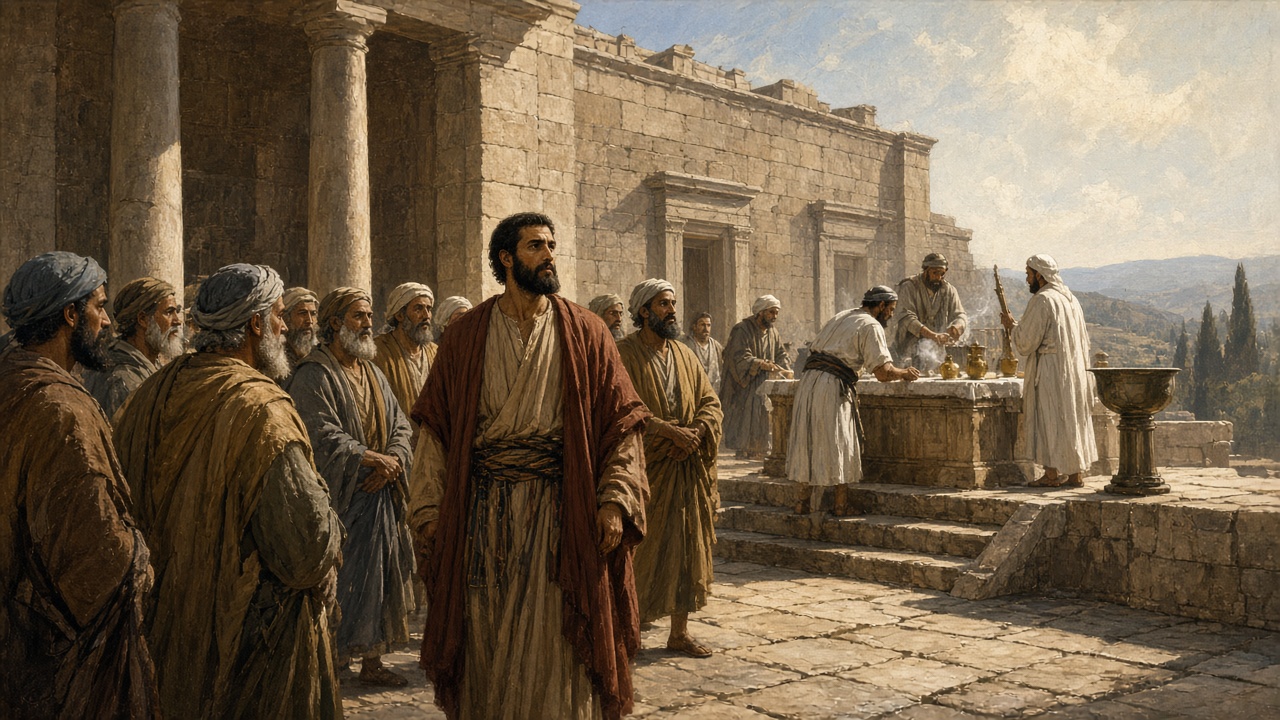
- The priests are rebuked for offering blind, lame, and diseased animals on the altar rather than unblemished livestock. Malachi exposes their disrespect by asking whether a civil governor would accept such inferior gifts.Sources: the Bible text itself
Notes written with AI assistance from open sources (Theographic Bible Metadata, CC BY-SA 4.0; Easton’s Bible Dictionary, public domain) and reviewed before publishing.
Places in this chapter
- Edom · 30.746, 35.604 · verse 4
Only places identified with high confidence are shown (90% or more according to the scholarly sources compiled by OpenBible). Period map: DARE (Digital Atlas of the Roman Empire), CC BY 4.0; modern map: © OpenStreetMap contributors; places: OpenBible.info (CC BY 4.0).
Credits and license for this translation
Translation for Translators
A Bible Translation for Bible Translators which makes implied information explicit in the text as an aid to the translator who may need that information to correctly translate into a particular language.
Copyright © 2008-2017 Ellis W. Deibler, Jr.
Language: English
Dialect: American
This translation is made available to you under the terms of the
Creative Commons Attribution Share-Alike license 4.0.
You have permission to share and redistribute this Bible translation in any format and to make reasonable revisions and adaptations of this translation, provided that:
You include the above copyright and source information.
If you make any changes to the text, you must indicate that you did so in a way that makes it clear that the original licensor is not necessarily endorsing your changes.
If you redistribute this text, you must distribute your contributions under the same license as the original.
Pictures included with Scriptures and other documents on this site are licensed just for use with those Scriptures and documents.
For other uses, please contact the respective copyright owners.
Note that in addition to the rules above, revising and adapting God's Word involves a great responsibility to be true to God's Word. See Revelation 22:18-19.
2026-10-02
Source: http://ebible.org/eng-t4t/ · eBible.org