2 Chronicles 11
LXX2012: Septuagint in American English 2012 · Tap a verse to see its cross-references.
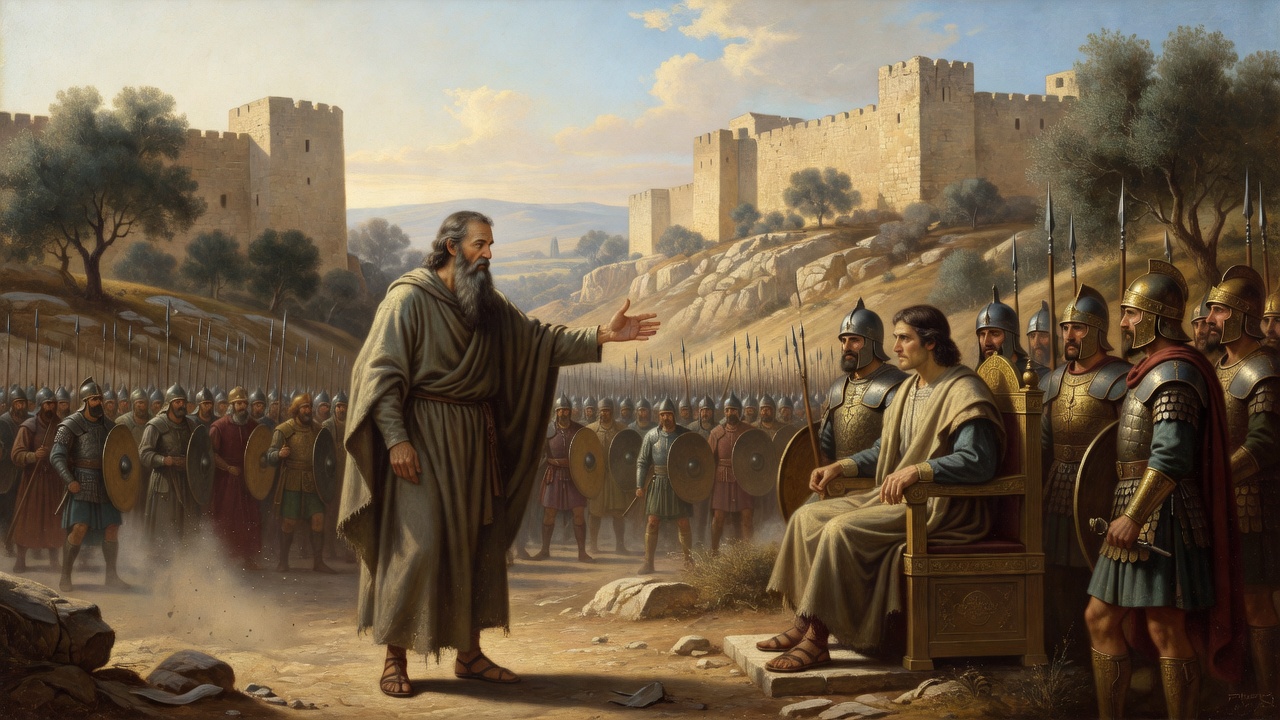
Shemaiah’s Prophecy
1And Roboam came to Jerusalem; and he assembled Juda and Benjamin, one hundred and eighty thousand young men fit for war, and he waged war with Israel to recover the kingdom to Roboam. 2And the Word of the Lord came to Samaias the man of God, saying, 3Speak to Roboam the son of Solomon, and to all Juda and Benjamin, saying, 4Thus says the Lord, You⌃ shall not go up, and you⌃ shall not war against your brethren: return every one to his home; for this thing is of me. And they listened to the word of the Lord, and returned from going against Jeroboam.
Rehoboam Fortifies Judah
5And Roboam lived in Jerusalem, and he built walled cities in Judea. 6And he built Bethleem, and Aetan and Thecoe, 7and Baethsura, and Sochoth, and Odollam, 8and Geth, and Marisa, and Ziph, 9and Adorai, and Lachis, and Azeca, 10and Saraa, and Aelom, and Chebron, which belong to Juda and Benjamin, walled cities. 11And he fortified them with walls, and placed in them captains, and stores of provisions, oil and wine, 12shields and spears in every several city, and he fortified them very strongly, and he had on his side Juda and Benjamin.
Jeroboam Forsakes the Priests and Levites
13And the priests and the Levites who were in all Israel were gathered to him out of all the coasts. 14For the Levites left the tents of their possession, and went to Juda to Jerusalem, because Jeroboam and his sons had ejected them so that they should not minister to the Lord. 15And he made for himself priests of the high places, and for the idols, and for the vanities, and for the calves which Jeroboam made. 16And he cast out from the tribes of Israel those who set their heart to seek the Lord God of Israel: and they came to Jerusalem, to sacrifice to the Lord God of their fathers. 17And they strengthened the kingdom of Juda; and Juda strengthened Roboam the son of Solomon for three years, for he walked three years in the ways of David and Solomon.
Rehoboam’s Family
18And Roboam took to himself for a wife, Moolath daughter of Jerimuth the son of David, and Abigaia daughter of Heliab the son of Jessae. 19And she bore him sons; Jeus, and Samoria, and Zaam. 20And afterwards he took to himself Maacha the daughter of Abessalom; and she bore him Abia, and Jetthi, and Zeza, and Salemoth. 21And Roboam loved Maacha the daughter of Abessalom more than all his wives and all his concubines: for he had eighteen wives and sixty concubines; and he begot twenty-eight sons, and sixty daughters. 22And he made Abia the son of Maacha chief, even a leader among his brethren, for he intended to make him king. 23And he was exalted beyond all his other sons in all the coasts of Juda and Benjamin, and in the strong cities; and he gave them provisions in great abundance: and he desired many wives.
Did you know?
Rehoboam Fortifies Judah
- After being warned by the prophet Shemaiah not to wage civil war against the northern tribes, Rehoboam fortified fifteen key cities across Judah and Benjamin—such as Bethlehem, Hebron, and Lachish—stocking them with officers, shields, spears, and supplies of food, oil, and wine.Sources: the Bible text itself · Shemaiah · Bethlehem
- When Jeroboam rejected the Levites and appointed his own priesthood for the calf and goat idols in the north, priests and Levites abandoned their common lands and migrated south to Jerusalem, followed by faithful worshippers from every tribe of Israel.Sources: the Bible text itself · Jeroboam
- Rehoboam favored his wife Maacah, a descendant of Absalom, and designated her son Abijah as chief prince and heir to the throne, while stationing his other sons throughout the fortified cities with abundant provisions.Sources: the Bible text itself · Maachah · Abijah
Notes written with AI assistance from open sources (Theographic Bible Metadata, CC BY-SA 4.0; Easton’s Bible Dictionary, public domain) and reviewed before publishing.
Places in this chapter
- Jerusalem · 31.777, 35.234 · verses 1, 5, 14, 16
- Bethlehem · 31.704, 35.208 · verse 6
- Tekoa · Today: Khirbet Teku’a · 31.632, 35.210 · verse 6
- Socoh · Today: Tel Socho · 31.682, 34.975 · verse 7
- Mareshah · Today: Tel Maresha · 31.593, 34.898 · verse 8
- Lachish · Today: Tell ed Duweir · 31.565, 34.849 · verse 9
- Hebron · Today: Tel Rumeida · 31.525, 35.102 · verse 10
Only places identified with high confidence are shown (90% or more according to the scholarly sources compiled by OpenBible). Period map: DARE (Digital Atlas of the Roman Empire), CC BY 4.0; modern map: © OpenStreetMap contributors; places: OpenBible.info (CC BY 4.0).
Credits and license for this translation
LXX2012: Septuagint in American English 2012
The Septuagint with Apocrypha, translated from Greek to English by Sir Lancelot C. L. Brenton and published in 1885, with some language updates (American English)
Public Domain
Language: English
Dialect (if applicable): American
Language in English: English
Translation by:
Sir Lancelot Charles Lee Brenton
Michael Paul Johnson
LXX2012: Septuagint in English 2012
This is a translation of the Old Testament and Apocrypha/Deuterocanon from Hebrew to Greek to 19th Century British English, with some updates of spelling and word usage to contemporary American English. The original English translation was done by Sir Lancelot Charles Lee Brenton and published by Samuel Bagster & Sons, Ltd., in London in 1851. It has entered the Public Domain due to the passage of sufficient time. In the process of scanning and typing the text, the original poetry and prose formatting, as well as peripheral material like introductions and notes, have been omitted.
This edition of the Septuagint has some language updates. Brenton's word order and punctuation has been mostly retained, meaning that quotation marks are not used, and sentences within quotes may not start with capital letters, as was standard usage in 1851. Names transliterated from Greek to those transliterated from Hebrew in the common English Bibles often differ. These language updates are dedicated to the Public Domain by the author of those edits, Michael Paul Johnson. Therefore this edition may be freely copied, published, etc.
Before considering making changes to the text of this work, I recommend that you consult with God, because this is really His Book.
If you find errors in the text, please report them so that we can correct them.
Donations to help with the expenses of operating this web site and thus help others have free access to the Word of God may be made to us, but are not required. Please see http://MLJohnson.org/partner/ for more about that.
Section headings adapted from the Berean Standard Bible (public domain); they are not part of this translation’s text.
Source: http://ebible.org/eng-lxx2012/ · eBible.org