2 Chronicles 10
LXX2012: Septuagint in American English 2012 · Tap a verse to see its cross-references.
Rebellion against Rehoboam
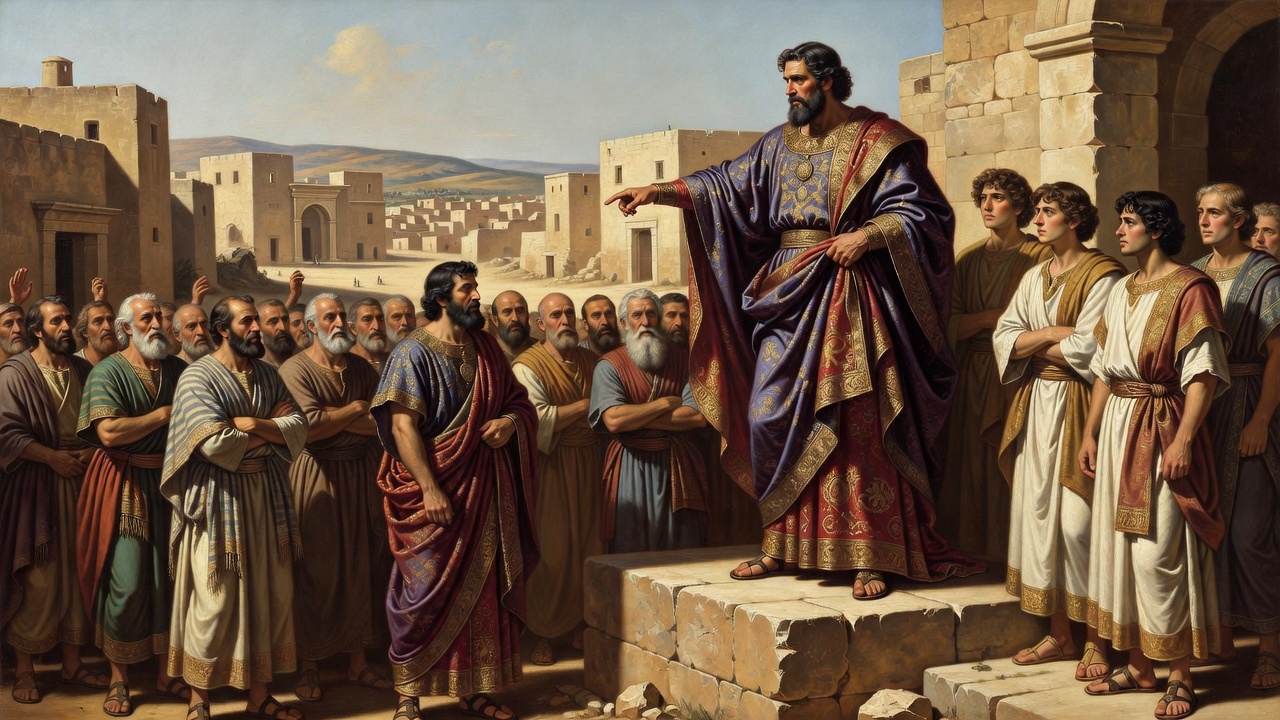
1And Roboam came to Sychem: for all Israel came to Sychem to make him king. 2And it came to pass when Jeroboam the son of Nabat heard it, (now he was in Egypt, forasmuch as he had fled there from the face of king Solomon, and Jeroboam lived in Egypt,) that Jeroboam returned out of Egypt. 3And they sent and called him: and Jeroboam and all the congregation came to Roboam, saying, 4Your father made our yoke grievous: now then abate somewhat of your father's grievous rule, and of his heavy yoke which he put upon us, and we will serve you. 5And he said to them, Go away for three days, and then come to me. So the people departed. 6And king Roboam assembled the elders that stood before his father Solomon in his life-time, saying, How do you⌃ counsel me to return an answer to this people? 7And they spoke to him, saying, If you would this day befriend this people, and be kind to them, and speak to them good words, then will they be your servants for ever. 8But he forsook the advice of the old men, who took counsel with him, and he took counsel with the young men who had been brought up with him, who stood before him. 9And he said to them, What do you⌃ advise that I should answer this people, who spoke to me, saying, Ease somewhat of the yoke which your father laid upon us? 10And the young men that had been brought up with him spoke to him, saying, Thus shall you speak to the people that spoke to you, saying, Your father made our yoke heavy, and do you lighten somewhat of it from us; thus shall you say, My little finger shall be thicker than my father's loins. 11And whereas my father chastised you with a heavy yoke, I will also add to your yoke: my father chastised you with whips, and I will chastise you with scorpions. 12And Jeroboam and all the people came to Roboam on the third day, as the king had spoken, saying, Return to me on the third day. 13And the king answered harshly; and king Roboam forsook the counsel of the old men, 14and spoke to them according to the counsel of the young men, saying, My father made your yoke heavy, but I will add to it: my father chastised you with whips, but I will chastise you with scorpions. 15And the king listened not to the people, for there was a change of their minds from God, saying, The Lord has confirmed his word, which he spoke by the hand of Achia the Selonite concerning Jeroboam the son of Nabat, and concerning all Israel;
The Kingdom Divided
16for the king did not listen to them. And the people answered the king, saying, What portion have we in David, or inheritance in the son of Jessae? to your tents, O Israel: now see to your own house, David. So all Israel went to their tents. 17But the men of Israel, even those who lived in the cities of Juda, remained and made Roboam king over them. 18And king Roboam sent to them Adoniram that was over the tribute; and the children of Israel stoned him with stones, and he died. And king Roboam hasted to mount his chariot, to flee to Jerusalem. 19So Israel rebelled against the house of David until this day.
Did you know?
The Division of the Kingdom
- Rehoboam traveled to Shechem to be confirmed as king, where the assembly demanded relief from the heavy forced labor and taxation imposed under Solomon. Jeroboam, a former supervisor of forced labor who had fled to Egypt, returned to represent the people's appeal.Sources: the Bible text itself · Rehoboam · Jeroboam
- Rehoboam rejected the counsel of his father's veteran elders to speak kindly to the people, choosing instead the harsh answer suggested by the young men who grew up with him. The biblical narrative notes that this turn of events fulfilled the prophecy delivered by Ahijah the Shilonite.Sources: the Bible text itself · Ahijah
- When the northern tribes revolted from the house of David, Rehoboam sent Hadoram, his superintendent over forced labor, to address them. The Israelites stoned Hadoram to death, forcing Rehoboam to flee in his chariot to Jerusalem.Sources: the Bible text itself · Adoniram
Notes written with AI assistance from open sources (Theographic Bible Metadata, CC BY-SA 4.0; Easton’s Bible Dictionary, public domain) and reviewed before publishing.
Places in this chapter
- Shechem · Today: Tell Balatah · 32.214, 35.282 · verse 1
- Egypt · 30.129, 31.308 · verse 2
- Shiloh · Today: Khirbet Seilun · 32.056, 35.290 · verse 15
- Jerusalem · 31.777, 35.234 · verse 18
Only places identified with high confidence are shown (90% or more according to the scholarly sources compiled by OpenBible). Period map: DARE (Digital Atlas of the Roman Empire), CC BY 4.0; modern map: © OpenStreetMap contributors; places: OpenBible.info (CC BY 4.0).
Credits and license for this translation
LXX2012: Septuagint in American English 2012
The Septuagint with Apocrypha, translated from Greek to English by Sir Lancelot C. L. Brenton and published in 1885, with some language updates (American English)
Public Domain
Language: English
Dialect (if applicable): American
Language in English: English
Translation by:
Sir Lancelot Charles Lee Brenton
Michael Paul Johnson
LXX2012: Septuagint in English 2012
This is a translation of the Old Testament and Apocrypha/Deuterocanon from Hebrew to Greek to 19th Century British English, with some updates of spelling and word usage to contemporary American English. The original English translation was done by Sir Lancelot Charles Lee Brenton and published by Samuel Bagster & Sons, Ltd., in London in 1851. It has entered the Public Domain due to the passage of sufficient time. In the process of scanning and typing the text, the original poetry and prose formatting, as well as peripheral material like introductions and notes, have been omitted.
This edition of the Septuagint has some language updates. Brenton's word order and punctuation has been mostly retained, meaning that quotation marks are not used, and sentences within quotes may not start with capital letters, as was standard usage in 1851. Names transliterated from Greek to those transliterated from Hebrew in the common English Bibles often differ. These language updates are dedicated to the Public Domain by the author of those edits, Michael Paul Johnson. Therefore this edition may be freely copied, published, etc.
Before considering making changes to the text of this work, I recommend that you consult with God, because this is really His Book.
If you find errors in the text, please report them so that we can correct them.
Donations to help with the expenses of operating this web site and thus help others have free access to the Word of God may be made to us, but are not required. Please see http://MLJohnson.org/partner/ for more about that.
Section headings adapted from the Berean Standard Bible (public domain); they are not part of this translation’s text.
Source: http://ebible.org/eng-lxx2012/ · eBible.org