Lamentations 4
Brenton Septuagint Translation · Tap a verse to see its cross-references.
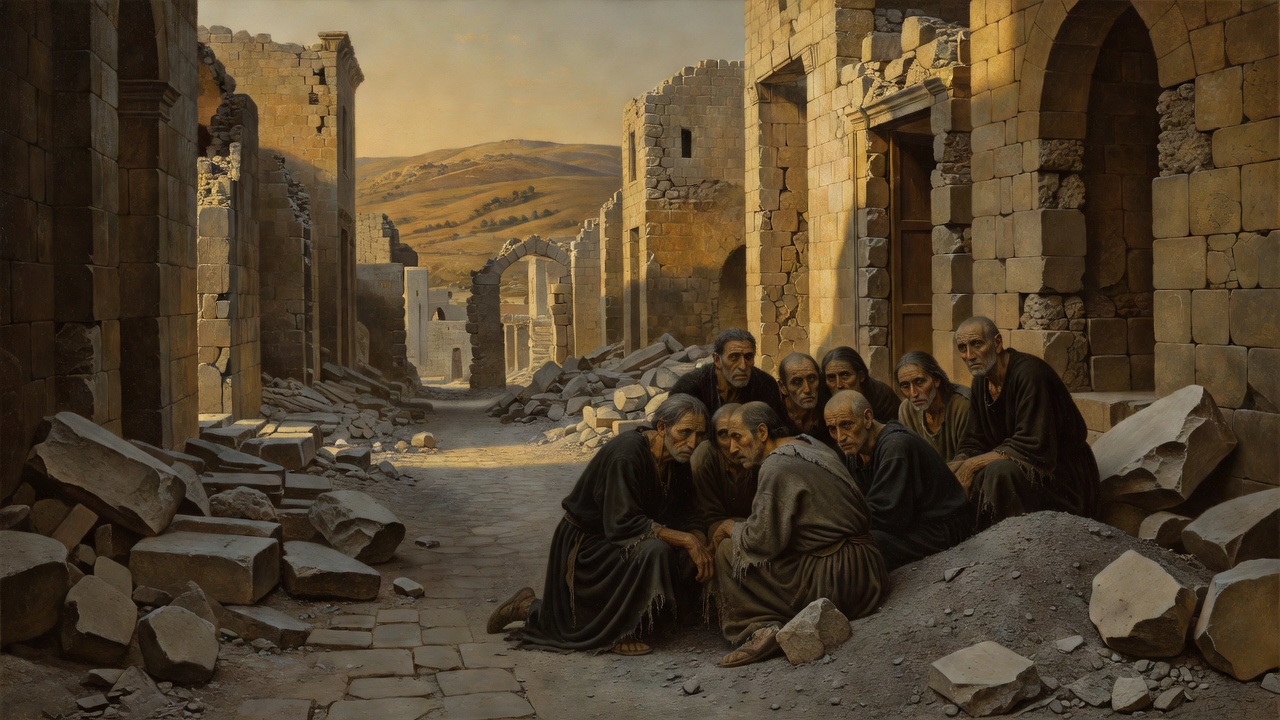
The Distress of Zion
1Aleph. How will the gold be tarnished, and the fine silver changed! the sacred stones have been poured forth at the top of all the streets.
2Beth. The precious sons of Zion, who were equalled in value with gold, how are they counted as earthen vessels, the works of the hands of the potter!
3Gimel. Nay, serpents have drawn out the breasts, they give suck to their young, the daughters of my people are incurably cruel, as an ostrich in a desert.
4Daleth. The tongue of the sucking child cleaves to the roof of its mouth for thirst: the little children ask for bread, and there is none to break it to them.
5He. They that feed on dainties are desolate in the streets: they that used to be nursed in scarlet have clothed themselves with dung.
6Vau. And the iniquity of the daughter of my people has been increased beyond the iniquities of Sodoma, the city that was overthrown very suddenly, and none laboured against her with their hands.
7Zain. Her Nazarites were made purer than snow, they were whiter than milk, they were purified as with fire, their polishing was superior to sapphire stone.
8Heth. Their countenance is become blacker than smoke; they are not known in the streets: their skin has cleaved to their bones; they are withered, they are become as a stick.
9Teth. The slain with the sword were better than they that were slain with hunger: they have departed, pierced through from want of the fruits of the field.
10Jod. The hands of tender-hearted women have sodden their own children: they became meat for them in the destruction of the daughter of my people.
11Chaph. The Lord has accomplished his wrath; he has poured out his fierce anger, and has kindled a fire in Sion, and it has devoured her foundations.
12Lamed. The kings of the earth, even all that dwell in the world, believed not that an enemy and oppressor would enter through the gates of Jerusalem.
13Mem. For the sins of her prophets, and iniquities of her priests, who shed righteous blood in the midst of her,
14Nun. her watchmen staggered in the streets, they were defiled with blood in their weakness, they touched their raiment with it.
15Samech. Depart ye from the unclean ones: call ye them: depart, depart, touch them not: for they are on fire, yea, they stagger: say ye among the nations, They shall no more sojourn there.
16Ain. The presence of the Lord was their portion; but he will not again look upon them: they regarded not the person of the priests, they pitied not the prophets.
17Phe. While we yet lived our eyes failed, while we looked in vain for our help. Tsade. We looked to a nation that could not save. 18We have hunted for our little ones, that they should not walk in our streets. Koph. Our time has drawn nigh, our days are fulfilled, our time is come. 19Our pursuers were swifter than the eagles of the sky, they flew on the mountains, in the wilderness they laid wait for us.
20Rechs. The breath of our nostrils, our anointed Lord, was taken in their destructive snares, of whom we said, In his shadow we shall live among the Gentiles.
21Chsen. Rejoice and be glad, O daughter of Idumea, that dwellest in the land: yet the cup of the Lord shall pass through to thee: thou shalt be drunken, and pour forth.
22Thau. O daughter of Sion, thine iniquity has come to an end; he shall no more carry thee captive: he has visited thine iniquities, O daughter of Edom; he has discovered thy sins.
Did you know?
The Agony of the Fallen City
- The poet considers Jerusalem's prolonged suffering worse than the fate of Sodom. While Sodom was overthrown in an instant by divine fire, the inhabitants of Jerusalem endured the agonizing and drawn-out torment of siege and starvation.Sources: the Bible text itself · Sodom
- Before its capture, Jerusalem was widely regarded as an impenetrable mountain city. The text observes that foreign kings and surrounding nations never believed an enemy could breach its fortified gates.Sources: the Bible text itself · Jerusalem
- The chapter closes with an address to Edom dwelling in the land of Uz, warning that judgment will soon overtake her. Uz is mentioned in only three biblical books: Job, Jeremiah, and Lamentations.Sources: the Bible text itself · Uz · Edom
Notes written with AI assistance from open sources (Theographic Bible Metadata, CC BY-SA 4.0; Easton’s Bible Dictionary, public domain) and reviewed before publishing.
Places in this chapter
- Zion · Today: Jerusalem · 31.777, 35.234 · verses 2, 11, 22
- Jerusalem · 31.777, 35.234 · verse 12
- Edom · 30.746, 35.604 · verses 21, 22
Only places identified with high confidence are shown (90% or more according to the scholarly sources compiled by OpenBible). Period map: DARE (Digital Atlas of the Roman Empire), CC BY 4.0; modern map: © OpenStreetMap contributors; places: OpenBible.info (CC BY 4.0).
Credits and license for this translation
Translation of the Greek Septuagint into English by Sir Lancelot Charles Lee Brenton
Published in 1851, and now in the Public Domain.
If you find errors in the text, please report them so that we can correct them.
Section headings adapted from the Berean Standard Bible (public domain); they are not part of this translation’s text.
Source: http://ebible.org/eng-Brenton/ · eBible.org