Lamentations 3
Brenton Septuagint Translation · Tap a verse to see its cross-references.
The Prophet’s Afflictions
1Aleph. I am the man that sees poverty, through the rod of his wrath upon me. 2He has taken me, and led me away into darkness, and not into light. 3Nay, against me has he turned his hand all the day. 4He has made old my flesh and my skin; he has broken my bones.
5Beth. He has built against me, and compassed my head, and brought travail upon me. 6He has set me in dark places, as them that have long been dead. 7He has builded against me, and I cannot come forth: he has made my brazen chain heavy.
8Gimel. Yea, though I cry and shout, he shuts out my prayer.
9Daleth. He has built up my ways, he has hedged my paths; 10he has troubled me, as a she-bear lying in wait: he is to me as a lion in secret places. 11He pursued me after I departed, and brought me to a stand: he has utterly ruined me.
12He. He has bent his bow, and set me as a mark for the arrow. 13He has caused the arrows of his quiver to enter into my reins. 14I became a laughing-stock to all my people; and their song all the day.
15Vau. He has filled me with bitterness, he has drenched me with gall. 16And he has dashed out my teeth with gravel, he has fed me with ashes. 17He has also removed my soul from peace: I forgot prosperity. 18Therefore my success has perished, and my hope from the Lord.
The Prophet’s Hope
19Zain. I remembered by reason of my poverty, and because of persecution my bitterness and gall shall be remembered; 20and my soul shall meditate with me. 21This will I lay up in my heart, therefore will I endure.
21Heth. It is the mercies of the Lord, that he has not failed me, because his compassions are not exhausted. Pity us, O Lord, early every month: for we are not brought to an end, because his compassions are not exhausted. 21They are new every morning: great is thy faithfulness. 21The Lord is my portion, says my soul; therefore will I wait for him.
25Teth. The Lord is good to them that wait for him: the soul which shall seek him 26is good, and shall wait for, and quietly expect salvation of the Lord.
27Teth. It is good for a man when he bears a yoke in his youth. 28He will sit alone, and be silent, because he has borne it upon him.
30Jod. He will give his cheek to him that smites him: he will be filled full with reproaches. 31For the Lord will not reject for ever.
32Chaph. For he that has brought down will pity, and that according to the abundance of his mercy. 33He has not answered in anger from his heart, though he has brought low the children of a man.
34Lamed. To bring down under his feet all the prisoners of the earth, 35to turn aside the judgment of a man before the face of the Most High, 36to condemn a man unjustly in his judgment, the Lord has not given commandment.
God’s Justice
37Who has thus spoken, and it has come to pass? the Lord has not commanded it. 38Out of the mouth of the Most High there shall not come forth evil and good.
39Mem. Why should a living man complain, a man concerning his sin?
40Nun. Our way has been searched out and examined, and we will turn to the Lord. 41Let us lift up our hearts with our hands to the lofty One in heaven. 42We have sinned, we have transgressed; and thou hast not pardoned.
43Samech. Thou hast visited us in wrath, and driven us away: thou hast slain, thou hast not pitied. 44Thou hast veiled thyself with a cloud because of prayer, that I might be blind, 45and be cast off. Ain. Thou hast set us alone in the midst of the nations. 46All our enemies have opened their mouth against us. 47Fear and wrath are come upon us, suspense and destruction. 48Mine eye shall pour down torrents of water, for the destruction of the daughter of my people.
49Phe. Mine eye is drowned with tears, and I will not be silent, so that there shall be no rest, 50until the Lord look down, and behold from heaven. 51Mine eye shall prey upon my soul, because of all the daughters of the city.
52Tsade. The fowlers chased me as a sparrow, all mine enemies destroyed my life in a pit without cause, 53and laid a stone upon me. 54Water flowed over my head: I said, I am cut off.
55Koph. I called upon thy name, O Lord, out of the lowest dungeon. 56Thou heardest my voice: close not thine ears to my supplication. 57Thou drewest nigh to my help: in the day wherein I called upon thee thou saidst to me, Fear not.
58Rechs. O Lord, thou hast pleaded the causes of my soul; thou hast redeemed my life. 59Thou hast seen, O Lord, my troubles: thou hast judged my cause. 60Thou hast seen all their vengeance, thou hast looked on all their devices against me.
61Chsen. Thou hast heard their reproach and all their devices against me; 62the lips of them that rose up against me, and their plots against me all the day; 63their sitting down and their rising up: look thou upon their eyes. 64Thou wilt render them a recompence, O Lord, according to the works of their hands.
65Thau. Thou wilt give them as a covering, the grief of my heart. 66Thou wilt persecute them in anger, and wilt consume them from under the heaven, O Lord.
Did you know?
Hope Amid Affliction
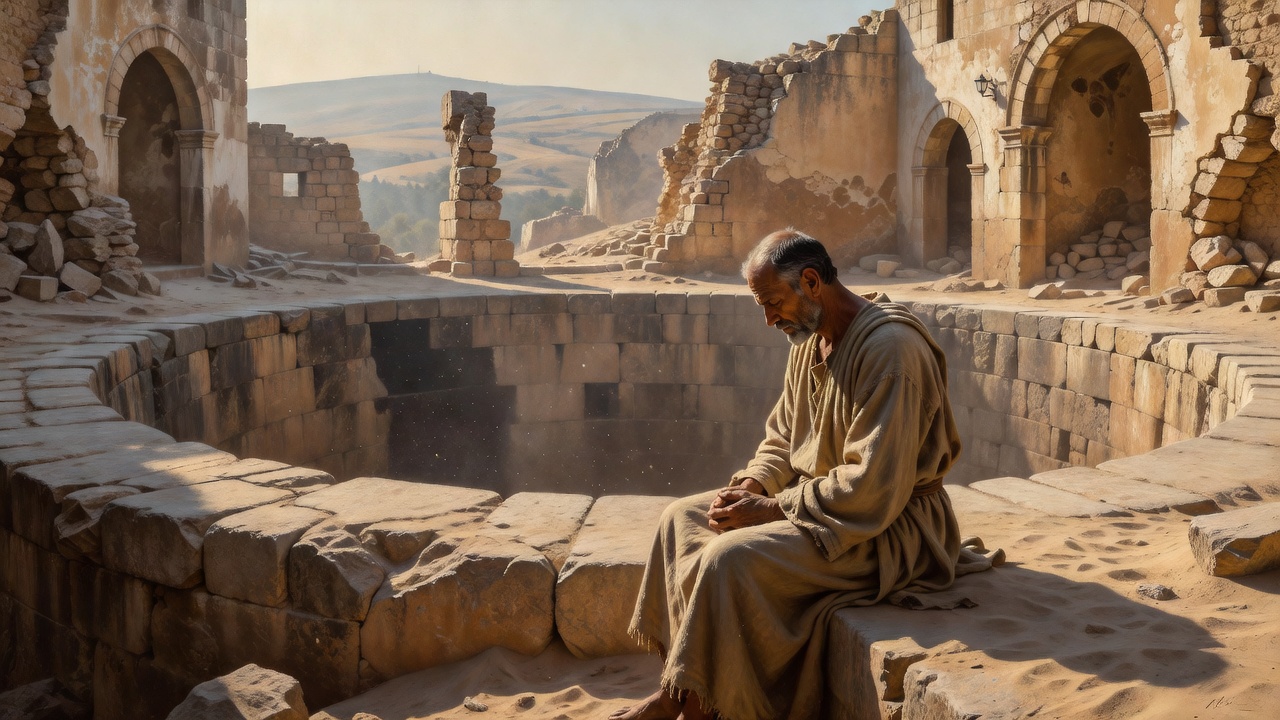
- Unlike the earlier chapters focusing broadly on Jerusalem's ruins, this chapter begins with an individual speaker describing his personal suffering under affliction before calling the community to examine their ways, confess rebellion, and return to the Lord.Sources: the Bible text itself
- In the midst of deep despair, the text introduces a central declaration of hope, affirming that the Lord's mercies never fail, are renewed every morning, and that God does not willingly afflict or cast off forever.Sources: the Bible text itself
- The speaker uses vivid imagery of being hunted like a bird and thrown into a pit with stones cast over him, yet recalls crying out to God from the depths and receiving the comforting response, 'Do not be afraid.'Sources: the Bible text itself
Notes written with AI assistance from open sources (Theographic Bible Metadata, CC BY-SA 4.0; Easton’s Bible Dictionary, public domain) and reviewed before publishing.
Places in this chapter
- Jerusalem · 31.777, 35.234 · verse 51
Only places identified with high confidence are shown (90% or more according to the scholarly sources compiled by OpenBible). Period map: DARE (Digital Atlas of the Roman Empire), CC BY 4.0; modern map: © OpenStreetMap contributors; places: OpenBible.info (CC BY 4.0).
Credits and license for this translation
Translation of the Greek Septuagint into English by Sir Lancelot Charles Lee Brenton
Published in 1851, and now in the Public Domain.
If you find errors in the text, please report them so that we can correct them.
Section headings adapted from the Berean Standard Bible (public domain); they are not part of this translation’s text.
Source: http://ebible.org/eng-Brenton/ · eBible.org