Isaiah 64
Brenton Septuagint Translation · Tap a verse to see its cross-references.
A Prayer for God’s Power
1as wax melts before the fire; and fire shall burn up the enemies, and thy name shall be manifest among the adversaries: at thy presence the nations shall be troubled, 2whenever thou shalt work gloriously; trembling from thee shall take hold upon the mountains.
3From of old we have not heard, neither have our eyes seen a God beside thee, and thy works which thou wilt perform to them that wait for mercy. 4For these blessings shall happen to them that work righteousness, and they shall remember thy ways: behold, thou wast angry and we have sinned; therefore we have erred, 5and we are all become as unclean, and all our righteousness as a filthy rag: and we have fallen as leaves because of our iniquities; thus the wind shall carry us away. 6And there is none that calls upon thy name, or that remembers to take hold on thee: for thou hast turned thy face away from us, and hast delivered us up because of our sins.
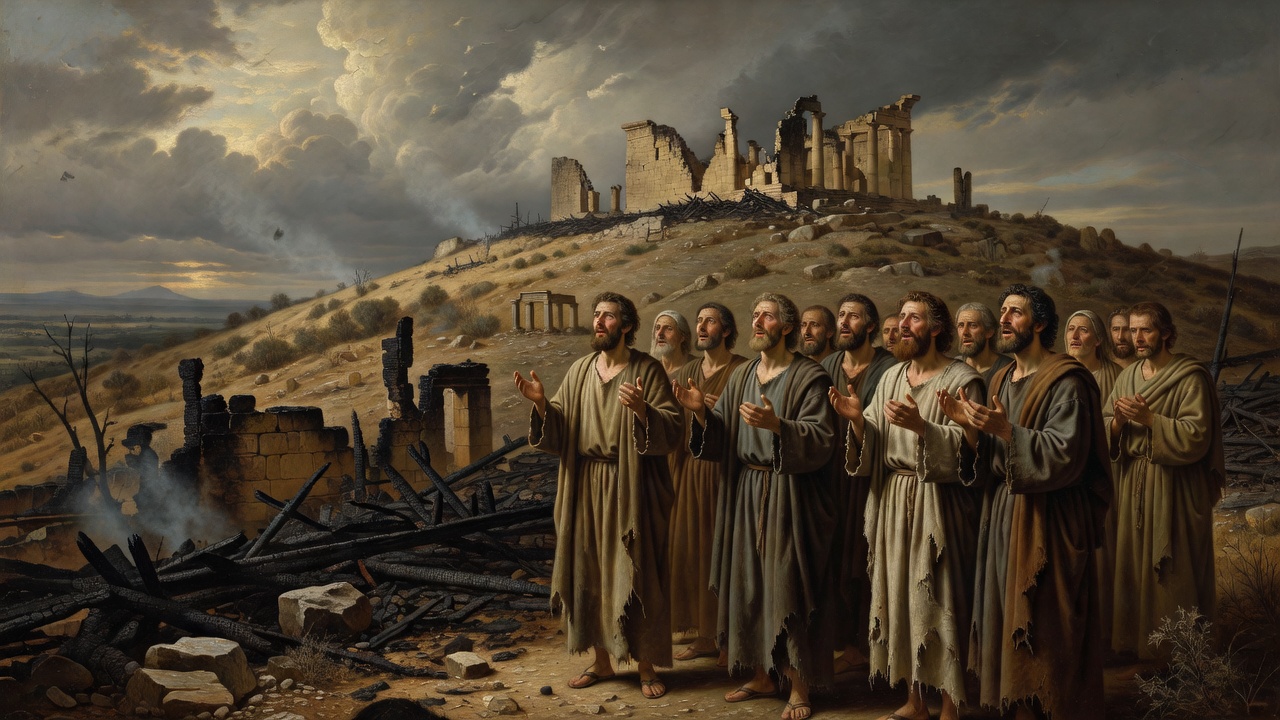
7And now, O Lord, thou art our Father, and we are clay, all of us the work of thine hands. 8Be not very wroth with us, and remember not our sins for ever; but now look on us, for we are all thy people. 9The city of thy holiness has become desolate, Sion has become as a wilderness, Jerusalem a curse. 10The house, our sanctuary, and the glory which our fathers blessed, has been burnt with fire: and all our glorious things have gone to ruin. 11And for all these things thou, O Lord, hast withholden thyself, and been silent, and hast brought us very low.
Did you know?
A Prayer for Mercy Amid Ruin
- The passage opens with a plea for God to rend the heavens and descend with world-shaking power, like fire that kindles brushwood. Yet it contrasts this desire for divine presence with a confession of human unworthiness, comparing people to withering leaves swept away by their own iniquities.Sources: the Bible text itself
- In Isaiah 64, the community appeals to God as a Father and craftsman, declaring, "we are the clay, and You are the potter." This imagery emphasizes human frailty and total dependence on God, pleading for divine mercy despite their acknowledged guilt.Sources: the Bible text itself
- The chapter laments the destruction of sacred spaces, describing Zion and Jerusalem as desolate wastelands. It specifically mourns the burning and ruin of the holy temple where past generations had offered praise.Sources: the Bible text itself · Zion · Jerusalem
Notes written with AI assistance from open sources (Theographic Bible Metadata, CC BY-SA 4.0; Easton’s Bible Dictionary, public domain) and reviewed before publishing.
Places in this chapter
Only places identified with high confidence are shown (90% or more according to the scholarly sources compiled by OpenBible). Period map: DARE (Digital Atlas of the Roman Empire), CC BY 4.0; modern map: © OpenStreetMap contributors; places: OpenBible.info (CC BY 4.0).
Credits and license for this translation
Translation of the Greek Septuagint into English by Sir Lancelot Charles Lee Brenton
Published in 1851, and now in the Public Domain.
If you find errors in the text, please report them so that we can correct them.
Section headings adapted from the Berean Standard Bible (public domain); they are not part of this translation’s text.
Source: http://ebible.org/eng-Brenton/ · eBible.org