Exodus 6
Brenton Septuagint Translation · Tap a verse to see its cross-references.
God Promises Deliverance
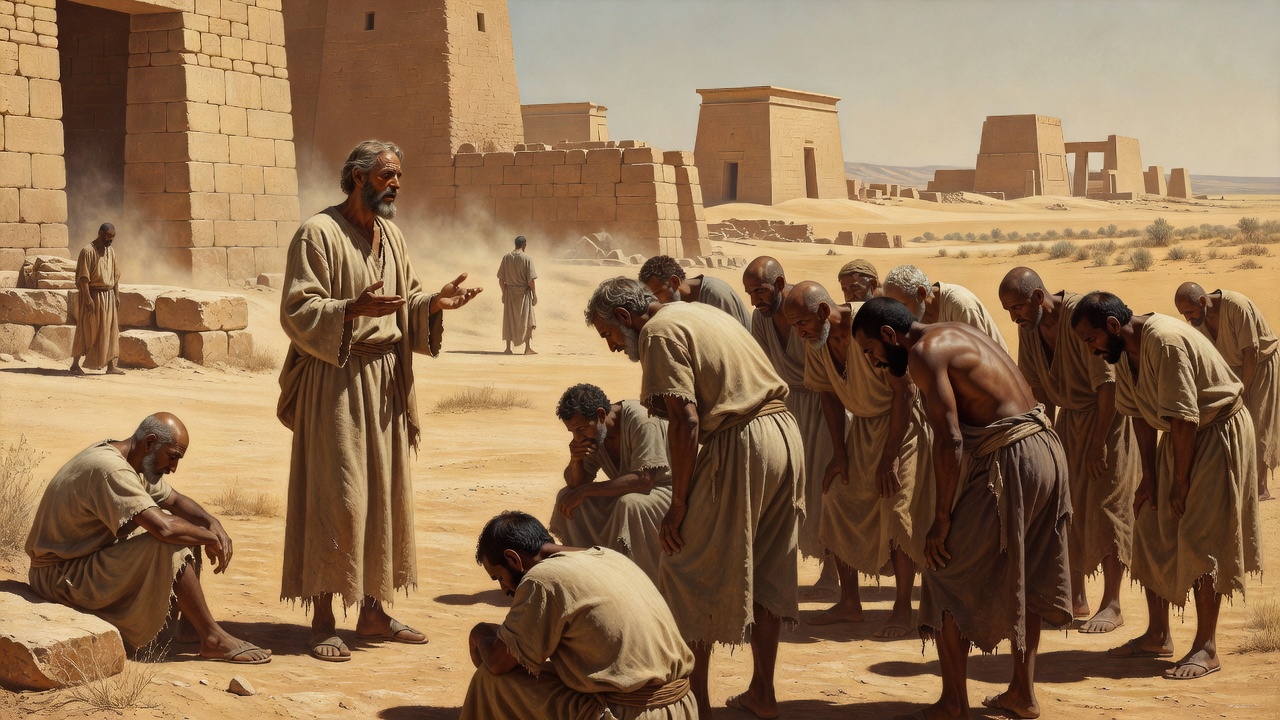
1And the Lord said to Moses, Now thou shalt see what I will do to Pharao; for he shall send them forth with a mighty hand, and with a high arm shall he cast them out of his land. 2And God spoke to Moses and said to him, I am the Lord. 3And I appeared to Abraam and Isaac and Jacob, being their God, but I did not manifest to them my name Lord. 4And I established my covenant with them, to give them the land of the Chananites, the land wherein they sojourned, in which also they dwelt as strangers. 5And I hearkened to the groaning of the children of Israel (the affliction with which the Egyptians enslave them) and I remembered the covenant with you. 6Go, speak to the children of Israel, saying, I am the Lord; and I will lead you forth from the tyranny of the Egyptians, and I will deliver you from bondage, and I will ransom you with a high arm, and great judgment. 7And I will take you to me a people for myself, and will be your God; and ye shall know that I am the Lord your God, who brought you out from the tyranny of the Egyptians. 8And I will bring you into the land concerning which I stretched out my hand to give it to Abraam and Isaac and Jacob, and I will give it you for an inheritance: I am the Lord. 9And Moses spoke thus to the sons of Israel, and they hearkened not to Moses for faint-heartedness, and for their hard tasks. 10And the Lord spoke to Moses, saying, 11Go in, speak to Pharao king of Egypt, that he send forth the children of Israel out of his land. 12And Moses spoke before the Lord, saying, Behold, the children of Israel hearkened not to me, and how shall Pharao hearken to me? and I am not eloquent. 13And the Lord spoke to Moses and Aaron, and gave them a charge to Pharao king of Egypt, that he should send forth the children of Israel out of the land of Egypt.
Genealogies of Moses and Aaron
14And these are the heads of the houses of their families: the sons of Ruben the first-born of Israel; Enoch and Phallus, Asron, and Charmi, this is the kindred of Ruben. 15And the sons of Symeon, Jemuel and Jamin, and Aod, and Jachin and Saar, and Saul the son of a Phœnician woman, these are the families of the sons of Symeon. 16And these are the names of the sons of Levi according to their kindreds, Gedson, Caath, and Merari; and the years of the life of Levi were a hundred and thirty-seven. 17And these are the sons of Gedson, Lobeni and Semei, the houses of their family. And the sons of Caath, 18Ambram and Issaar, Chebron, and Oziel; and the years of the life of Caath were a hundred and thirty-three years. 19And the sons of Merari, Moöli, and Omusi, these are the houses of the families of Levi, according to their kindreds. 20And Ambram took to wife Jochabed the daughter of his father's brother, and she bore to him both Aaron and Moses, and Mariam their sister: and the years of the life of Ambram were a hundred and thirty-two years. 21And the sons of Issaar, Core, and Naphec, and Zechri. 22And the sons of Oziel, Misael, and Elisaphan, and Segri. 23And Aaron took to himself to wife Elisabeth daughter of Aminadab sister of Naasson, and she bore to him both Nadab and Abiud, and Eleazar and Ithamar. 24And the sons of Core, Asir, and Elkana, and Abiasar, these are the generations of Core. 25And Eleazar the son of Aaron took to himself for a wife one of the daughters of Phutiel, and she bore to him Phinees. These are the heads of the family of the Levites, according to their generations. 26This is Aaron and Moses, whom God told to bring out the children of Israel out of the land of Egypt with their forces. 27These are they that spoke with Pharao king of Egypt, and Aaron himself and Moses brought out the children of Israel from the land of Egypt, 28in the day in which the Lord spoke to Moses in the land of Egypt; 29then the Lord spoke to Moses, saying, I am the Lord: speak to Pharao king of Egypt whatsoever I say to thee. 30And Moses said before the Lord, Behold, I am not able in speech, and how shall Pharao hearken to me?
Did you know?
I Am the LORD
- In Exodus 6 God tells Moses that he is the LORD, and that he appeared to Abraham, Isaac, and Jacob as God Almighty but did not make himself known to them by the name the LORD. He recalls the covenant to give them the land of Canaan, where they had lived as foreigners. Easton's Bible Dictionary (1897) says the name Canaan signifies the lowlands, and that in the time of Moses and Joshua it denoted the whole country west of the Jordan and the Dead Sea.Sources: the Bible text itself · Canaan
- A family list then identifies the men charged to bring the Israelites out of Egypt: Levi, Jacob’s third son by Leah, whose name is linked to her Hebrew word meaning joined, and Levi’s sons Gershon, Kohath, and Merari. Levi lived 137 years, and Kohath, Amram’s father, lived 133; Amram married his father’s sister Jochebed, a daughter of Levi, and she bore Aaron and Moses. Aaron, the elder brother, was born in Egypt three years before Moses and married Elisheba, daughter of Amminadab of the house of Judah.Sources: the Bible text itself · Levi (patriarch) · Kohath · Aaron
- Moses and Aaron are sent to speak to Pharaoh king of Egypt. Easton's Bible Dictionary (1897) says the Pharaoh of the Exodus was probably Menephtah I, the fourteenth and eldest surviving son of Rameses II, who resided at Zoan, where those interviews took place. That entry still leaves open whether Seti II or his father Menephtah was that Pharaoh, and notes that some think the evidence favors Seti II.Sources: the Bible text itself · Pharaoh (of the Exodus)
Notes written with AI assistance from open sources (Theographic Bible Metadata, CC BY-SA 4.0; Easton’s Bible Dictionary, public domain) and reviewed before publishing.
Places in this chapter
Only places identified with high confidence are shown (90% or more according to the scholarly sources compiled by OpenBible). Period map: DARE (Digital Atlas of the Roman Empire), CC BY 4.0; modern map: © OpenStreetMap contributors; places: OpenBible.info (CC BY 4.0).
Credits and license for this translation
Translation of the Greek Septuagint into English by Sir Lancelot Charles Lee Brenton
Published in 1851, and now in the Public Domain.
If you find errors in the text, please report them so that we can correct them.
Section headings adapted from the Berean Standard Bible (public domain); they are not part of this translation’s text.
Source: http://ebible.org/eng-Brenton/ · eBible.org