Exodus 5
Brenton Septuagint Translation · Tap a verse to see its cross-references.
Pharaoh’s First Refusal
1And after this went in Moses and Aaron to Pharao, and they said to him, These things says the Lord God of Israel, Send my people away, that they may keep a feast to me in the wilderness. 2And Pharao said, Who is he that I should hearken to his voice, so that I should send away the children of Israel? I do not know the Lord, and I will not let Israel go. 3And they say to him, The God of the Hebrews has called us to him: we will go therefore a three days' journey into the wilderness, that we may sacrifice to the Lord our God, lest at any time death or slaughter happen to us. 4And the king of Egypt said to them, Why do ye, Moses and Aaron, turn the people from their works? depart each of you to your works. 5And Pharao said, Behold now, the people is very numerous; let us not then give them rest from their work.
Bricks and Straw
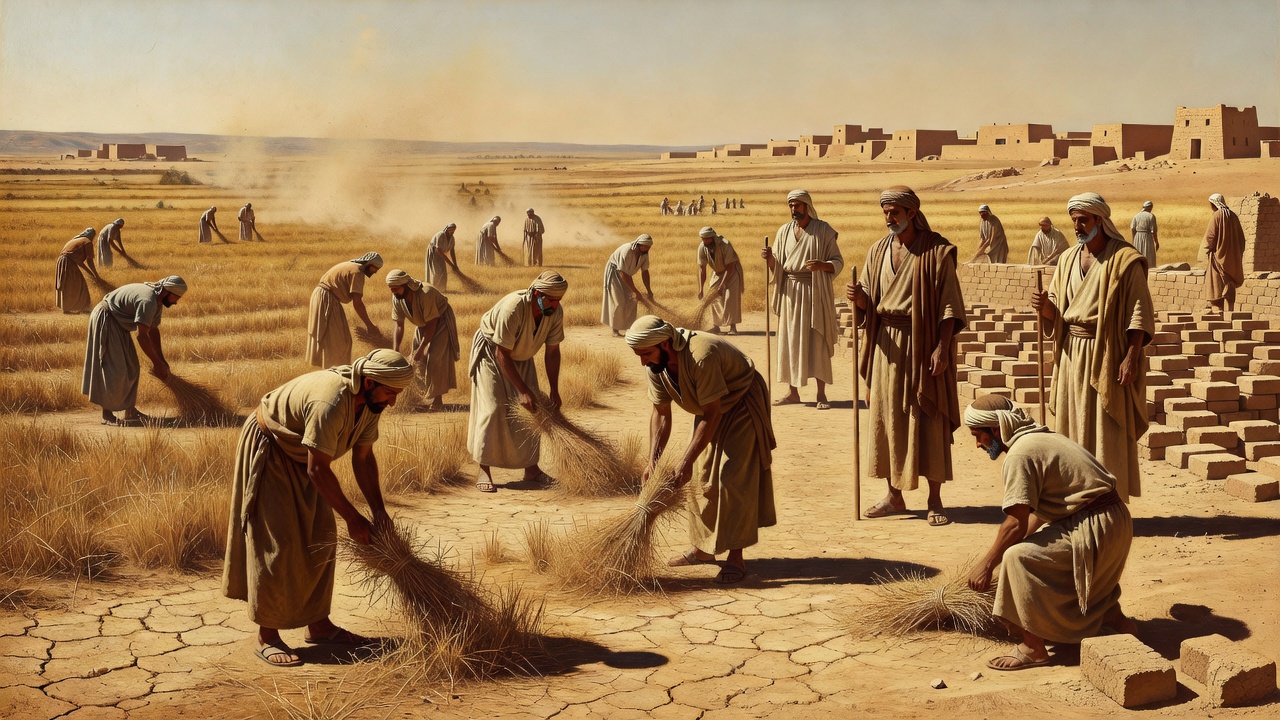
6And Pharao gave orders to the task-masters of the people and the accountants, saying, 7Ye shall no longer give straw to the people for brick-making as yesterday and the third day; but let them go themselves, and collect straw for themselves. 8And thou shalt impose on them daily the rate of brick-making which they perform: thou shalt not abate anything, for they are idle; therefore have they cried, saying, Let us arise and do sacrifice to our God. 9Let the works of these men be made grievous, and let them care for these things, and not care for vain words.
10And the taskmasters and the accountants hastened them, and they spoke to the people, saying, Thus says Pharao, I will give you straw no longer. 11Go ye, yourselves, get for yourselves straw whencesoever ye can find it, for nothing is diminished from your rate. 12So the people were dispersed in all the land of Egypt, to gather stubble for straw. 13And the taskmasters hastened them, saying, Fulfil your regular daily tasks, even as when straw was given you. 14And the accountants of the race of the children of Israel, who were set over them by the masters of Pharao, were scourged, [ and questioned,] men saying, Why have ye not fulfilled your rates of brick-work as yesterday and the third day, to-day also?
The Cry of the Israelites
15And the accountants of the children of Israel went in and cried to Pharao, saying, Why dost thou act thus to thy servants? 16Straw is not given to thy servants, and they tell us to make brick; and behold thy servants have been scourged: thou wilt therefore injure thy people. 17And he said to them, Ye are idle, ye are idlers: therefore ye say, Let us go and do sacrifice to our God. 18Now then go and work, for straw shall not be given to you, yet ye shall return the rate of bricks. 19And the accountants of the children of Israel saw themselves in an evil plight, men saying, Ye shall not fail to deliver the daily rate of the brick-making. 20And they met Moses and Aaron coming forth to meet them, as they came forth from Pharao. 21And they said to them, The Lord look upon you and judge you, for ye have made our savour abominable before Pharao, and before his servants, to put a sword into his hands to slay us. 22And Moses turned to the Lord, and said, I pray, Lord, why hast thou afflicted this people? and wherefore hast thou sent me? 23For from the time that I went to Pharao to speak in thy name, he has afflicted this people, and thou hast not delivered thy people.
Did you know?
Harder Work After Pharaoh's Refusal
- Easton's Bible Dictionary (1897) says the Pharaoh of the Exodus was probably Menephtah I, the fourteenth and eldest surviving son of Rameses II, but it treats the identification as still an open question: some scholars, it notes, favor Seti II, whose reign it describes as beginning peacefully and ending in sudden disaster. The entry says he resided at Zoan, where he received Moses and Aaron in the interviews recorded in Exodus.Sources: Pharaoh (of the Exodus) · the Bible text itself
- Easton's Bible Dictionary (1897) places Jacob's arrival in Egypt probably about 350 years before Moses was born. It says a Hyksos king, from a pastoral Semitic people of Asia and called a shepherd king, received the family favorably and assigned them Goshen, the best of the land; in this chapter Pharaoh treats the people of Israel, now numerous, as laborers he will not let go.Sources: Moses · the Bible text itself
- Pharaoh answers the request to hold a feast in the wilderness by no longer supplying straw for the bricks, while still requiring the same daily quota. The people scatter through the land of Egypt to gather stubble, and the Israelite foremen whom Pharaoh's taskmasters had set over them are beaten when that quota is not met.Sources: the Bible text itself
Notes written with AI assistance from open sources (Theographic Bible Metadata, CC BY-SA 4.0; Easton’s Bible Dictionary, public domain) and reviewed before publishing.
Places in this chapter
Only places identified with high confidence are shown (90% or more according to the scholarly sources compiled by OpenBible). Period map: DARE (Digital Atlas of the Roman Empire), CC BY 4.0; modern map: © OpenStreetMap contributors; places: OpenBible.info (CC BY 4.0).
Credits and license for this translation
Translation of the Greek Septuagint into English by Sir Lancelot Charles Lee Brenton
Published in 1851, and now in the Public Domain.
If you find errors in the text, please report them so that we can correct them.
Section headings adapted from the Berean Standard Bible (public domain); they are not part of this translation’s text.
Source: http://ebible.org/eng-Brenton/ · eBible.org