Exodus 11
Brenton Septuagint Translation · Tap a verse to see its cross-references.
The Plague on the Firstborn Foretold
1And the Lord said to Moses, I will yet bring one plague upon Pharao and upon Egypt, and after that he will send you forth thence; and whenever he sends you forth with every thing, he will indeed drive you out. 2Speak therefore secretly in the ears of the people, and let every one ask of his neighbour jewels of silver and gold, and raiment. 3And the Lord gave his people favour in the sight of the Egyptians, and they lent to them; and the man Moses was very great before the Egyptians, and before Pharao, and before his servants. 4And Moses said, These things saith the Lord, About midnight I go forth into the midst of Egypt. 5And every first-born in the land of Egypt shall die, from the first-born of Pharao that sits on the throne, even to the first-born of the woman-servant that is by the mill, and to the first-born of all cattle. 6And there shall be a great cry through all the land of Egypt, such as has not been, and such shall not be repeated any more. 7But among all the children of Israel shall not a dog snarl with his tongue, either at man or beast; that thou mayest know how wide a distinction the Lord will make between the Egyptians and Israel. 8And all these thy servants shall come down to me, and do me reverence, saying, Go forth, thou and all the people over whom thou presidest, and afterwards I will go forth. 9And Moses went forth from Pharao with wrath. And the Lord said to Moses, Pharao will not hearken to you, that I may greatly multiply my signs and wonders in the land of Egypt. 10And Moses and Aaron wrought all these signs and wonders in the land of Egypt before Pharao; and the Lord hardened the heart of Pharao, and he did not hearken to send forth the children of Israel out of the land of Egypt.
Did you know?
One More Plague before the Exodus
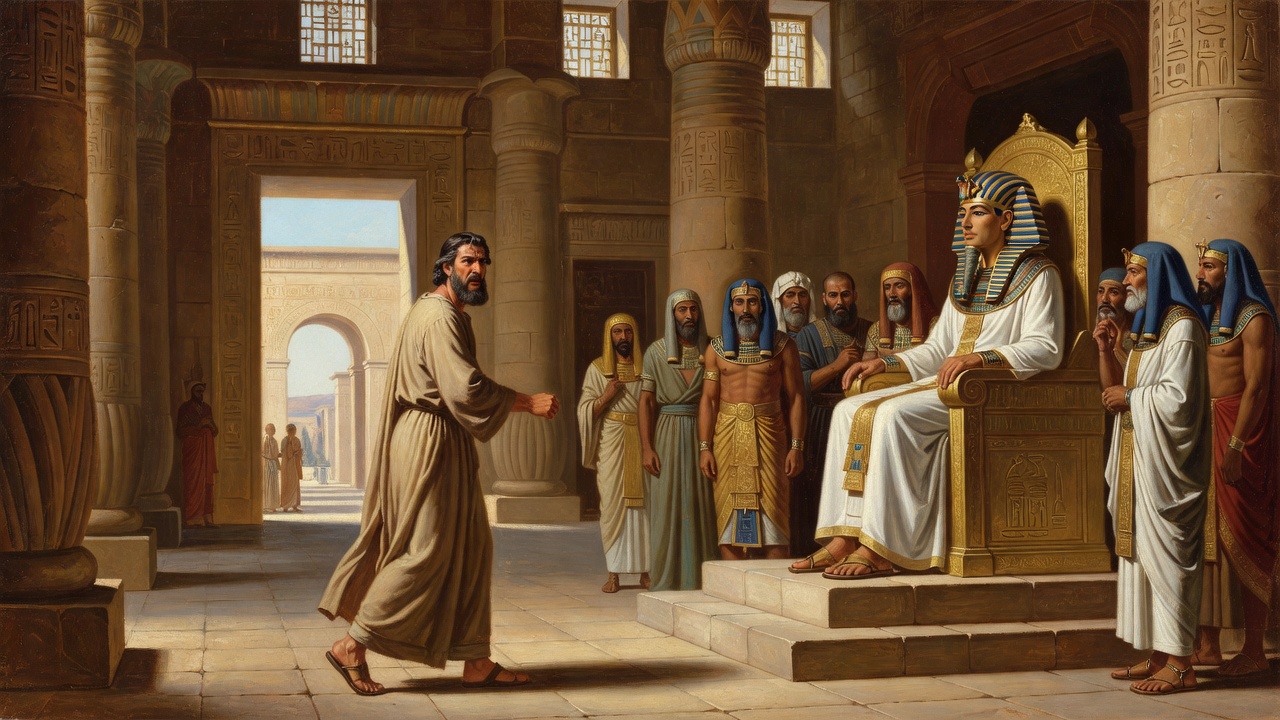
- Easton's Bible Dictionary (1897) says the pharaoh of the Exodus was probably Menephtah I, the fourteenth son of Rameses II and the eldest of the sons who survived, but it also says it is still a question whether he or Seti II was that king; some favor Seti II. The same entry says that pharaoh lived at Zoan, where his interviews with Moses and Aaron took place. This chapter ends as Moses, hot with anger, leaves Pharaoh's presence.Sources: Pharaoh (of the Exodus) · the Bible text itself
- Easton's Bible Dictionary (1897) says Jacob and his sons went down to Egypt probably about 350 years before Moses was born, and that the king gave them the best of the land, Goshen, to live in. In this chapter Israelite men and women alike are told to ask their neighbors for articles of silver and gold, and the account says the LORD gave the people favor in the sight of the Egyptians.Sources: Moses · the Bible text itself
- An event listing dates the start of the Exodus from Egypt to 1490 BC. In this chapter the LORD tells Moses that after one more plague Pharaoh will let the people leave and will drive them out completely.Sources: Exodus from Egypt · the Bible text itself
Notes written with AI assistance from open sources (Theographic Bible Metadata, CC BY-SA 4.0; Easton’s Bible Dictionary, public domain) and reviewed before publishing.
Places in this chapter
Only places identified with high confidence are shown (90% or more according to the scholarly sources compiled by OpenBible). Period map: DARE (Digital Atlas of the Roman Empire), CC BY 4.0; modern map: © OpenStreetMap contributors; places: OpenBible.info (CC BY 4.0).
Credits and license for this translation
Translation of the Greek Septuagint into English by Sir Lancelot Charles Lee Brenton
Published in 1851, and now in the Public Domain.
If you find errors in the text, please report them so that we can correct them.
Section headings adapted from the Berean Standard Bible (public domain); they are not part of this translation’s text.
Source: http://ebible.org/eng-Brenton/ · eBible.org