John 11
Beibel: okanisi tongo · Tap a verse to see its cross-references.
Lasalesi dede
1Ma namo, da wan man Lasalesi be de a wan pikin foto den e kai Betaniya. Da wan uman den e kai Maliya be e tan de tu anga en sisa Malita. Ma namo, da Lasalesi be kai a siki. 2Da a Maliya ya, na a seefi uman di o tutu a sumee switi fatu a Masaa Jesesi futu dee Masaa futu baka anga en ede uwii. Da ne en baala Lasalesi be kai a siki. 3Da den tu sisa fu Lasalesi ya sende bosikopu gi Masaa Jesesi taki: “Masaa! I lobi mati kai a siki.”
4Ma di Masaa Jesesi yee a bosikopu, ne a taki: “A siki di a siki de, a ná wan siki di o kii en. Ma a siki o meke Masaa Gadu fende gaandi. Bika a Manpikin fu Masaa Gadu seefi o fende gaandi.” 5We, Masaa Jesesi be lobi Malita anga en sisa anga Lasalesi tuutuu. 6Ma toku di a yee taki Lasalesi siki, a tan tu dei moo a pe a be de. 7Ne Masaa Jesesi taigi den bakaman fi en taki: “Meke u go baka a Judeja!”
8Ma den bakaman fi en taigi en taki: “Labai! Wantu dei pasa, den sama fu Judeja be wani kii yu anga siton, ne yu o go anda baka?”
9Ma Masaa Jesesi piki den taki: “A ná twalufu yuu wan dei abi, no? We, sama di e waka a dei, ná o naki en futu. Bika ai si a leti fu a goontapu ya. 10Ma sama di e waka a neti, o naki en futu. Bika a ná abi ná wan leti. 11Ne baka di a taki a sani ya, ne a taigi den bakaman fi en taki: ‘A mati fu wi, Lasalesi siibi. Ma mi e go anda fu weki en.’ ”
12We, ne den bakaman fi en taigi en taki: “We, efu ai siibi, da a o betee.” 13Ma na a dede fu Lasalesi Masaa Jesesi be e taki. Ma den bakaman fi en be denki taki na fu siibi wawan a be e taki.
14We, na fu dati ede meke Masaa Jesesi taigi den kiinkiin taki: “Lasalesi dede kaba. 15Ma na fu u ede, mi piisii fu di mi á be de ape. Bika u abi a sani di o pasa de fanowdu. A o meke u a biibi fu u kon moo taanga. Ma, u meke u go ne en nownow.”
16Ma, Towmasi, di den be e kai Toolengi*f12*, taigi den taa bakaman fu Masaa Jesesi taki: “Meke u go anga en fu u sa dede anga en.”
Masaa Jesesi na a opobaka a dede anga a libi
17We, di Masaa Jesesi kon a Betaniya, ne den taigi en taki: “Lasalesi de a ini geebi fo dei kaba.” 18Ma somen Dyu be komoto a Jelusalem kon a Betaniya fu kee pina anga Malita anga Maliya fu a dede fu a baala fi en. Bika Jelusalem anga Betaniya be sa de wan sani fu dii kilomeiti so koosube anga denseefi.
20We, fa i si Malita yee taki Masaa Jesesi kon de, ne wanten a opo go miti en. Ma Maliya fika sidon sidon a osu. 21Ne Malita taigi Masaa Jesesi taki: “Masaa! Efi i be de ya, mi baala á be o dede. 22Ma toku, now mi sabi taki ala sani di i begi akisi Masaa Gadu, a o gi yu en.”
23Ne Masaa Jesesi taigi en taki: “Malita! I baala o opo baka!”
24Ne Malita taigi en taki: “We, Masaa, mi sabi taki a o opo baka te ala den dede sama o opo baka na a kiiboi dei.”
25Ne Masaa Jesesi piki en taki: “Mi na a sama di e weki sama puu a dede. Na mi na a sama di e gi libi. Sama di e biibi a mi, sa libi, wansi a dede. 26Da sama di de a libi, ne ai biibi a mi, ná o dede ná wan ten! Yu e biibi dati?”
27Ne Malita taigi en taki: “Iya, Masaa! Mi e biibi taki yu na a Kelestesi, a Manpikin fu Masaa Gadu di be mu kon a goontapu.”
Gaan tyali kisi Masaa Jesesi
28We, ne di Masaa Jesesi taki so, ne Malita go, ne a kai en sisa saafi taki: “A Mesiti kon kaba, ai kai yu.” 29We, di Maliya yee so, ne a opo pala, waka go a Masaa. 30Bika Masaa Jesesi á be doo a ini a kondee ete, ma a be de a pe a be taki anga Malita ete. 31We, sama fu Judeja di be de a ini osu de be e gi en taanga sikin. Namo di den si taki, Maliya opo pala waka go a doose, ne den waka go ne en baka. Den denki taki, ai go na a geebi fu go kee anda.
32We, di Maliya doo na a peesi pe Masaa Jesesi de, di a si en, ne a kai a Masaa Jesesi futu, ne a taki: “Masaa, efi i be de ya, mi baala á be o dede, baa!”
33Ma namo, di Masaa Jesesi si Maliya anga den taa sama fu Judeja di be kon ne en e kee so, ne wan gaan tyali kisi en a ini en ati. 34Ne Masaa Jesesi akisi den taki: “On pe u poti en?”
Ne den taigi en taki: “Masaa, kon, da i sa si!”
35Ma namo, ne wataa lon a Masaa Jesesi ain pala pala. 36Na fu dati ede meke den Dyu taki: “Kee! Luku fa a be lobi en, baa.”
37Ma wantu fu den taki: “We, a ná a man ya be e meke den beendiman kon si baka, no? Ne fa a waka a á be poi yeepi a man ya, fu a á dede?”
Masaa Jesesi weki Lasalesi puu a dede
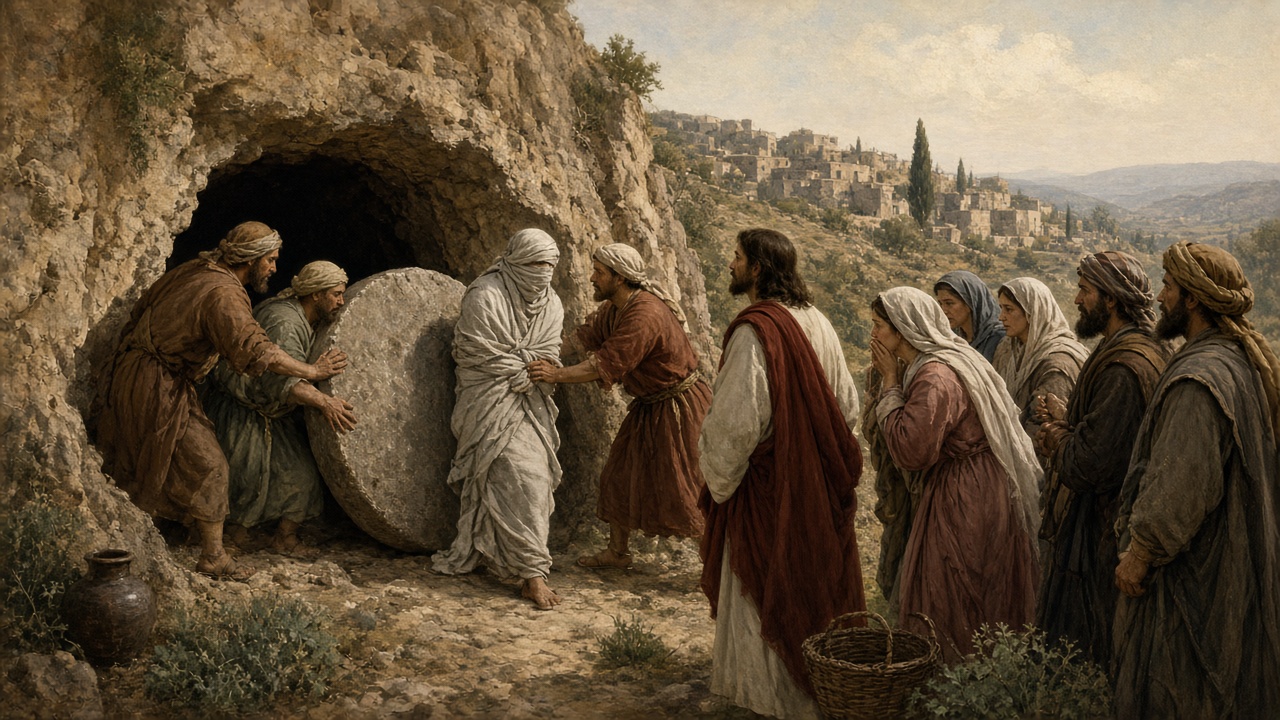
38Ma wan gaan tyali kisi Masaa Jesesi baka a ini en ati. Ne na so a go na a geebi. Ma namo, da a geebi ya na be wan siton olo. Da den be tapu a geebi mofu anga wan siton. 39We, ne Masaa Jesesi taki: “U puu a siton na a geebi mofu!”
Ma Malita, a sisa fu a man di dede, taigi en taki: “Masaa! Ai tingi kaba. Bika na fo dei kaba di a de a ini a geebi.”
40Ma Masaa Jesesi piki en taki: “Mi á be taigi i kaba taki, efi i biibi, yu o si a hei fasi fu Gadu, no?” 41We, ne den puu a siton na a geebi mofu. Ne Masaa Jesesi opo ede luku tapu, ne a taki: “Mi Tata! Gaantangi fi yu fu di a de taki i yee mi kaba. 42Mi sabi tuutuu taki yu e yee mi alaten. Ma na fu den sama di taampu lontu ya ede meke mi e taki so, fu den sa kon biibi taki na yu be sende mi kon a goontapu.” 43We, ne di Masaa Jesesi taki so, ne a bali kai Lasalesi taanga taki: “Lasalesi! Kon a doo!” 44We, ne a dedesama komoto kon a doo. En futu anga en ana de teitei anga geebi koosi ne en sikin. Da en fesi seefi be de teitei anga wan koosi. Ne Masaa Jesesi taigi den taki: “U losi en meke a go!”
Fa den be wani kii Masaa Jesesi
45We, di den sama di be kon a Maliya si a sani di Masaa Jesesi du, ne den daai kon e biibi ne en. 46Ma wantu fu den go a den Faliseiman go taigi den san Masaa Jesesi du. 47We, na fu dati ede meke den Faliseiman anga den apaiti begiman fu a Mama Keliki, kai wan gaan kuutu makandii, anga a Dyulanti di e kuutu sani. Ne den e akisi taki: “San wi mu du? We, bika a sama e du somen somen foondoo foondoo wooko. 48Efu wi á luku bun, da ala sama o daai kon e biibi ne en. Da den Loma o kon feti booko a Mama Keliki anga a nasi fu wi kaba a soso.”
49Ma Kayafasi, wan fu den man, di be de a moo hei apaiti begiman, na a yali de, taigi den taki: “U á sabi ná wan sani! 50U á sabi taki a moo bun fu wankodo sama dede gi a nasi, moo enke pe fu a hii nasi dede go kaba a soso, no?” 51Ma a ná enseefi be taki a sani de. Ma na fu di a be de a moo hei apaiti begiman a yali de, na fu dati ede meke Masaa Gadu be meke a taki den wowtu ya taki: “Masaa Jesesi mu dede gi a hii nasi. 52Ma a ná den Dyu wawan a o dede gi, ma a o tyai ala den sama fu Masaa Gadu, di de paati paati a hii goontapu, kon makandii a wan ipi.”
53We, ne fanafu a dei di de oli a kuutu de, ne den poti taki den sa kii en namo. 54We, na fu dati ede meke Masaa Jesesi á be e waka a na a pisiwataa fu Judeja moo a pe ala sama sa si en. Ma a komoto de go a wan foto den e kai Efalamu, di de koosube fu wan sabana. Ne en anga den bakaman fi en de ape.
55Ma namo, da a Pasika Piisii fu den Dyu be de koosube fu doo. Da somen sama fu a pisi de, be subi go a Jelusalem fu go kiin denseefi enke fa a weiti taki fu den be sa de kaba kaba fosi a Pasika Piisii doo. 56Di den taampu a ini a Mama Keliki, ne den be e suku Masaa Jesesi. Den e akisi den na den taki: “San u denki? U denki taki a o kon fu nyan a Pasika Piisii ya?” 57Bika den hei apaiti begiman anga den Faliseiman be poti taki, efu wan sama sabi pe a de, den mu taigi den, fu den go kisi en.
Did you know?
Lazarus Raised at Bethany
- John places Bethany, the village of Lazarus and his sisters Mary and Martha, a little less than two miles from Jerusalem. Easton's Bible Dictionary (1897) locates it on the southeastern slope of the Mount of Olives, on the road to Jericho, and says it took its name from the palm trees that grew there and was known as el-Azariyeh, “place of Lazarus.”Sources: Bethany · the Bible text itself
- Thomas, one of the twelve, was also called Didymus, the Greek equivalent of his name, which means “twin.” When Jesus chose to go back to Judea, where people had just tried to stone him, Thomas said to the other disciples, “Let us also go, so that we may die with Him.”Sources: Thomas · the Bible text itself
- After some reported what Jesus had done, the chief priests and Pharisees convened the Sanhedrin, afraid that if everyone believed in Jesus the Romans would take away both their place and their nation. Caiaphas, high priest that year and, according to Easton's Bible Dictionary (1897), a Sadducee who held office from A.D. 27 to 36, said it was better that one man die for the people than that the whole nation perish. John says that as high priest that year he was prophesying that Jesus would die for the nation, and from that day they plotted to kill him.Sources: Caiaphas · the Bible text itself
Notes written with AI assistance from open sources (Theographic Bible Metadata, CC BY-SA 4.0; Easton’s Bible Dictionary, public domain) and reviewed before publishing.
Places in this chapter
- Judea · Today: Judea 1 · 31.777, 35.234 · verses 7, 8, 54
- Jerusalem · 31.777, 35.234 · verses 18, 54, 55
- Ephraim · Today: Taybeh · 31.954, 35.300 · verse 54
Only places identified with high confidence are shown (90% or more according to the scholarly sources compiled by OpenBible). Period map: DARE (Digital Atlas of the Roman Empire), CC BY 4.0; modern map: © OpenStreetMap contributors; places: OpenBible.info (CC BY 4.0).
Credits and license for this translation
Beibel: okanisi tongo
New Testament in Eastern Maroon Creole (NS:djk:Eastern Maroon Creole)
copyright © 2009 Wycliffe Bible Translators, Inc.
Language: Eastern Maroon Creole
Translation by: Wycliffe Bible Translators, Inc.
Eastern Maroon Creole
djk
Suriname
Copyright Information
© 2009, Wycliffe Bible Translators, Inc. All rights reserved.
This translation text is made available to you under the
terms of the Creative Commons License: Attribution-Noncommercial-No Derivative Works.
( http://creativecommons.org/licenses/by-nc-nd/3.0/ )
In addition, you have permission to port the text to different file formats, as long as you
do not change any of the text or punctuation of the Bible.
You may share, copy, distribute, transmit, and extract portions
or quotations from this work, provided that you include the above copyright
information:
You must give Attribution to the work.
You do not sell this work for a profit.
You do not make any derivative works that change any of the actual words or punctuation of the Scriptures.
Permissions beyond the scope of this license may be
available if you contact
us with your request.
The New Testament
in Eastern Maroon Creole
© 2009, Wycliffe Bible Translators, Inc. All rights reserved.
This translation is made available to you under the terms of the
Creative Commons Attribution-Noncommercial-No Derivatives license 4.0.
You may share and redistribute this Bible translation or extracts from it in any format, provided that:
You include the above copyright and source information.
You do not sell this work for a profit.
You do not change any of the words or punctuation of the Scriptures.
Pictures included with Scriptures and other documents on this site are licensed just for use with those Scriptures and documents.
For other uses, please contact the respective copyright owners.
2014-04-22
Source: http://ebible.org/djkNT/ · eBible.org