John 10
Beibel: okanisi tongo · Tap a verse to see its cross-references.
Sama na a tuutuu soluguman // fu den sikapu?
1Fu tuutuu mi e taigi u taki: “A sama di e suku fu pasa a wan taa peesi go a ini a pen fu den sikapu boiti a doo, na wan fufuuman efu wan kiiman. 2Ma, a sama di e waka pasa na a doo go a ini a pen fu den sikapu, ne en na wan soluguman fu den sikapu. 3Te a kon, da wanten a man di e oli waki na a pen e opo a doo fu a pen gi en. Da o kai den sikapu fi en a nen, da den sikapu o yee en tongo. Da a o tyai den puu a ini a koi go a doo. 4Da te a tyai den go a doo, da ai waka a den fesi, da den sikapu e waka ne en baka. Bika den sikapu sabi en tongo. 5Ma te taa sama o kon, da den ná o komoto go waka ne en baka. Ma den o lon gwe, bika den á sabi a sama de.” 6Ma Masaa Jesesi be gi den a ageisi toli ya. Ma den á be fusutan seefi seefi san a be wani taki.
Masaa Jesesi na a doo
7Ne Masaa Jesesi taigi den taki: “Fu tuutuu mi e taigi u ete wan toon taki, miseefi na a doo di sama sa waka pasa go a ini a pen fu den sikapu. 8Ibii sama di be kon a mi fesi, na soso fufuuman anga kiiman. Na fu dati ede meke den sama ná aliki den, leti enke fa i si sikapu nái fitoow wan sama di den á sabi. 9Da leti enke fa i si wan sama sa waka pasa a wan opo opo doo go a ini wan osu, da na letiso mi de fu u waka pasa go a ini fu fende a bun solugu fu Gadu. Na mi na a doo fu a koi fu den sikapu fu Gadu. A mi u sa go a ini kon a doo on ten u wani. 10Ma wan fufuuman, te a kon, ai kon namo fu fufuu anga kii anga booko sani poli kaba a soso. Ma mi kon fu gi libi a libi tapu te a pasa peesi.”
Masaa Jesesi na a bun soluguman // fu den sikapu
11“Mi na a bunbun soluguman fu den sikapu. Da leti enke fa i si a soluguman fu den sikapu e kibii den sikapu fi en, na letiso mi sa gi mi libi fu kibii den bakaman fu mi tu fu sani á du den. 12Ma wan sama di den yuu fu luku den sikapu, di á de wan soluguman, á de so. Bika ná en abi den sikapu. Da te a si wan takuu meti e kon, da wanten wanten ai lon gwe fika den sikapu wawan. Da a takuu meti o kon, da a kisi son fu den. Da a yaki den paati. 13A sama di den be yuu lon gwe fi en. Bika na yuu namo den yuu en. A ná abi toobi anga den sikapu, bika a ná fi en.
14“Ma mi na a bunbun soluguman fu den sikapu. Mi sabi den sikapu fu mi, da den sikapu fu mi seefi sabi mi tu. 15Leti enke fa i si mi anga mi Tata sabi useefi, na letiso mi anga den sikapu fu mi sabi useefi tu. Da mi ná abi toobi fu dede gi den. 16Ma mi abi taa sikapu ete, di á de na a kulu ya ete. Da den dati seefi mi mu tyai kon na a kulu ya tu. Bika den o yee mi tongo, da den kon a mi. Da na so a o de: Wankodo ipi sikapu anga wankodo soluguman.
17“Da mi Tata lobi mi, fu di mi e gi mi libi fu dede gi den sikapu fu teke en baka. 18Ná wan sama o puu mi libi a mi. Nono! Kweti kweti! Ma na anga miseefi wani mi e dede. Mi abi a taanga fu dede. Ma soseefi mi abi a taanga fu teke mi libi baka tu. Bika na mi Tata seefi sende mi fu du dati.”
19Da den wowtu fu Masaa Jesesi di a taki ya, meke den Dyu kisi den wan gaan toobi anga denseefi. 20Somen fu den taki: “Na wan takuu jeje de na a man de tapu! Ai law! Saide meke u taampu de e aliki en ete?”
21Taawan taki: “Na so wan sama di takuu jeje de ne en tapu e taki? Wan takuu jeje sa opo wan beendiman ain fu meke ai si baka?”
Den Dyu á wani Masaa Jesesi
22Da a yuu de, da den be abi wan piisii fesa fu den a Jelusalem. Da te den be e nyan a piisii ya, da den be e pakisei a ten di den be e wei a Mama Keliki gi Masaa Gadu. Da na a moo koo pisiten fu a yali a ini Islayeli Kondee. 23We, ne Masaa Jesesi de fi en, e koi na den baikon fu a Mama Keliki di den be e kai a Baikon fu Salomo. 24We, ne den Dyu kon lontu en de, ne den akisi en taki: “We, man, on langa yu o daai daai u ete? Taigi u kiinkiin. Yu na a Kelestesi? Taigi u meke u sabi.”
25Ne Masaa Jesesi piki den taki: “Mi be taigi u kaba. Ma u á wani biibi mi san mi taigi u. Bika den wooko di mi e du, a mi Tata nen e soi kiinkiin sama a mi. 26Ma u nái biibi mi. Bika u a ná mi sikapu. 27Den sikapu fu mi e waka a mi baka. Bika den sabi mi tongo, da den e du san mi taki. Da soseefi, miseefi sabi den tu. 28Da mi e gi den a libi fu tego. Noiti wanten den sa lasi go kaba a soso moo. Da soseefi ná wan sani sa puu den a ini mi ana ini. 29Bika mi Tata di gi mi den, bigi moo ala san di de. Da ná wan sama di poi puu den a ini mi Tata ana ini tu. 30Bika mi anga mi Tata na awan.”
Den Dyu teke siton fu naki // Masaa Jesesi kii
31Ma now di a taki a sani ya, ne den Dyu teke siton baka fu naki en kii. 32Ma Masaa Jesesi taigi den taki: “Mi du somen gaan foondoo foondoo wooko a u mindii fu soi u a kaakiti fu Gadu. We, fu on di fu den sani ya ede, meke u wani naki mi kii anga siton?”
33We, ne den Dyu piki en taki: “We, a ná fu wan fu den foondoo foondoo wooko di i du meke u wani kii yu. Ma na fu di yu e oli Gadu a sipowtu. Bika yu na wan kuwownu libisama enke u ya. Ma yu e poti iseefi enke Gadu.”
34Ne Masaa Jesesi piki den taki: “A ná a ini useefi weiti a taki, Masaa Gadu taki: ‘U na gadu, no?’ 35We, wi sabi taki san Masaa Gadu Buku e taki na tuu fu alaten. Da Masaa Gadu e kai den sama di e teke a bosikopu fi en, gadu. 36We, efu na den kuwownu libisama de a kai gadu, da fa fu Awan di Masaa Gadu teke poti apaiti fasi gi enseefi, sende kon a goontapu? Fa u sa taigi mi taki, mi e oli Masaa Gadu a sipowtu, fu di mi taki, mi na a Manpikin fu Masaa Gadu? 37We, efu u si taki a ná den wooko fu mi Tata mi e du, da u ná abi fu biibi mi. 38Ma, efu na den wooko fu mi Tata mi e du, da u ná abi fu biibi mi seefi, ma u biibi den wooko. Bika te u biibi den wooko, da u sa kon fusutan fu sabi taki: A Tata de a ini mi. Da soseefi mi de a ini a Tata tu.”
39Ma di Masaa Jesesi taki so, ne den e suku baka fu kisi en tyai gwe. Ma a waka saafi komoto a den ini de gwe.
Ipi sama kon e biibi Masaa Jesesi
40Ne a koti go na abaa fu a Joodani Liba, a pe Johanisi be e dopu sama fosi. Ne a tan de. 41Ne somen sama kon ne en taki: “Na tuu. Johanisi a á be e du ná wan foondoo sani. Ma ala san di a be taki fu a sama ya, ala den fiya na tuu.” 42We, somen sama kon e biibi a Masaa Jesesi di a de ape.
Did you know?
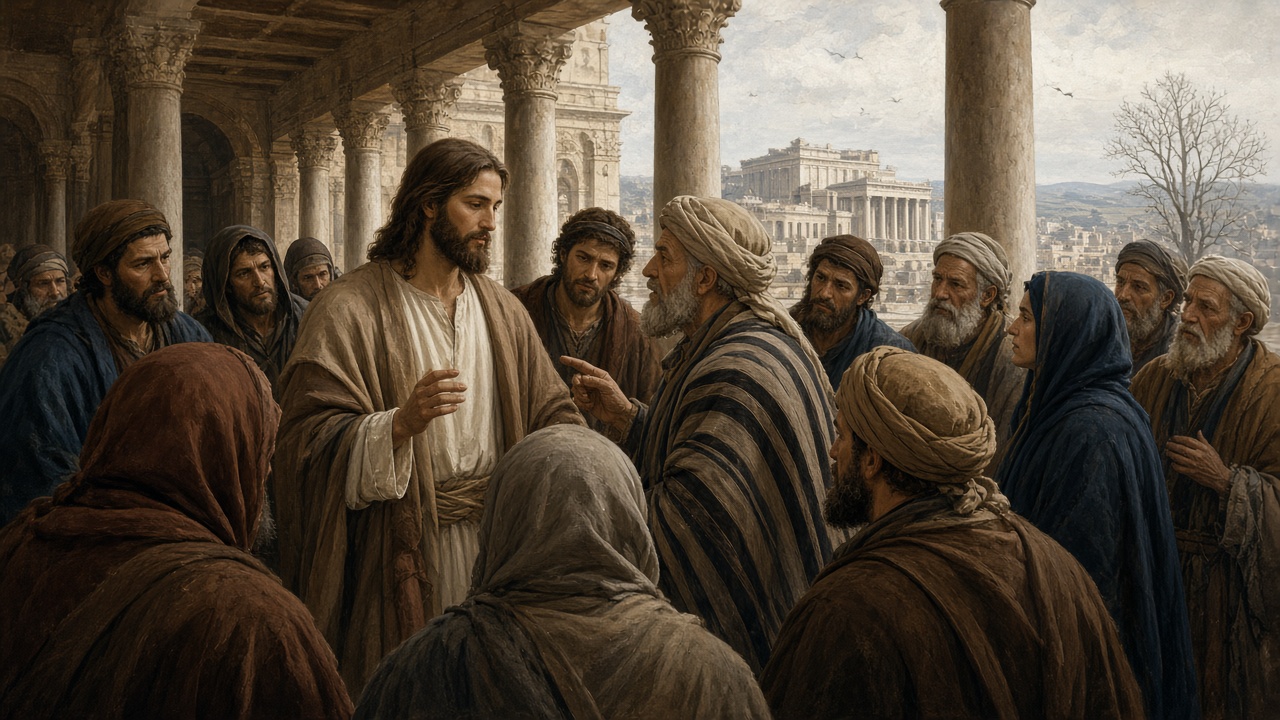
The Good Shepherd
- During the Feast of Dedication in Jerusalem it was winter, and Jesus was walking in the temple courts in Solomon's Colonnade. The name Jerusalem, in a dual form, means "possession of peace" or "foundation of peace"; that form probably refers to the mountains of Zion and Moriah, or, as some suppose, to the upper and lower city. Solomon's Hebrew name, Shelomoh, means "peaceful."Sources: the Bible text itself · Jerusalem · Solomon
- A chronology of Gospel events dates the Good Shepherd teaching to AD 29, and dates a time of teaching and healing from Perea to Jerusalem to AD 30.Sources: The Good Shepherd Teaching · Teaching and Healing in Perea to Jerusalem
- Jesus then went back across the Jordan to the place where John had first been baptizing, and many people there believed in him. John was of priestly descent: his father, Zacharias, was a priest of the course of Abia, and his mother, Elisabeth, was of the daughters of Aaron. His birth, six months before that of Jesus, was foretold by an angel; those who came said that John never performed a sign, yet everything he had said about Jesus was true.Sources: the Bible text itself · John the Baptist
Notes written with AI assistance from open sources (Theographic Bible Metadata, CC BY-SA 4.0; Easton’s Bible Dictionary, public domain) and reviewed before publishing.
Places in this chapter
- Jerusalem · 31.777, 35.234 · verse 22
- Solomon’s Portico · Today: in Jerusalem · 31.777, 35.234 · verse 23
- Jordan · Today: Jordan River · 31.761, 35.558 · verse 40
Only places identified with high confidence are shown (90% or more according to the scholarly sources compiled by OpenBible). Period map: DARE (Digital Atlas of the Roman Empire), CC BY 4.0; modern map: © OpenStreetMap contributors; places: OpenBible.info (CC BY 4.0).
Credits and license for this translation
Beibel: okanisi tongo
New Testament in Eastern Maroon Creole (NS:djk:Eastern Maroon Creole)
copyright © 2009 Wycliffe Bible Translators, Inc.
Language: Eastern Maroon Creole
Translation by: Wycliffe Bible Translators, Inc.
Eastern Maroon Creole
djk
Suriname
Copyright Information
© 2009, Wycliffe Bible Translators, Inc. All rights reserved.
This translation text is made available to you under the
terms of the Creative Commons License: Attribution-Noncommercial-No Derivative Works.
( http://creativecommons.org/licenses/by-nc-nd/3.0/ )
In addition, you have permission to port the text to different file formats, as long as you
do not change any of the text or punctuation of the Bible.
You may share, copy, distribute, transmit, and extract portions
or quotations from this work, provided that you include the above copyright
information:
You must give Attribution to the work.
You do not sell this work for a profit.
You do not make any derivative works that change any of the actual words or punctuation of the Scriptures.
Permissions beyond the scope of this license may be
available if you contact
us with your request.
The New Testament
in Eastern Maroon Creole
© 2009, Wycliffe Bible Translators, Inc. All rights reserved.
This translation is made available to you under the terms of the
Creative Commons Attribution-Noncommercial-No Derivatives license 4.0.
You may share and redistribute this Bible translation or extracts from it in any format, provided that:
You include the above copyright and source information.
You do not sell this work for a profit.
You do not change any of the words or punctuation of the Scriptures.
Pictures included with Scriptures and other documents on this site are licensed just for use with those Scriptures and documents.
For other uses, please contact the respective copyright owners.
2014-04-22
Source: http://ebible.org/djkNT/ · eBible.org