Genesis 13
Nǫ̀htsı̨̨ Nı̨̨htł'è · Tap a verse to see its cross-references.
Abram eyıts'ǫ wesah Lot
1Eyıt'à Abram edets'èkeè eyıts'ǫ t'asìı hazǫǫ̀ wets'ǫ sìı xè Egypt nèk'e gots'ǫǫ̀ nageèhde. Ekìı-ka nèk'e Negev gòyeh ekǫ ts'ǫ̀ agejà. Wesah Lot yexè at'ı̨. 2Abram sahzǫ̀ą eyıts'ǫ ejıe łǫ wets'ǫ ajà, sǫǫ̀mba degoo eyıts'ǫ sǫǫ̀mbaekwo łǫ wets'ǫ t'à dǫ ahxee whelı̨.
3Ekìı-ka nèk'e Negev gòyeh gots'ǫ hazǫǫ̀ ts'ǫ̀ wek'eèhoowo, eyı tł'axǫǫ̀ kǫ̀ta Bethel nǫ̀ǫtła. Eyı kǫ̀ta Bethel eyıts'ǫ kǫ̀ta Ayı wege wekǫ̀ k'è gòı̨ɂà ı̨lèe sìı ts'ǫ̀ anajà. 4Ekǫ t'aa t'akwełǫ̀ǫ̀ kwe ełeka nèyı̨ı̨wa t'à kwe-ladà whehtsı̨ ı̨lè. Abram eyı k'achı̨ Nǫ̀htsı̨ ghàsǫedı.
5Ekìıyeè k'e Lot edeɂeh Abram xè at'ı̨ ı̨lè. Ededı̨ sı sahzǫ̀ą, ejıe, eyıts'ǫ tł'ǫhbàa łǫ wets'ǫ. 6Hanìkò eyı dèè k'e ełexè nàgedèe sìı gıgha gòɂǫ-le agòjà. Sıì tıts'aàdìı łǫ gıts'ǫ t'à ełexè nàgedè ha dìì agòjà. 7Eyıt'à Abram wets'ǫ tıts'aàdìı-k'èdìı-dǫǫ̀, eyıts'ǫ Lot wets'ǫ tıts'aàdìı-k'èdìı-dǫǫ̀ ełeghǫgeet'ı̨į̀ agejà. Ekò k'e Kanan got'ı̨į̀ eyıts'ǫ Perız got'ı̨į̀ eyı nèk'e nàgedè ı̨lè.
8Eyıt'à Abram edesah Lot ts'ǫ̀ hadı, “Ełèot'ı̨ ats'ı̨ı̨t'e t'à ełek'èch'a ats'ııdì-le. Sets'ǫ tıts'aàdìı-k'èdìı-dǫǫ̀, eyıts'ǫ nets'ǫ tıts'aàdìı-k'èdìı-dǫǫ̀ ełek'èch'a hogıhtsį̀-le. 9Jǫ dèè haı̨hcho gonadąą̀ wheɂǫ hǫt'e. Ełets'ǫǫ̀ ats'ııde. Sa kàɂàa ts'ǫnèe anejà nı̨dè sı̨ dą̀ą ts'ǫnèe ahde ha. Ekò nı̨ dą̀ą ts'ǫnèe anejà nı̨dè sı̨ sa kàɂàa ts'ǫnèe ahde ha,” hadı.
10Lot kǫ̀ta Zoyar ts'ǫ̀ dèè hazǫǫ̀ k'e k'eet'į̀. Jordan deh nıɂàa gà dèè hazǫǫ̀ wek'e tı at'ı̨ t'à dèè nezı̨ı̨ wègaat'ı̨. Gots'ǫ̀ K'àowo wets'ǫ dèè-wèdaat'ı̨ı̨-k'è lanì xègaat'ı̨, Egypt nèk'e lanì xègaat'ı̨. (Gots'ǫ̀ K'àowo, kǫ̀godeè nàke Sodom eyıts'ǫ Gomorah gòyeh godıhòèhtsı̨ kwe hagǫ̀ht'e ı̨lè.) 11Lot sa kàɂàa ts'ǫnèe Jordan deh nıɂàa gà dèè hazǫǫ̀ edegha yį̀į̀hchì t'à ekǫ ts'ǫ̀ ajà. Eyıt'à Lot eyıts'ǫ Abram į̀łak'aà agejà. 12Abram Kanan nèk'e nàdè eyıts'ǫ wesah Lot Jordan deh nıɂàa gà kǫ̀ta gòlaa sìı gota nàdè. Kǫ̀ta Sodom gòyeh gà edenı̨hbàa nàı̨hgè. 13Dǫzhìı kǫ̀ta Sodom nàgedèe sìı hołı̨ı̨ nàowoò k'ę̀ę̀ geeda, gots'ǫ̀ K'àowo k'èch'a hołı̨ı̨ hogehtsı̨.
14Lot Abram ts'ǫǫ̀ naèhtła tł'axǫǫ̀ gots'ǫ̀ K'àowo Abram ts'ǫ̀ hadı, “Eyı nàąwo gots'ǫ yeè chı̨k'è ts'ǫ̀ k'eęt'į̀, sazı̨ nèk'e, sa kàɂàa eyıts'ǫ dą̀ą sı ts'ǫ̀ k'eęt'į̀. 15Dèè hazǫǫ̀ weghàı̨daa sìı nı̨ eyıts'ǫ nets'ıhɂǫ̀ǫ-dǫǫ̀ naxıghàehłe ha, welǫ whìle ts'ǫ̀ naxıghaelı̨ ha. 16Nets'ıhɂǫ̀ǫ-dǫǫ̀ dèè k'e ehtł'è lageètłǫ agehłe ha. Ehtł'è gıhtà ha dìì-le nı̨dè nets'ıhɂǫ̀ǫ-dǫǫ̀ sı gogıhtà ha dìì-le. 17Dıı dèè hazǫǫ̀ neghàehłe ha hǫt'e, eyıt'à dıı dèè hazǫǫ̀ wek'e k'eı̨tło,” gots'ǫ̀ K'àowo Abram ts'ǫ̀ hadı.
18Eyıt'à Abram edenı̨hbàa hazǫǫ̀ nàı̨wa. Hebron nèk'e Amor got'ı̨į̀ Mamer wets'ǫ ts'ı nechàa nàwheɂaa ts'ǫ̀ tàèhtła. Ekǫ gots'ǫ̀ K'àowo ts'ǫ̀ t'asìı k'eehk'ǫ̀ gha kwe ełeka nèyı̨ı̨wa t'à kwe-ladà whehtsı̨. Kǫ̀ta Hebron|src="HK00359B.TIF" size="span" ref="13.18"
Did you know?
Abram and Lot Separate
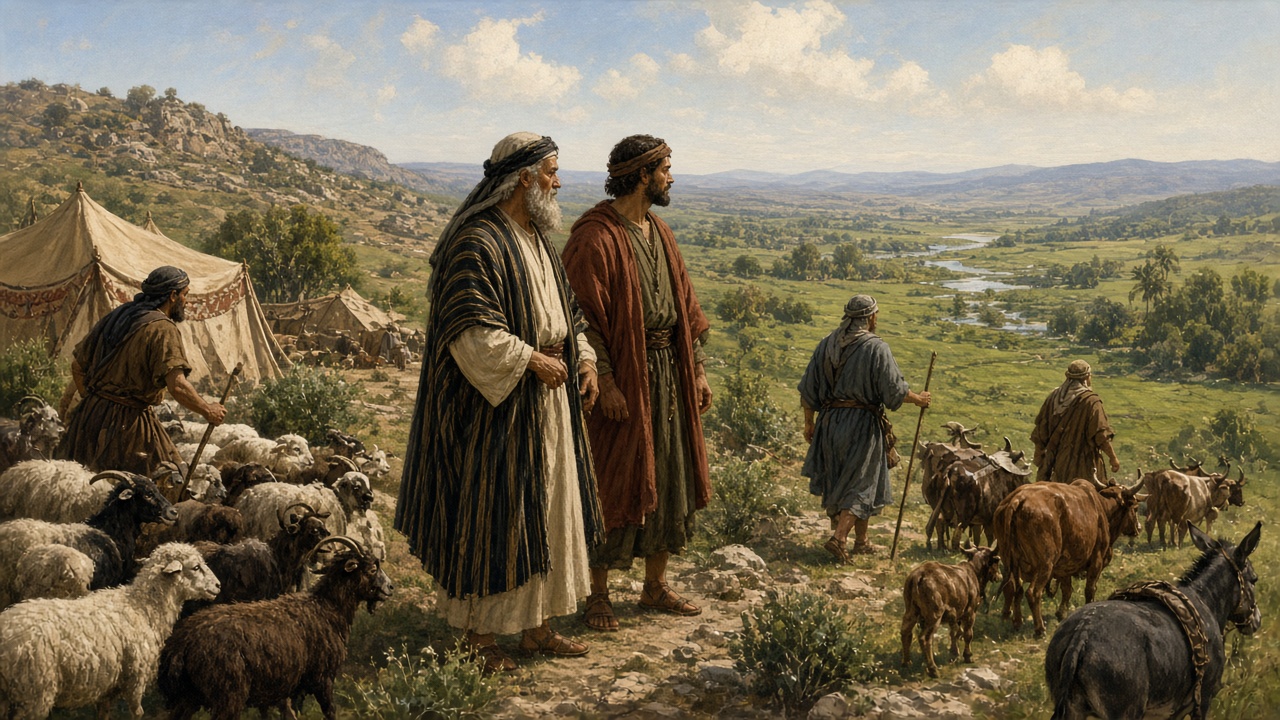
- Abram came up from Egypt into the Negev, the arid district south of Palestine through which the caravan route ran from central Palestine to Egypt, and traveled from place to place toward Bethel.Sources: Negeb · the Bible text itself
- He returned to the place between Bethel and Ai where his tent had stood and where he had built an altar, and there he called on the name of the LORD. Easton's Bible Dictionary (1897) describes Bethel, about ten miles north of Jerusalem, as originally the royal Canaanite city of Luz, and holds that the name Bethel was first given to a nearby sanctuary rather than to the city itself until the tribe of Ephraim conquered it. Ai was one of the royal Canaanite cities and lay to the east of Bethel.Sources: Bethel (of Palestine) · Ai · the Bible text itself
- Lot looked out and saw the plain of the Jordan, well watered all the way to Zoar like the garden of the LORD and like the land of Egypt. Easton's Bible Dictionary (1897) calls this the first historical notice of the Jordan, in the account of Abraham and Lot's separation, and places Sodom, toward which Lot pitched his tent, in the vale of Siddim. The chapter notes that the LORD had not yet destroyed Sodom and Gomorrah, a destruction the dictionary attributes to fire from heaven because of the city's wickedness.Sources: Plain of Jordan · Sodom · the Bible text itself
Notes written with AI assistance from open sources (Theographic Bible Metadata, CC BY-SA 4.0; Easton’s Bible Dictionary, public domain) and reviewed before publishing.
Places in this chapter
- Egypt · 30.129, 31.308 · verses 1, 10
- Negeb · 31.245, 34.841 · verses 1, 3
- Jordan Valley · 32.317, 35.570 · verses 10, 11, 12
- Canaan · 32.767, 35.333 · verse 12
- Hebron · Today: Tel Rumeida · 31.525, 35.102 · verse 18
Only places identified with high confidence are shown (90% or more according to the scholarly sources compiled by OpenBible). Period map: DARE (Digital Atlas of the Roman Empire), CC BY 4.0; modern map: © OpenStreetMap contributors; places: OpenBible.info (CC BY 4.0).
Credits and license for this translation
Nǫ̀htsı̨̨ Nı̨̨htł'è
Dogrib: Dogrib Genesis & New Testament New Testament & Portions of Old Testament
copyright © 2009 Canadian Bible Society
Language: Dogrib
Translation by: Canadian Bible Society
Tłı̨chǫ Genesis and New Testament
About Tłı̨chǫ
Tłı̨chǫ (Dogrib) is a Na-Dene (Athabaskan) language. It is spoken by the First Nations Tłı̨chǫ people in the Northwest Territories in Canada. It has the largest number of speakers of any of the Aboriginal language communities in the NWT, and is one of the official languages of the Northwest Territories.
About This Translation
This translation includes the book of Genesis and the New Testament in Tłı̨chǫ. The first edition of the Tłı̨chǫ New Testament was published in 2003. It was a historic event, as it was the first time in more than a hundred years that a complete New Testament was published for one of the Dene First Nations in the Territories. The first edition was well received and quickly sold out. In the meantime the book of Genesis had been completed. Consequently, the 2008 reprint of the Tłı̨chǫ New Testament included Genesis.
Though this translation of the New Testament and Genesis took a total of ten years, the people who worked on it built on years of labor invested by the Tłı̨chǫ people, elders, priests and missionaries, translators, educators, and linguists. The material contained in this book was checked and approved by consultants from Wycliffe Bible Translators and the Canadian Bible Society.
If you are interested in obtaining a printed copy of this Bible, please contact the Canadian Bible Society at http://www.biblescanada.com .
Copyright Information
Dogrib Genesis and New Testament © 2003, 2008 Canadian Bible Society
The text of the Bible in Tłı̨chǫ that appears in this electronic format or website is for personal use only.
Up to five hundred (500) verses of the Bible text in any form (written, visual, electronic or audio) may be quoted without permission. The quoted verses may not be more than 50% of a complete book of the Bible, or more than 25% of the total text of the work in which they are quoted. Prior written permission must be obtained for any other use of the text. Copyright acknowledgement must in all cases appear on the title or copyright page.
For more information on copyright conditions or to apply, visit http://www.biblesociety.ca/copyright .
This translation is made available to you under the terms of the
Creative Commons Attribution-Noncommercial-No Derivatives license 4.0.
You may share and redistribute this Bible translation or extracts from it in any format, provided that:
You include the above copyright and source information.
You do not sell this work for a profit.
You do not change any of the words or punctuation of the Scriptures.
Pictures included with Scriptures and other documents on this site are licensed just for use with those Scriptures and documents.
For other uses, please contact the respective copyright owners.
2014-04-22
Source: http://ebible.org/dgrDOGNT/ · eBible.org