1 Kings 1
Las Escrituras en Ashéninka Ucayali del Sur del Perú · Tap a verse to see its cross-references.

About this book
About 1 Kings
- Easton's Bible Dictionary (1897) treats the authorship of the books of Kings as uncertain. A tradition that Jeremiah wrote them is, in Easton's view, supported by passages almost identical with parts of Jeremiah and by events Jeremiah knew personally, yet Easton thinks it more probable that Ezra, after the Captivity, compiled the books from earlier documents, perhaps written by David, Solomon, Nathan, Gad, and Iddo. Easton dates the composition between 561 B.C., when Jehoiachin was released from captivity by Evil-merodach, and 538 B.C., the decree of Cyrus.Sources: Easton: Kings, The Books of
- Easton says these books contain the annals of the kingdom from Solomon's accession until Nebuchadnezzar and the Babylonians subdued it, a period he estimates at about 453 years. 1 Kings opens while David is dying: Adonijah, his fourth son, who had become heir-apparent to the throne after the deaths of Amnon and Absalom, has himself proclaimed king, but Nathan and Bathsheba persuade David to enthrone Solomon at once. Solomon, David's son by Bathsheba, whose history is recorded in 1 Kings 1-11, came to the throne, Easton suggests, at about sixteen or eighteen.Sources: Easton: Kings, The Books of · Adonijah · Solomon
- In the Hebrew Scriptures the two books of Kings originally formed one book; the Septuagint first divided them and, with the Vulgate, numbers them as the third and fourth books of Kings, the books of Samuel being the first and second. Easton notes that Chronicles gives greater prominence to the priestly or Levitical office, while Kings gives greater prominence to the royal office, and that in the threefold division of the Scriptures by the Jews these books are ranked among the Prophets. The narrative points to earlier sources: the book of the acts of Solomon and the chronicles of the kings of Judah and of Israel.Sources: Easton: Kings, The Books of
- After Solomon's death the ten tribes revolted and invited Jeroboam, son of Nebat, to be their king; Easton calls him the first king of those tribes and dates his reign from 976 to 945 B.C. He had fled to Egypt under the protection of Shishak I, and later moved his residence from Shechem, his first capital, to Tirzah, which remained the chief residence of Israel's kings until Omri bought the hill of Shomeron from Shemer for two talents of silver and built Samaria. The later narrative includes Ahab, Omri's son and the seventh king of Israel, whose wife was Jezebel: to the calf worship introduced by Jeroboam he added the worship of Baal, and he was severely admonished by the prophet Elijah.Sources: Jeroboam · Tirzah · Samaria · Ahab
Notes written with AI assistance from open sources (Theographic Bible Metadata, CC BY-SA 4.0; Easton’s Bible Dictionary, public domain) and reviewed before publishing.
Kaatapaaki ipinkatharitzi David
1Tema antari-pero-tapaaki pinkathari David, oshekitaki rojarentsite. Ipewiryaa-kowiteetari osheki iithaari, teemaeta ijaawatzi. 2Ikantakiri romperatani: “¡Pinkatharí! ¿Pikoyi naminemi ewankawo? Rootaki aminemini, opashikaemi, otsipatemi pimayi ojaawantemi.” 3Jataki ithotyaakotzi kamethaa-nikiro ewankawo maawoeni inampiki Israel-paeni. Iñaaki ewankawo iitachari Abisag poñaachari Apimakoryaariniki. Rootaki ramakiniriri pinkathari. 4Maperori okamethaa-nikitzi Abisag. Rootaki aminapaa-kiniriri okaatzi ikowayi-tziri pinkathari, teemaeta iinantawo.
32Opoñaashita ikantaki pinkathari David: “Pikaeminari Ompera-tajorentsitaa-rewo Sadoc, Kamantan-taniri Natán, Benaía itomi Joiada.” Ari ipokaeyakini rirori iñiiri pinkathari. 33Ikantawakiri: “¡Nosheninká! Pitsipa-tanakyaari nomperatani-paeni, ikyaakae-yaari nopira notyomi Salomón, paanakiri Shipopo-shaariniki. 34Eeroka Sadoc Ompera-tajorentsitaa-rewo eejatzi Kamantan-taniri Natán, pijee-patzii-toteri notyomi Salomón omatant-yaari ipinkathari-wenteeri asheninka-paeni Israel-paeni. Pitziwooteeyini janta, pikaemaeyini eejatzi, pikante: ‘¡Irikawé pinkathari Salomón!’ 35Ompoñaashitya poyaatee-yirini itaapiiki aririka ipiyee, roojatzi ijeekan-tapaa-kyaari nowinkathari-mentoki, tema riitaki poyaateenani. Tema riitaki niyoshii-takiri ipinkathari-wenteeri asheninka-paeni Judá-paeni, eejatzi itsipapaeni Israel-paeni.” 36Ari rakanaki Benaía itomi Joiada, ikantzi: “¡Pinkatharí! Aritaki okantyaari. Riitaki Pitajorentsite nintakaan-tzirori. 37Riitaki Tajorentsi tsipata-piintakimiri eeroka, okantashitzimaetya ari ikimitzitaiyaari eejatzi Salomón, ikantakae-yaawo imaperotero ipinkatharitee rirori.”
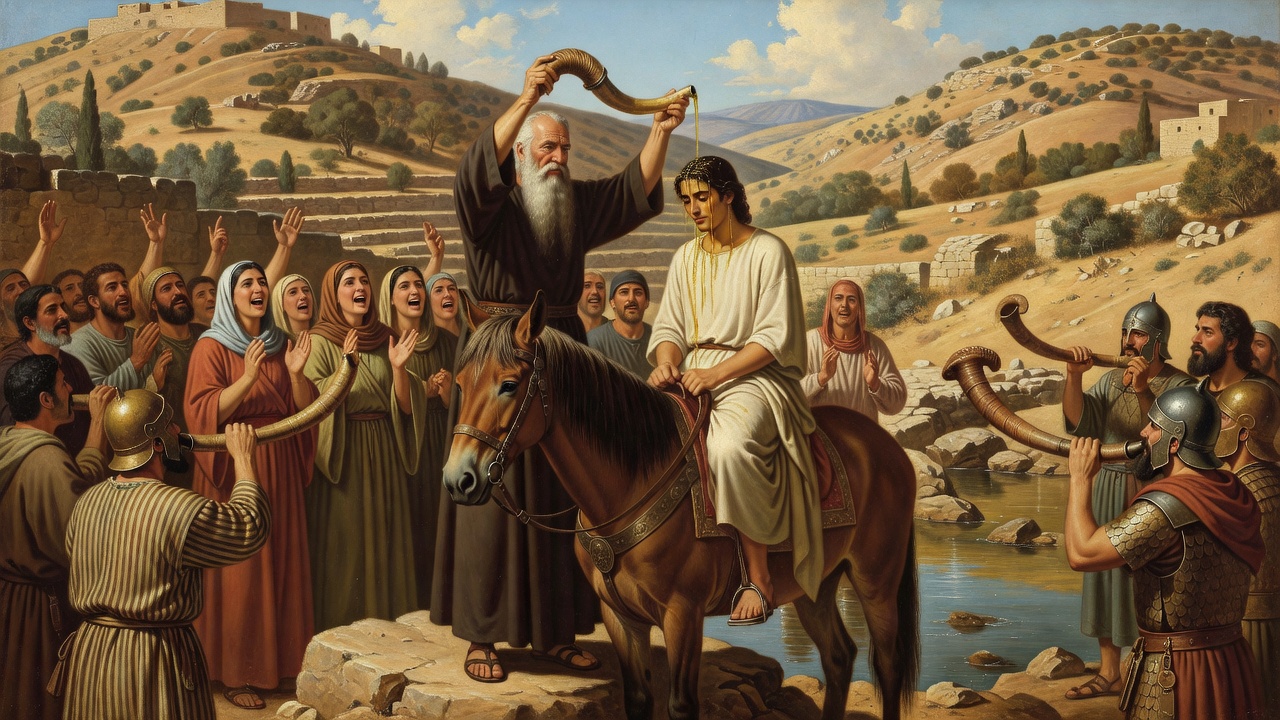
38Ikanta Ompera-tajorentsitaa-rewo Sadoc, Kamantan-taniri Natán, Benaía itomi Joiada, Peyakaa-shitaniri-paeni, Akoryantzi-paeni, ikyaakotanakari Salomón ipiraki pinkathari David, raanakiri Shipopo-shaariniki. 39Ari raaki Ompera-tajorentsitaa-rewo Sadoc waakapa eejatzi yeenkantsi, jeekatsiri tajorentsi-thaanteki, ijeepatzii-totakiri Salomón. Ari ikaatzi itziwootee-yanakini maawoeni janta, ikaemae-yanakini ikanteeyini: “¡Irikawé pinkathari Salomón!”
Did you know?
The Succession to David's Throne
- As David's oldest surviving son after the deaths of Amnon and Absalom, Adonijah claimed the royal succession, backed by the military commander Joab and the high priest Abiathar. However, David chose his younger son Solomon, who was supported by the prophet Nathan, the priest Zadok, and the royal bodyguard under Benaiah.Sources: Adonijah · Solomon · the Bible text itself
- Riding the king's own mule was a decisive public declaration of royal authority. By David's explicit instruction, Solomon was escorted down to the spring of Gihon, where Zadok anointed him king with oil taken from the tabernacle to the sound of ram's horns and popular celebration.Sources: Gihon · Zadok · the Bible text itself
- Upon hearing of Solomon's public coronation, Adonijah fled in terror and sought asylum by taking hold of the horns of the sacrificial altar. Solomon granted him conditional clemency, sparing his life so long as he proved himself a worthy man.Sources: Adonijah · the Bible text itself
Notes written with AI assistance from open sources (Theographic Bible Metadata, CC BY-SA 4.0; Easton’s Bible Dictionary, public domain) and reviewed before publishing.
Places in this chapter
- Shunem · Today: Sulam · 32.606, 35.334 · verse 3
- Serpent’s Stone · Today: within 100 m of Bir Ayub · 31.767, 35.236 · verse 9
- Gihon · Today: Gihon Spring · 31.773, 35.236 · verses 33, 38, 44, 45
- Jerusalem · 31.777, 35.234 · verse 40
Only places identified with high confidence are shown (90% or more according to the scholarly sources compiled by OpenBible). Period map: DARE (Digital Atlas of the Roman Empire), CC BY 4.0; modern map: © OpenStreetMap contributors; places: OpenBible.info (CC BY 4.0).
Credits and license for this translation
Las Escrituras en Ashéninka Ucayali del Sur del Perú
The Holy Bible in the South Ucayali Ashéninka language of Peru
Las Escrituras en Ashéninka Ucayali del Sur del Perú
copyright © 2008 Wycliffe Bible Translators, Inc.
Language: Ashéninka Ucayali del Sur (Ashéninka, South Ucayali)
Translation by: Wycliffe Bible Translators
This translation is made available to you under the terms of the
Creative Commons Attribution-Noncommercial-No Derivatives license 4.0.
You may share and redistribute this Bible translation or extracts from it in any format, provided that:
You include the above copyright and source information.
You do not sell this work for a profit.
You do not change any of the words or punctuation of the Scriptures.
Pictures included with Scriptures and other documents on this site are licensed just for use with those Scriptures and documents.
For other uses, please contact the respective copyright owners.
2016-06-08
Source: http://ebible.org/cpy/ · eBible.org