Zephaniah 1
Paipel · Tap a verse to see its cross-references.
About this book
About Zephaniah
- Easton's Bible Dictionary (1897) presents Zephaniah, whose name it explains as "Jehovah has concealed" or "Jehovah of darkness," as the son of Cushi and great-grandson of Hezekiah, and as the ninth of the minor prophets. It dates his prophecy to the reign of Josiah, king of Judah (641–610 B.C.), and says he was contemporary with Jeremiah, with whom he had much in common.Sources: Easton: Zephaniah · Zephaniah · Cushi
- Amon, Josiah's father, restored idolatry in Judah, and Easton reads Zephaniah 1:4 and 3:4, 11 as referring to that reign. The same dictionary links Zephaniah 1:4–6 with the worship of Baal and Zephaniah 1:5 with Malcham, described as the national idol of the Ammonites. Josiah, who came to the throne at eight, is presented as later acting against the idolatry that prevailed.Sources: Amon · Josiah · Baal · Malcham
- Easton's Bible Dictionary outlines the book as an introduction announcing judgment on the world and on Israel because of their transgressions (1:1–6), a description of the judgment (1:7–18), an exhortation to seek God while there is still time (2:1–3), judgment on other peoples (2:4–15), what it calls the hopeless misery of Jerusalem (3:1–7), and a promise of salvation (3:8–20).Sources: Easton: Zephaniah
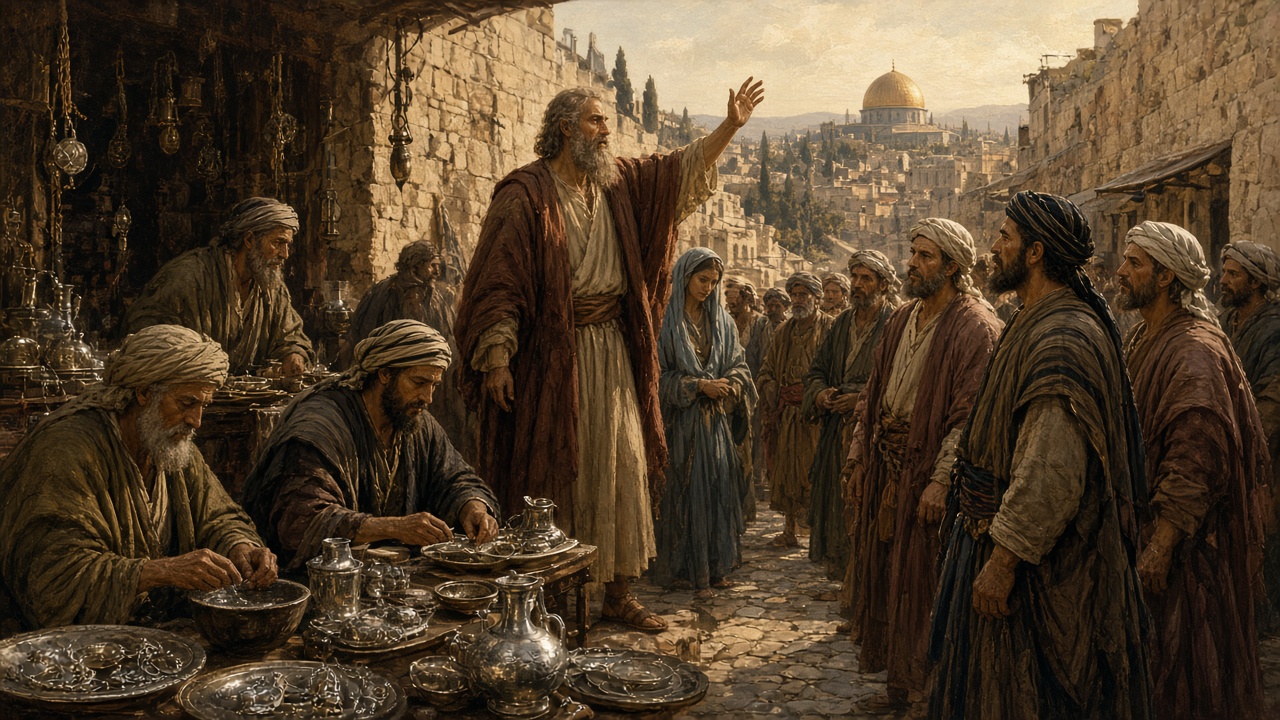
- Zephaniah 1:11 names the Mortar, a place in or near Jerusalem inhabited by silver merchants. It has been conjectured that this was the Phoenician quarter of the city, where traders of that nation lived.Sources: Mortar
Notes written with AI assistance from open sources (Theographic Bible Metadata, CC BY-SA 4.0; Easton’s Bible Dictionary, public domain) and reviewed before publishing.
Ewe ränin än Kot apwüng
1Iei alon ewe Samol mi Lapalap ngeni Sefanaia nöün Kusi we mwän. Kusi nöün Ketalia, Ketalia nöün Amaria, nge Amaria nöün Hiskia. Ei a fis lon mwün Josia ewe kingen Juta nöün Amon we mwän.
2Iei alon ewe Samol mi Lapalap, “Ngang üpwe wesewesen ataela mettoch meinisin won fanüfan. 3Üpwe niela aramas me man, ekewe mansüsü me ekewe ikenen leset. Üpwe asapwilätiu ekewe aramasangau o ärala aramas meinisin seni won fanüfan. Ngang ewe Samol mi Lapalap üa kapas. 4Üpwe apwüngü chon Juta me chon Jerusalem meinisin. Üpwe ärala seni ei leni mine a chüen fis ren angangen fel ngeni Paal, üpwe pwal arosala ekewe souasor mi angang ngeni anümwäl. 5Üpwe ärala chokewe mi fel ngeni akkar me maram me ekewe fü me won ekewe imw. Üpwe pwal ärala chokewe mi fel ngeniei o eäni itei lon ar pwon fän akapel, nge ra pwal eäni iten ewe kot Milkom lon ar pwon fän akapel. 6Üpwe ärala chokewe mi kul seni ar tapwela müri, chokewe resap küttaei ika resap angei öüröürer me rei.”
7Oupwe mosonosonola fän mesen Kot ewe Samol mi Lapalap. Pun ränin ewe Samol mi Lapalap a arapoto. A amolätä eu asor o apini chokewe a körireto. 8Iei alon ewe Samol mi Lapalap, “Lon ewe ränin asor üpwe apwüngü ekewe meilap me nöün ewe king kewe mwän, pwal meinisin mi föri örünien chon ekis. 9Üpwe pwal apwüngü ir meinisin mi eäni fel lon lapalapen chon lükün, pwal chokewe mi solä o nimanauei aramas pwe repwe aura imwen ar kot ren mine ra angei seniir.”
10Iei alon ewe Samol mi Lapalap, “Lon ewe rän aramas repwe rongorong eu puchör seni ewe Asamalapen Ik me lon Jerusalem, eu ngüngüres seni ewe kinikin söfö me lon ewe telinimw me eu ngüngün ta mi leüömong seni ekewe chukutekison. 11Oupwe ngüngüres ämi mi imweimw lon kinikinin ewe telinimw me fan, pun ekewe chon amömö meinisin repwe rosola, nge ekewe chon kiloni silifer repwe ärela. 12Lon ewe fansoun üpwe chosani Jerusalem fän eu lamp. Üpwe apwüngü ekewe mwän mi menemen ren püsin ar tufich o lükü püsin ir, ir chokewe mi ekieki lon leluker, ‘Ewe Samol mi Lapalap esap föri och mi mürina, esap pwal föri och mi ngau.’ 13Aramas repwe soläni ar kewe pisek, nge imwer kewe repwe tala. Inamwo ika ra aüetä imwer, resap fokun nonom lor. Inamwo ika ra fotuki tanipin wain, resap fokun ün wain seniir.”
14Ewe rän mi lap, ränin ewe Samol mi Lapalap a arapoto, a arapoto o müttirito. Oupwe rong! Ränin ewe Samol mi Lapalap epwe eu rän mi weires. Pwal ekewe mwän mi pwora repwe leüömong le puchörüngau. 15Ewe rän epwe eu ränin lingeringer, eu ränin riaföü me niuokus, eu ränin tatakis me feiengau, eu ränin rochopwak me toputop, eu ränin kuchuchu me rochokichin rochopwak, 16epwe pwal eu ränin tikin rappwa me puchörün maun, lupwen ekewe sounfiu repwe maun ngeni ekewe telinimw mi pöchökül tittir me ekewe imw tekia mi nom lon ekewe pwokuku.
17Iei alon ewe Samol mi Lapalap, “Üpwe atoto riaföü won aramas pwe repwe fetal usun chon chun pokiten ar tipis ngeniei. Char epwe ninitiu usun chök koluk, nge fituker epwe toropas usun chök kiten mongö.” 18Sap ar silifer ika ar kolt epwe tongeni angaseer lon ewe ränin än ewe Samol mi Lapalap lingeringer. Unusen fanüfan epwe karala ren ekkeiin an lingeringer, pun epwe müttir le awesi manauen chon fanüfan meinisin.
Did you know?
The Day of the LORD and Judgment on Idolatry
- Zephaniah traces his lineage back four generations to Hezekiah, dating his prophetic ministry to the reign of King Josiah of Judah. Josiah came to power after his father, King Amon, had restored idolatry across Judah before being assassinated by his own servants.Sources: the Bible text itself · Josiah · Amon · Hizkiah
- The chapter denounces religious syncretism in Jerusalem, where people bowed on rooftops to the host of heaven and combined their devotion to the LORD with oaths to Baal and Malcham, the national idol of the Ammonites.Sources: the Bible text itself · Baal · Malcham
- The prophecy specifies landmarks in Jerusalem that would experience turmoil, including the Fish Gate and the Mortar (or Hollow), a district inhabited by merchants who weighed out silver.Sources: the Bible text itself · Fish Gate · Mortar
Notes written with AI assistance from open sources (Theographic Bible Metadata, CC BY-SA 4.0; Easton’s Bible Dictionary, public domain) and reviewed before publishing.
Places in this chapter
- Jerusalem · 31.777, 35.234 · verses 4, 12
- Fish Gate · Today: in Jerusalem · 31.777, 35.234 · verse 10
- Second Quarter · Today: in Jerusalem · 31.777, 35.234 · verse 10
- Canaan · 32.767, 35.333 · verse 11
- Mortar · Today: in Jerusalem · 31.777, 35.234 · verse 11
Only places identified with high confidence are shown (90% or more according to the scholarly sources compiled by OpenBible). Period map: DARE (Digital Atlas of the Roman Empire), CC BY 4.0; modern map: © OpenStreetMap contributors; places: OpenBible.info (CC BY 4.0).
Credits and license for this translation
Paipel
The Holy Bible in the Chuukese language of the Federated States of Micronesia
copyright © 1984, 1989, 1991, 2001 Liebenzel Mission
Language: Chuukese
Translation by: Liebenzell Mission
Old Testament © 1989, 2001 Liebenzel Mission
New Testament © 1984, 1991 Liebenzel Mission
This translation is made available to you under the terms of the
Creative Commons Attribution-No Derivatives license 4.0.
You may share and redistribute this Bible translation or extracts from it in any format, provided that:
You include the above copyright and source information.
You do not make any derivative works that change any of the actual words or punctuation of the Scriptures.
Pictures included with Scriptures and other documents on this site are licensed just for use with those Scriptures and documents.
For other uses, please contact the respective copyright owners.
2024-01-24
Source: http://ebible.org/chk/ · eBible.org