Job 30
Paipel · Tap a verse to see its cross-references.
Hiop a ngüngüres pokiten an nonom lon riaföü
1“Nge iei, ekewe mwän mi ierkükün fai ra urumwoteei.
Semelaper kewe ra aücheangau me rei
pwe üsap mwo nge mwüt ngeniir ar repwe nom ren nei kewe kolak
le tümwünü nei kewe pwiin sip.
2Met lomoten pöchökülen pöür ngeniei?
Pun ir mwän mi apwangapwang.
3Ra asüngürü waren ekewe irä lon fanüapö,
ra fokun kichüchü pokiten ar mwelele me echik.
4Ra fichi chön ewe irä malow me chön ekewe sokopaten irä pwe ener mongö,
ra pwal eni waren ewe irä pirum.
5Aramas ra asürela me leir,
ra puchörula müriir usun ar puchörula mürin eman chon solä.
6Ra imweimw won palen ekewe lemol,
lon pwangen pwül me pwangen achau.
7Ra wörüwör me lein ekewe irän lemäl
o achachachfengen fän ewe irä lantana.
8Ir nöün chokewe esap wor lomoter,
eu mwichen aramas esap wor iter.
Aramas ra fen asürela seni lon ewe fanü.
9Nge iei ir ra kölüei lon ar kölün turunufas
o leaweniei lon ar kapasen ämängau.
10Ra nioput ngang o nonom toau seniei,
resap mwo nge säw le atufolong lon mesei.
11Pokiten Kot a apwangapwangaei o atekisonaei,
iei mine resap chüen meninitiei.
12Eu mwichen aramas mi akürang a fiu ngeniei me pelifichi.
Ra iseis eu sär fän iten pechei
o senätä ar ororen maun pwe repwe afeiengauaei.
13Ra pinei ai al, pwe üsap tongeni sü,
o awattelai ai feiengau, nge esap wor eman a apetiir.
14Ra tolong usun chök ar tolong lon eu pwang mi chölap,
ra afawunoto woi me lein ekewe leni mi tala.
15Eniweniw a pwölüeila,
ai iteüöch a sü seniei usun asepwäl a ässala mettoch,
wöüi a feil seniei usun eu kuchu.
16Nge iei üa arap ngeni mäla,
esap wor ai ngasala seni riaföü.
17Lepwin chüi ra cheuch,
ai metek mi weichin esap ükütiu.
18Kot a turufi üfei fän pöchökül mi lapalap,
a angütü pöün won üei usun kalan üfei sööch.
19Kot a aturueilong lon ewe pwakak,
üa wewe ngeni pwül moromor me falang.
20Üa siö ngonuk, ai Kot, nge kosap pälüeniei,
lupwen üa iotek ngonuk, kosap afäliei.
21Ka kulitiei o fokun ariaföüüei,
ka afeiengauaei ren pöchökülen poum.
22Ka uweeitä lon asepwäl o föri pwe üpwe ässila,
ka pönieila ren eu mölümöl.
23Ewer, üa silei pwe kopwe emweniei ngeni mäla,
ngeni ewe leni mi kefilitä fän iten chon manau meinisin.
24Ifa usun, eman aramas mi kokotiu lon riaföü esap aitietä pöün
o siö pwe eman epwe alisi lon an feiengau?
25Ifa usun, üsap kechüeiti ätewe mi nom lon riaföü?
Ifa usun, üsap letipeta fän iten ekewe chon wöüngau?
26Nge lupwen ngang üa asüküsükü feiöch, feiengau a toriei.
Lupwen üa witiwiti saram, rochopwak a toriei.
27Lelukei a fitikoko, nge esap manasösö,
iteiten rän ai riaföü a chök lapala.
28Üa fetalfeil fän letipeta, nge esap wor ai chip.
Üa ütä lein ewe mwichen aramas o siö pwe eman epwe alisiei.
29Üa pwiini ekewe kolak mi mwacho,
üa chiechi ngeni ekewe fukuro.
30Ünüchei a cholola o säre seniei,
inisi a fokun pwichikar.
31Tikin nei ükülele a wiliti kölün letipeta,
nge tikin nei aangün a wiliti ngingin kechü.”
Did you know?
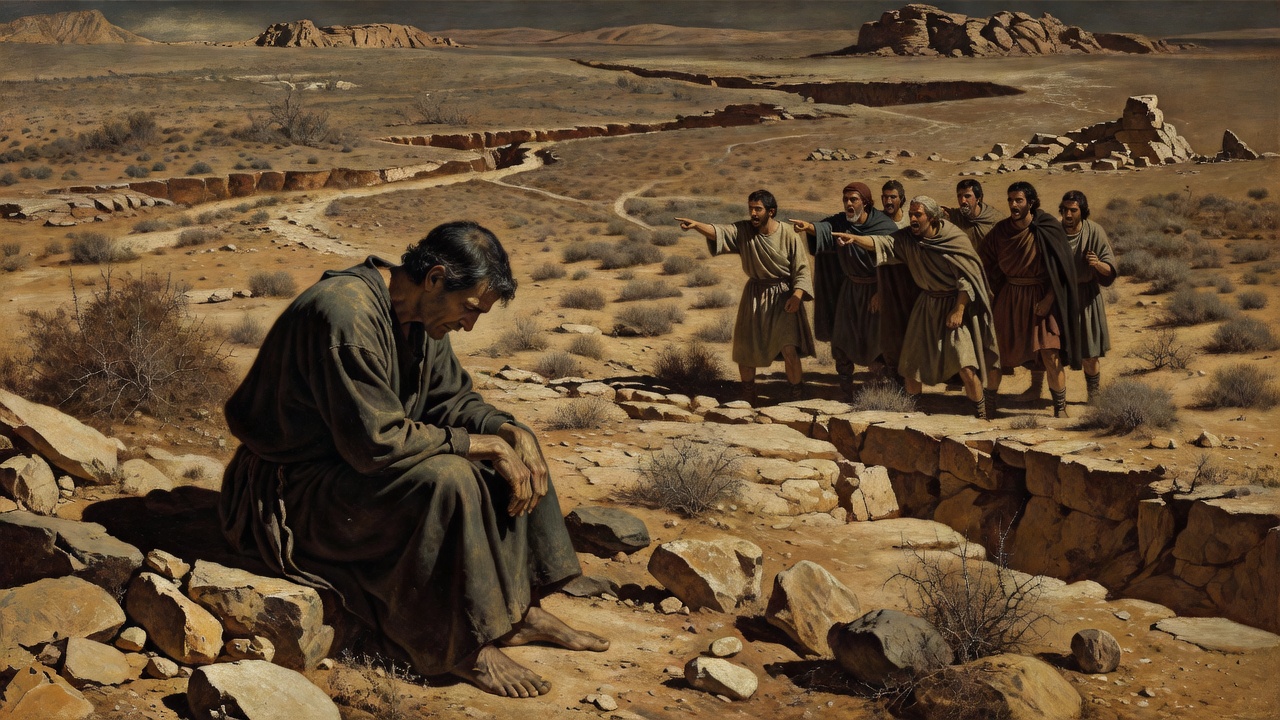
Humiliation, Physical Suffering, and Desert Outcasts
- In this chapter, Job contrasts his previous social standing with his current humiliation at the hands of impoverished outcasts. He describes these men as surviving on the margins of society, foraging for wild mallow and broom tree roots in desolate wadis and rock hollows.Sources: the Bible text itself
- Job uses vivid siege metaphors, picturing his attackers as an advancing army laying ramps and breaking through breaches against him, while he endures severe physical afflictions such as fever, gnawing pain, and blackened, peeling skin.Sources: the Bible text itself
- To convey the isolation and intensity of his grief, Job identifies with the mournful sounds of wilderness creatures, calling himself a companion to jackals and ostriches, while his musical instruments—the harp and flute—are turned entirely to weeping.Sources: the Bible text itself
Notes written with AI assistance from open sources (Theographic Bible Metadata, CC BY-SA 4.0; Easton’s Bible Dictionary, public domain) and reviewed before publishing.
Credits and license for this translation
Paipel
The Holy Bible in the Chuukese language of the Federated States of Micronesia
copyright © 1984, 1989, 1991, 2001 Liebenzel Mission
Language: Chuukese
Translation by: Liebenzell Mission
Old Testament © 1989, 2001 Liebenzel Mission
New Testament © 1984, 1991 Liebenzel Mission
This translation is made available to you under the terms of the
Creative Commons Attribution-No Derivatives license 4.0.
You may share and redistribute this Bible translation or extracts from it in any format, provided that:
You include the above copyright and source information.
You do not make any derivative works that change any of the actual words or punctuation of the Scriptures.
Pictures included with Scriptures and other documents on this site are licensed just for use with those Scriptures and documents.
For other uses, please contact the respective copyright owners.
2024-01-24
Source: http://ebible.org/chk/ · eBible.org