Job 28
Paipel · Tap a verse to see its cross-references.
Aramas ra küttafesifesi tipachem
1“Ellet mi wor eu lenien silifer fän pwül,
mi pwal wor eu leni ia aramas ra limeti kolt ie.
2Aramas ra atowu mächä seni fän pwül,
ra pwal eteli kapa mi nofitfengen me fau pwe repwe imwüfesen.
3Aramas ra awesi rochopwak,
lupwen ra tötiu epin fanüfan,
pwe repwe tuw ekewe fau lon ewe lenien rochokichin rochopwak.
4Ra tuw pwang mi alolol lon ekewe lemol.
Ikkei ekewe leni aramas resap feila ngeni,
pun ra toau seni ewe ia aramas ra nom ie.
Ra fisenitiu won säl lon ekewe pwang o likamwaüchfeil.
5Irän mongö ra märitä won pwül,
nge fan a fis tatakis usun ekkei a atai mettoch.
6Ekewe fau aüchea iter safaia ra nom lon ekewe fau,
mi pwal wor moromoren kolt lon ewe pwül.
7Esap wor eman machang mi mwacho a silei ewe al mi aletiu fan,
pwal ewe machang itan falkon esap fen küna.
8Ekewe manmwacho mi pwora resap fetal won,
esap pwal wor eman laion epwe pwerela won.
9Aramas ra amökkü ekewe achau mi fokun pöchökül
o tuw ekewe chuk pwe epwe pwä lepopur.
10Ra tuw al lon ekewe achau
o küna mettoch mi fokun aüchea.
11Ra pinei michchin ekewe koluk pwe resap mich,
o pwärawu ekewe mettoch mi monomon lon saram.
12Nge ia sipwe küna me ie tipachem?
Ia sia tongeni kaiö weweöch me ie?
13Aramas resap silei aüchean tipachem,
esap wor eman a tongeni küna me lon fanüen ekewe mi manau.
14Ewe leni mi alolol a apasa, ‘Tipachem esap nom loi,’
nge matau a apasa, ‘Esap nom rei.’
15Sisap tongeni kamö ren kolt ika liwini ngeni silifer.
16Tipachem a kon aüchea seni ewe kolt seni Ofair
me ekewe fau aüchea iter oniks me safaia.
17Kolt me kilas mi aüchea resap wewe ngeni aüchean tipachem,
fout seni kolt mi mürina esap tongeni akasiwil ngeni.
18Sisap tongeni awewe ngeni tipachem eengin leset ika kilas mi molupolup,
liwinin a lap seni liwinin föün pwei.
19Ewe fau aüchea itan topas seni Itiopia esap tongeni wewe ngeni,
tipachem a kon aüchea seni kolt mi mürina.
20Ian chök tipachem a feito me ie?
Nge ifa lenien ach kaiö weweöch?
21A opola seni mesen mönümanau meinisin
o monola seni ekewe machangen failäng.
22Ewe leni mi alolol me mäla ra apasa,
‘Äm aia chök rongorong püngöpüngan.’
23Kot echök a silei ewe al ngeni tipachem,
i a silei lenian.
24Pun a nenengeni lesopun fanüfan
o küna mettoch meinisin mi nom failäng.
25Lupwen Kot a awora ngeni asepwäl an pöchökül
o aükü ekewe matau ngeni ükükün,
26lupwen a föri allük fän iten püngün üt
o awora efoch al fän iten fifi me chopulap,
27iei otun a küna tipachem o pwärätä usun,
a anüküchara o aükü alololun.
28Nge a üreni aramas, ‘Ämi niuokusiti ewe Samol iei tipachem,
nge ämi sü seni mine a ngau iei weweöch.’”
Did you know?
The Mining of Treasures and the Value of Wisdom
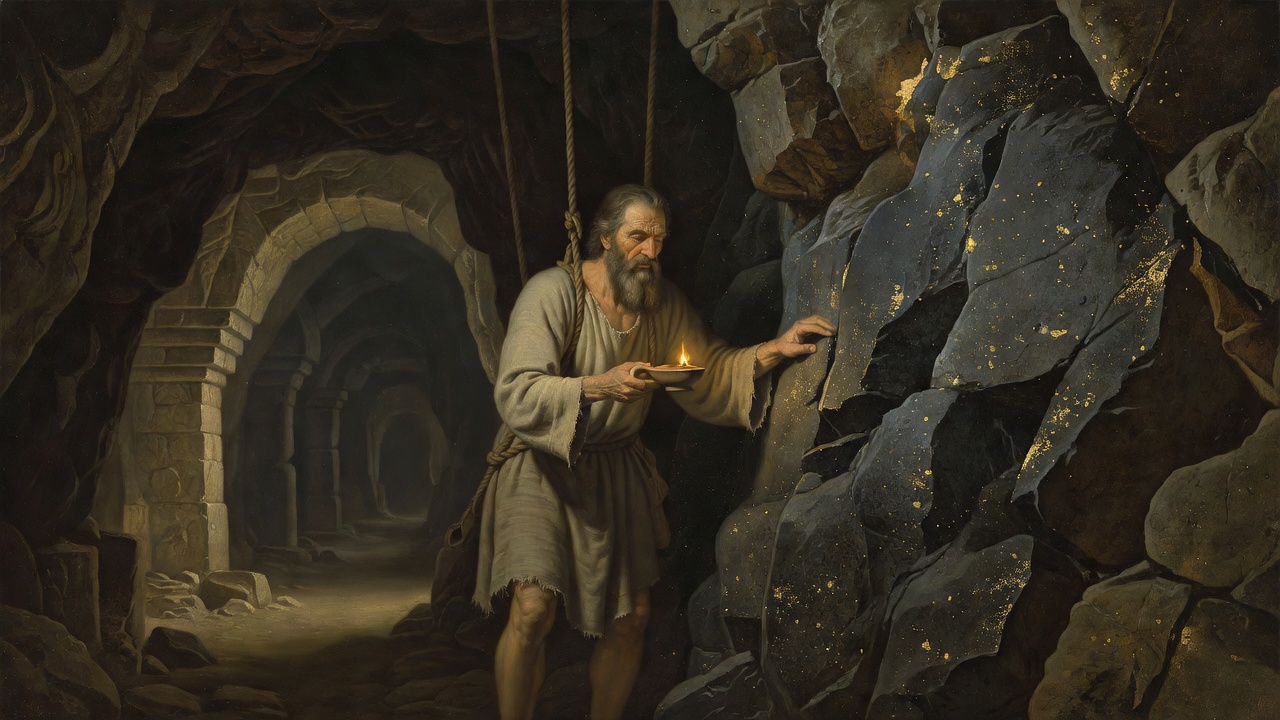
- Job 28 offers a vivid description of ancient mining practices, including digging deep shafts far from human settlements, descending on ropes, tunneling through rock, and damming underground water sources to extract copper, iron, silver, and precious stones.Sources: the Bible text itself
- To emphasize that wisdom exceeds all earthly wealth, the poem references the gold of Ophir and topaz from Cush (translated as Ethiopia in the Greek Septuagint). Ophir was a famous ancient source of pure gold often linked to Arabia or India, while Cush designated the region south of Egypt.Sources: the Bible text itself · Ophir · Ethiopia
- The poem concludes that while humans can master the subterranean world to extract buried treasures, true wisdom cannot be bought or mined. Instead, God reveals that wisdom for mortals consists in the fear of the Lord and turning away from evil.Sources: the Bible text itself
Notes written with AI assistance from open sources (Theographic Bible Metadata, CC BY-SA 4.0; Easton’s Bible Dictionary, public domain) and reviewed before publishing.
Places in this chapter
- Ethiopia · 16.935, 33.751 · verse 19
Only places identified with high confidence are shown (90% or more according to the scholarly sources compiled by OpenBible). Period map: DARE (Digital Atlas of the Roman Empire), CC BY 4.0; modern map: © OpenStreetMap contributors; places: OpenBible.info (CC BY 4.0).
Credits and license for this translation
Paipel
The Holy Bible in the Chuukese language of the Federated States of Micronesia
copyright © 1984, 1989, 1991, 2001 Liebenzel Mission
Language: Chuukese
Translation by: Liebenzell Mission
Old Testament © 1989, 2001 Liebenzel Mission
New Testament © 1984, 1991 Liebenzel Mission
This translation is made available to you under the terms of the
Creative Commons Attribution-No Derivatives license 4.0.
You may share and redistribute this Bible translation or extracts from it in any format, provided that:
You include the above copyright and source information.
You do not make any derivative works that change any of the actual words or punctuation of the Scriptures.
Pictures included with Scriptures and other documents on this site are licensed just for use with those Scriptures and documents.
For other uses, please contact the respective copyright owners.
2024-01-24
Source: http://ebible.org/chk/ · eBible.org