Genesis 48
I tnalù dwata · Tap a verse to see its cross-references.
I kdasal Dyékob i lwe tingà Dyosif
1Na satu duh, nun tmulen ku Dyosif nun fdas i maan. Taman faginan lwe tingaan lagi, Manasas na Ifraim, du mlauy ku Dyékob. 2Na di ktulenla ku Dyékob kakel i tingaan Dyosif, du mlauy kenen, fangalan i nawan, na sudeng di gumilean.
3Na man Dyékob ku Dyosif, “Dwata, Too Mtulus, msut di deg di muna fa déén di banwe Lus di Kanaan, na banlén agu kafye. 4Hae, du manan di deg, ‘Toota ge fbel, du fye i dad belam mgimò i bong lumbuk i dad to, na blégu dale tanà ani, na nfunla kel di landè sen.’
Ani gman Dwata di deg. 5Na i lwe tingaam lagi i sut dini di Idyif di là agu fa salu dini, fakufgu ale di dad ngàgu. Hae, Ifraim na Manasas fasngadgu i dad ngàgu lagi, na kalnawagu dale salngad i too glut dad ngàgu lagi gambet ku Rubén na Simyon. 6Ku nun fa i dad ngaam sut tmadol dale làgu fakuf di dad ngàgu, bay gablà di tanà gdawat i dad belgu di kfatigu, gakuf ale di lumbuk fagu di dad twegela Manasas demen Ifraim. 7Nimògu ani, du too bong nawagu i yéam Rakél. Bong klidù nawagu di kfatin di Kanaan, mdadong di Éfrata di kulêgu mdà di Mésofotamya. Na lbanggu kenen mdadong di dalan salu di Éfrata.” (Éfrata ani, sadni dagitan Bétléhém.)
8Di kite Dyékob i dad ngà Dyosif, smalek kenen, “Simto dad ngà ani?” 9Tmimel Dyosif, “Mà, ani i dad ngà i blé Dwata deg dini di Idyif.” Na man Dyékob, “Fdadongam ale dini di deg, du fnigu di Dwata, fye banlén ale kafye.” 10Takamwanal nan i kite Dyékob du mdà di taktuan, na én duenan là nan too mite. Taman fafdadong Dyosif i dad ngaan di maan, na lkafan na nalakan ale.
11Na man Dyékob di ku Dyosif, “Là agu faglut ku teenta ge fa, bay bong fye di Dwata, du falohan ite fa site na lêgu teen fa i dad ngaam.”
12Nwè Dyosif i dad ngaan di saféd Dyékob, na lkuad kenen di muna i maan. 13Na nagotan i lwe dad ngaan, Ifraim gsen di ibeng Dyékob, na Manasas gsen di kwananan, na léan ale fdadong di kenen. 14Kabay Dyékob balingan santaday i sigalan, taman i kmalan gsen di kwanan i agotan di tah ulu Ifraim, balù kenen i twali, na i ibengan di tah ulu Manasas, balù kenen i twege.
15Kafnge én, mni di Dwata kafye ku Dyosif, manan, “E, Dwata, ge sa i Dwata lalò i fùgu Abraham na i màgu Isaak. Ge i Dwata malak dagu mdà di tukay agu kel i ani. 16Ge i kasaligan i falwà dagu mdà di kdee dad fsasè dagu. Taman kayègu ku lê ge mlé moon kafye di dad sawang lagi ani. Na kayègu ku i dagitgu na i dagit i fùgu Abraham na i màgu Isaak, too magdengeg mdà di dad fùgu ani. Na lêgu kayè ku toom ale fbel di tah tanà ani.”
17Na di kite Dyosif i fkah maan i kmalan gsen di kwanan di ulu Ifraim, laan lehew dun, taman nilin i kmal i maan di ulu Manasas. 18Na manan di maan, “Mà, ise én, du ani i twege. Kenen ulu gumkaham i kwananam.” 19Kabay là nagin maan i knayean, na manan, “Ngàgu, gadègu sa. I dad bel Manasas mbaling dee, bay i dad bel Ifraim, i twalin, mdatah fa di kenen, na i dad belan mgimò kadang dee sahal bung dad to too mlabung.” 20Taman di duh én, fadlug kenen mni di Dwata kafye di dad fuan ani, manan, “Gamu dagit i gafaldam i dad belgu, kadang satu duh, di kafnila kafye, manla, ‘Kayèmi ku ge Dwata mlé gami kafye salngad i kablém ku Ifraim na Manasas.’ ”
Fagu di manan én, fdatah Dyékob Ifraim di twegen Manasas. 21Di kdasalan, man Dyékob di ku Dyosif, “Tò, tamdadong nan i duh i kfatigu, bay fadlug Dwata samnagin ge, na fasfuléan i dad belta kadang satu duh di banwe i gumnè i dad gutambulta. 22Blégu di ge, ise ku di dad flanekam, i tanàgu di Sikim. Too fye tanà ditù, tanwègu di dad to di Amori di kasfati ditù fagu di sudanggu na i boholgu.”
Did you know?
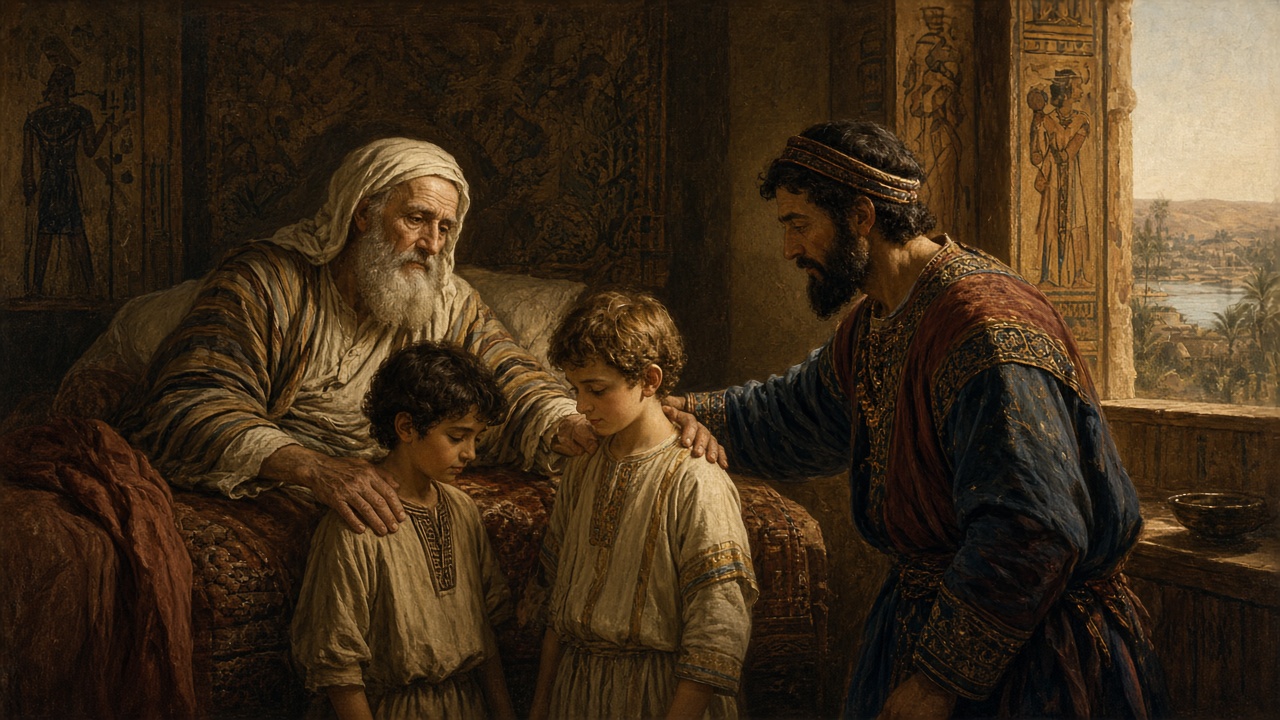
Adoption and Blessing of Ephraim and Manasseh
- Jacob reckons Joseph’s two sons, born to him in Egypt, as his own, on a level with Reuben and Simeon, Leah’s sons. Children born to Joseph after them were to remain Joseph’s, and were to be called by their brothers’ names in the territory they inherited.Sources: the Bible text itself · Manasseh (son of Joseph) · Reuben · Simeon
- Manasseh was the elder son and Ephraim the younger, born in Egypt. The name Ephraim means double fruitfulness, because God had made him fruitful in the land of his affliction. Though Israel could hardly see for age, he crossed his hands, laid his right hand on Ephraim, and insisted that the younger brother would be greater.Sources: the Bible text itself · Ephraim · Manasseh (son of Joseph)
- Jacob recalls that God Almighty appeared to him at Luz in the land of Canaan and blessed him there. Luz was the ancient name of a royal Canaanite city near Bethel, where Jacob halted and received a prophetic vision. He also remembers Rachel, Joseph’s mother, who died to his sorrow on the way back from Paddan—a name found only in this verse, for Padan-aram—and whom he buried beside the road to Ephrath, that is, Bethlehem.Sources: the Bible text itself · Luz · Paddan · Rachel
Notes written with AI assistance from open sources (Theographic Bible Metadata, CC BY-SA 4.0; Easton’s Bible Dictionary, public domain) and reviewed before publishing.
Places in this chapter
- Canaan · 32.767, 35.333 · verses 3, 4, 7, 21
- Luz · Today: Beitin · 31.923, 35.241 · verse 3
- Egypt · 30.129, 31.308 · verses 5, 9
- Bethlehem · 31.704, 35.208 · verse 7
- Ephrath · Today: Bethlehem · 31.704, 35.208 · verse 7
Only places identified with high confidence are shown (90% or more according to the scholarly sources compiled by OpenBible). Period map: DARE (Digital Atlas of the Roman Empire), CC BY 4.0; modern map: © OpenStreetMap contributors; places: OpenBible.info (CC BY 4.0).
Credits and license for this translation
I tnalù dwata
New Testament in Blaan, Sarangani
copyright © 1998 Wycliffe Bible Translators, Inc.
Language: Sarangani Blaan (Blaan, Sarangani)
Translation by: Wycliffe Bible Translators
Contributor: Wycliffe Bible Translators, Inc.
Copyright Information
© 1998, Wycliffe Bible Translators, Inc. All rights reserved.
This translation text is made available to you under the
terms of the Creative Commons License: Attribution-Noncommercial-No Derivative Works.
( http://creativecommons.org/licenses/by-nc-nd/3.0/ )
In addition, you have permission to port the text to different file formats, as long as you
do not change any of the text or punctuation of the Bible.
You may share, copy, distribute, transmit, and extract portions
or quotations from this work, provided that you include the above copyright
information:
You must give Attribution to the work.
You do not sell this work for a profit.
You do not make any derivative works that change any of the actual words or punctuation of the Scriptures.
Permissions beyond the scope of this license may be
available if you contact
us with your request.
The New Testament
in Blaan, Sarangani
© 1998, Wycliffe Bible Translators, Inc. All rights reserved.
This translation is made available to you under the terms of the
Creative Commons Attribution-Noncommercial-No Derivatives license 4.0.
You may share and redistribute this Bible translation or extracts from it in any format, provided that:
You include the above copyright and source information.
You do not sell this work for a profit.
You do not change any of the words or punctuation of the Scriptures.
Pictures included with Scriptures and other documents on this site are licensed just for use with those Scriptures and documents.
For other uses, please contact the respective copyright owners.
2015-03-17
Source: http://ebible.org/bps/ · eBible.org