Genesis 21
I tnalù dwata · Tap a verse to see its cross-references.
Di ksut Isaak
1Na nun kafye blé Dwata ku Sara, du dnohoan i tafakangan di kenen. 2Hae, du mbaling kenen maltien. Kafnge én, nun tingaan di ku Abraham, balù tatoo tua nan, du tasut i tingàla na lagi. Na sut i tingaan too gaslà di bang i fakang Dwata ku Abraham. 3Na dnagit Abraham i tingaan di ku Sara, dunan Isaak. 4Di gwalu du klon sut Isaak tnulì Abraham, du én i dek Dwata kenen. 5Na di ksut Isaak, mlatu fali Abraham.
6Na man Sara, “Tabanlé agu Dwata klehew, na balù simto mlinge gablà di deg, magin deg lehew.” 7Léan man, “Di muna, simto kè i fakay gamtulen di ku Abraham na satu duh fantutùgu i tingà? Balù tatoo kenen tua, mngà agu fa i tingaan lagi.”
Fdà Abraham Hagar na Ismaél
8Kafnge én, tatoo lamnok i tingàla Isaak, na taman sankahla tmutù. Di duh kaskahla kenen tmutù, mimò Abraham i bong fista. 9Na Ismaél, i tingà Abraham di ku Hagar, i libun mdà di Idyif, gal madoy i twalin Isaak. Na di kite Sara ani, 10manan di ku Abraham, “Falwaam dini i lifanam libun na i tingaan, du là fakay ku tingà i lifan dmawat i alel di dad knunam di kfatim, du alò tingàgu i fakay mfun i kdee knunam.”
11Na ani gumdà i bong klidù nawa Abraham, du Ismaél i tingaan. 12Kabay man Dwata di kenen, “Nang ge too mlidù gablà di tingaam lagi na i lifanam libun Hagar. Fanlingem Sara, na naginam i knayean, du fagu alò di tingaam Isaak dnilègu i too glut dad belam. 13Lêgu banlé kadang i tingaam mdà di lifanam libun, dee dad belan, du fye mbaling ale dee na mgimò i satu bung dad to too mlabung, du kenen i tingaam.”
14Na di kakwalan too flafus, banlé Abraham Hagar knaan, na i gumkah yéél too fnò. Na ftiangan kenen, na fdaan kenen na i tingaan lagi. Mdà ale na salu di banwe landè to dnagit Bérsiba, na lamngab ale déén.
15Na di kti yéélla, tnagak Hagar i tingaan lagi di dungan i tukay kayu. 16Na mili kenen di gumdadongan, i nun kè satu nligo i kawagan, na sudeng kenen ditù. Na di ksudengan déén mlanu, du manan di nawan, manan, “Mati kè i tingàgu kadang, na là agu mayè meye i kfatin.”
17Na Dwata mlinge i kngel i tingaan. Na kaklingen dun, tlo kasaligan Dwata Hagar, mdà di langit, na manan, “Tan kè duenam mlidù? Nang ge likò, du talinge Dwata i klanu i tingaam na teenan i kagkahan. 18Tadag ge, na salu ge ditù di tingaam, na nlalam kenen, du fandeegu kadang i dad belan, na mbaling ale sbung dad to too mlabung.”
19Kafnge ani, fite Dwata ku Hagar i satu ktufa. Na fananoan i gumkahan yéél, na fninuman i tingaan lagi.
20Too nifat Dwata Ismaél ani kel di kalnokan. Na mnè kenen di gulandè to, na mbaling kenen satu to too fulung dmulak. 21Klon mnè di gulandè to dnagit ku Faran, nalék i yéan i satu libun di Idyif du nimoan yaanan.
Did you know?
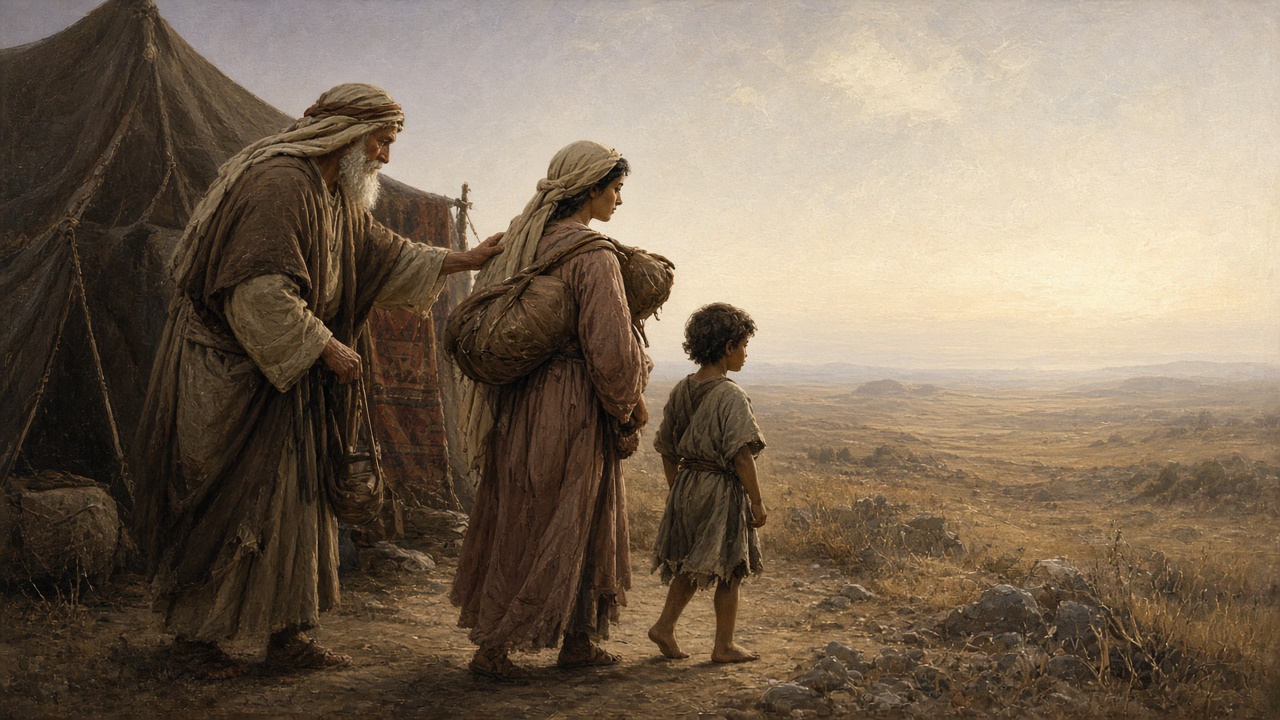
Isaac’s birth, Hagar’s departure, and Beersheba
- Abraham was a hundred years old when Sarah bore him Isaac, their only son together, and he circumcised the child at eight days old, as God had commanded. Sarah said that God had made her laugh, and that everyone who heard of this would laugh with her. Easton's Bible Dictionary (1897) notes that a great feast was held when Isaac was weaned, probably when he was about two years old.Sources: the Bible text itself · Isaac
- Hagar, whose name is explained as “flight” or, according to others, “stranger,” was an Egyptian and Sarah’s handmaid, whom Sarah gave to Abraham as a secondary wife. After Isaac’s birth, Abraham sent Hagar and their son Ishmael into the Wilderness of Beersheba with bread and a skin of water. Ishmael later settled in the Wilderness of Paran, a desert tract in the northeastern Sinai Peninsula between the Arabah on the east and the wilderness of Shur on the west, became a great archer, and his mother got him a wife from Egypt.Sources: the Bible text itself · Hagar · Paran
- Beersheba, “well of the oath” or “well of seven,” was named when Abraham and Abimelech swore an oath there over a well that Abraham said he had dug; he set apart seven ewe lambs as a witness, and the two made a covenant. Phicol, chief captain of the army of Abimelech, the Philistine king of Gerar, entered that alliance with Abraham. Abraham then planted a tamarisk at Beersheba and lived for a long time in the land of the Philistines.Sources: the Bible text itself · Beersheba · Phichol
Notes written with AI assistance from open sources (Theographic Bible Metadata, CC BY-SA 4.0; Easton’s Bible Dictionary, public domain) and reviewed before publishing.
Places in this chapter
Only places identified with high confidence are shown (90% or more according to the scholarly sources compiled by OpenBible). Period map: DARE (Digital Atlas of the Roman Empire), CC BY 4.0; modern map: © OpenStreetMap contributors; places: OpenBible.info (CC BY 4.0).
Credits and license for this translation
I tnalù dwata
New Testament in Blaan, Sarangani
copyright © 1998 Wycliffe Bible Translators, Inc.
Language: Sarangani Blaan (Blaan, Sarangani)
Translation by: Wycliffe Bible Translators
Contributor: Wycliffe Bible Translators, Inc.
Copyright Information
© 1998, Wycliffe Bible Translators, Inc. All rights reserved.
This translation text is made available to you under the
terms of the Creative Commons License: Attribution-Noncommercial-No Derivative Works.
( http://creativecommons.org/licenses/by-nc-nd/3.0/ )
In addition, you have permission to port the text to different file formats, as long as you
do not change any of the text or punctuation of the Bible.
You may share, copy, distribute, transmit, and extract portions
or quotations from this work, provided that you include the above copyright
information:
You must give Attribution to the work.
You do not sell this work for a profit.
You do not make any derivative works that change any of the actual words or punctuation of the Scriptures.
Permissions beyond the scope of this license may be
available if you contact
us with your request.
The New Testament
in Blaan, Sarangani
© 1998, Wycliffe Bible Translators, Inc. All rights reserved.
This translation is made available to you under the terms of the
Creative Commons Attribution-Noncommercial-No Derivatives license 4.0.
You may share and redistribute this Bible translation or extracts from it in any format, provided that:
You include the above copyright and source information.
You do not sell this work for a profit.
You do not change any of the words or punctuation of the Scriptures.
Pictures included with Scriptures and other documents on this site are licensed just for use with those Scriptures and documents.
For other uses, please contact the respective copyright owners.
2015-03-17
Source: http://ebible.org/bps/ · eBible.org