Genesis 18
I tnalù dwata · Tap a verse to see its cross-references.
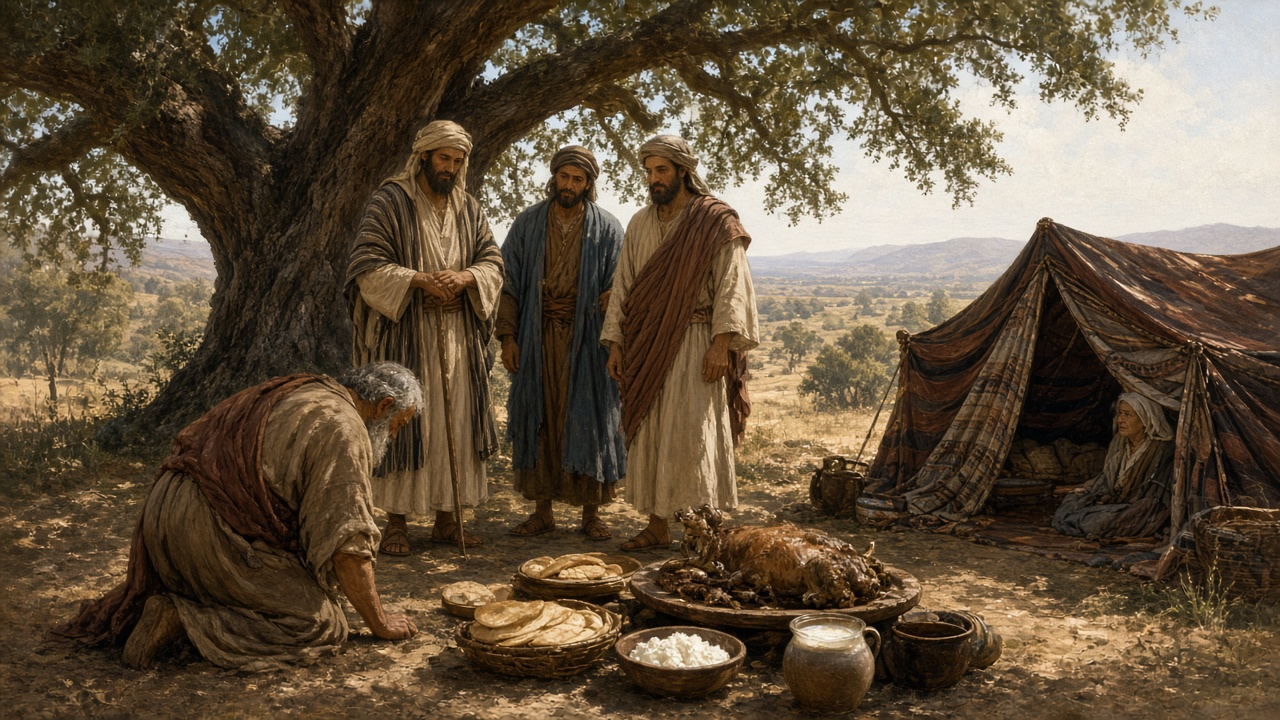
I tlu dad to mlauy di ku Abraham
1Satu duh, msut Dwata i Amu di ku Abraham di gunun malbang kayu nfun Mamri di ltu i duh klon sudeng di gufusuk di slungan. 2Na keye Abraham, nun teenan tlu dad lagi tadag mdadong déén. Di kiten dale sadlu smitong na lkuad du mafè dale.
3Na man Abraham di dale, manan “Lew, beg gamu slob. Nang gamu fadlug, du gani agu na tmabeng agu gamu. 4Fafwè agu yéél, du alob i blìyu. Na beg gamu fakay ftud di dungan i kayu ani. 5Fankaanta gamu, du fye nun galyu di là gamu fa fadlug di kaguyu. Lehew agu, du tanlauyyu agu na kayègu tmabeng gamu.” Na tmimel ale, manla, “Tay, too fye sa. Na nimoam i gmanam.”
6Kaklinge Abraham i manla, gasil kenen fusuk di slungan di ku Sara, na manan, “Faflal ge. Nweam satu saku too fye arina na nimoam fan.”
7Kafnge én, faflal Abraham salu di dad bakan, du kanfean i too fye guyà baka, ftatéan di saligan, na faflalan ftaga. 8Di kafnge ktaga i kdee blé Abraham di dad to én gine, na léan blé gatas, na satu bung gkaan nimò mdà di gatas. Klola kmaan dun, tadag kenen mdadong di dale di dungan i kayu. 9Slengla kmaan snalekla ku Abraham, manla, “Tanè i yaanam Sara?” Tnimelan ale, “Ditù kenen di slungmi.”
10Kafnge én, man i satu di dad to tlang déén, dunan Dwata i Amu, manan, “Salngad ani bangan kadang di fulé fali, too agu samfulê na mngà yaanam Sara tingà lagi.”
Na Sara kadì, tadag di gufusuk i slungla di gsen i kagol i to atù, na lingen i manan. 11Na Abraham na Sara tatoo tua nan, na taglius i bang Sara mngà. 12Taman mulé kenen, du manan di nawan, “Tatoo agu tua, na yaangu too tua nan. Tan kibò i klehew ani kel di deg?”
13Na man Dwata i Amu di ku Abraham, “Tan dé duen Sara mulé na manan di nawan ku tan i kiboan mngà du tatoo tua nan? 14Nun kè i làgu gagan nimò? Landè sa! Salngad ani bangan di fulé fali samfulê agu, du mngà Sara tingaan lagi.”
15Na du likò Sara taman tmulen kéng, na manan, “Là agu mulé.” Kabay man Dwata, “Too glut mulé ge.”
I kafni Abraham gablà di dad to mnè di Sodom
16Na di fan mdà dad lagi ani, meye ale ditù gsen di banwe Sodom na magin Abraham dale, du tdoan i dalanla. 17Klola magu man Dwata i Amu di kton, “Làgu buni di ku Abraham i fandamgu i fangu nimò, 18du i dad belan too dee kadang, na mbaling sbung dad to too mdatah, na banlégu kafye i kdee bung dad to di klamang banwe du mdà di kenen. 19Tamgalékgu Abraham, du fye tdoan i dad ngaan na i dad belan kibòla mimen deg, fagu di kimòla fye na matlu. Na ku én nimòla, dnohògu i kdee fakanggu di kenen.”
20Kafnge én, man Dwata i Amu di ku Abraham, “Too dee tmulen di deg gablà di dad to di dad banwe Sodom na Gomora. Too blat kun i dad salàla. 21Taman salu agu ditù, du neyegu ku glut i kaklingegu ku là.”
22Kafnge én, i lwe to mdà, na fadlug salu di banwe Sodom, na mnè Abraham di saféd i Amun Dwata. 23Na fdadong Abraham di Dwata na smalek, manan, “Di kafalmom i dad to sasè, fakufam kè i dad to matlu? 24Kaflingenta dun, ku nun lime falò to i matlu ditù di Sodom, falmom fa kè i klamang syudad? Kandom kè i dad lime falò to matlu? 25Toogu fnaglut laam tì fnati i dad to matlu fakuf di dad to sasè. Laam kè nimò ani! Ku fanlayamam i dad to sasè laam fakuf i dad to matlu. Hae, du ge sa i mukum i kdee dad to na i kukumam too matlu.”
26Na tmimel Dwata i Amu, manan, “Ku nun lime falò dad to matlu ditù di Sodom, làgu falmo kadang i klamang syudad, duenan du mdà di dale.”
27Na lêman talù Abraham di Dwata, manan, “Balù alò agu to, na ge Dwata i Amu, toom beg fantahà i nawam di deg di kafadluggu stulen di ge. 28Ken nun alò fat falò lime i dad to matlu, falmom fa i klamang syudad du kulang lime di lime falò gine?” Tmimel i Dwata, “Ku nun fat falò lime i dad to matlu, làgu falmo i syudad.”
29Na lêman talù Abraham, “Ken nun alò teenam fat falò?” Tmimel Dwata, manan, “Ku nun fat falò, làgu falmo dun.” 30Man Abraham, “Tabyà, balù ge i Amu, nang ge flabè di deg ku lêman agu talù. Kaflingenta dun, ku nun alò tlu falò teenam ditù?” Tmimel i Dwata, “Ku nun teengu tlu falò, làgu falmo dun.” 31Man Abraham, “Balù ge i Amu, fantahaam nawam di deg. Tan ku én alò teenam lwe falò dad to matlu?” Man Dwata, “Ku nun teengu lwe falò dad to matlu, làgu falmo dun.” 32Na lêman talù Abraham, manan, “Tabyà, ge i Amu, bay nang ge flabè di deg, du ani gusen i mangu. Tan kè ku én alò teenam sfalò?” Na tmimel i Dwata, “Ku nun teengu sfalò, làgu falmo dun.” 33Kafnge Dwata i Amu na Abraham stulen, mdà Dwata na mulê Abraham.
Did you know?
Visitors at Mamre and a Plea for Sodom
- In Genesis 18, the LORD appeared to Abraham by the Oaks of Mamre in the heat of the day, while Abraham sat at the entrance of his tent. Mamre was an Amorite chief in alliance with Abraham. Abraham ran to meet three men, bowed to the ground, offered them water for their feet and rest under the tree, and then set before them bread, a tender and choice calf, curds, and milk.Sources: the Bible text itself · Mamre
- Sarah, Abraham’s wife, is given the sense “Princess” in Easton's Bible Dictionary (1897), which says the name was given when it was announced that she would be the mother of the promised child. In Genesis 18 the LORD said he would return in about a year and Sarah would have a son, though both were already old and she had passed the age of childbearing. She laughed to herself and, because she was afraid, denied that she had laughed.Sources: Sarah · the Bible text itself
- Sodom, a city in the vale of Siddim, and Gomorrah, one of the five cities of that plain, are named together in Genesis 18 because of the great outcry against their grievous sin. Easton's Bible Dictionary (1897) says the cities of that plain probably stood close together near the northern end of what is now the Dead Sea, and explains Sodom and Gomorrah as “Burning; the walled” and “Submersion.” Two of the men went toward Sodom, while Abraham stayed and asked the LORD to spare the city for the sake of the righteous, lowering the number from fifty to ten.Sources: Sodom · Gomorrah · the Bible text itself
Notes written with AI assistance from open sources (Theographic Bible Metadata, CC BY-SA 4.0; Easton’s Bible Dictionary, public domain) and reviewed before publishing.
Credits and license for this translation
I tnalù dwata
New Testament in Blaan, Sarangani
copyright © 1998 Wycliffe Bible Translators, Inc.
Language: Sarangani Blaan (Blaan, Sarangani)
Translation by: Wycliffe Bible Translators
Contributor: Wycliffe Bible Translators, Inc.
Copyright Information
© 1998, Wycliffe Bible Translators, Inc. All rights reserved.
This translation text is made available to you under the
terms of the Creative Commons License: Attribution-Noncommercial-No Derivative Works.
( http://creativecommons.org/licenses/by-nc-nd/3.0/ )
In addition, you have permission to port the text to different file formats, as long as you
do not change any of the text or punctuation of the Bible.
You may share, copy, distribute, transmit, and extract portions
or quotations from this work, provided that you include the above copyright
information:
You must give Attribution to the work.
You do not sell this work for a profit.
You do not make any derivative works that change any of the actual words or punctuation of the Scriptures.
Permissions beyond the scope of this license may be
available if you contact
us with your request.
The New Testament
in Blaan, Sarangani
© 1998, Wycliffe Bible Translators, Inc. All rights reserved.
This translation is made available to you under the terms of the
Creative Commons Attribution-Noncommercial-No Derivatives license 4.0.
You may share and redistribute this Bible translation or extracts from it in any format, provided that:
You include the above copyright and source information.
You do not sell this work for a profit.
You do not change any of the words or punctuation of the Scriptures.
Pictures included with Scriptures and other documents on this site are licensed just for use with those Scriptures and documents.
For other uses, please contact the respective copyright owners.
2015-03-17
Source: http://ebible.org/bps/ · eBible.org