Exodus 13
I tnalù dwata · Tap a verse to see its cross-references.
I kifal ale i Fulè Mahin
17Di kfaloh i harì di Idyif ku lamwà dad bel Israél di banwen, là ale nalak Dwata magu di dalan salu di tanà gumnè i dad to Filistin, balù én too gumdadong dalan mdà di Idyif salu di banwe Kanaan, i tanà i fakang Dwata blé dale. Hae, du balù nun tek nebela mdà di Idyif, man nawa Dwata, manan, “Ken mguman i fandam i dad togu, na samfulê ale di Idyif, ku teenla i dad to Filistin i dmuen dale, gatlagad samfati dale.” Taman nalakan ale flibut, fagu di dalan salu di banwe gulandè to, salu di Fulè Mahin.
19Na nebe Mosis i dad tulan Dyosif mdà di Idyif, du ani fafakang Dyosif di dad belan, du gmanan di dale di muna fa, manan, “Tnabeng gamu Dwata, du kadang satu duh, neben gamu lamwà di banwe Idyif salu di Kanaan, na di kebe Dwata gamu samfulê di Kanaan, tooyu nebe mulê i dad tulangu.” Én kated Dyosif di muna fa, di dad bel Israél.
20Na di kdà i dad bel Israél di banwe Sukot, mnè ale flo di banwe Étam, di kilil i banwe gulandè to. 21Na di mduh, Dwata i Amu malak dale, fagu di labun fkahan di munala. I labun ani, di mduh i kafbawehan tahà gambet i bong lahan gumnè, na di butang i kafbawehan gambet i lifoh tmuyal i dalanla, du fye fakay ale magu mduh demen butang. 22Na i labun na i lifoh ani, là lana di munala di mduh demen di butang.
Did you know?
The Firstborn and the Departure from Egypt
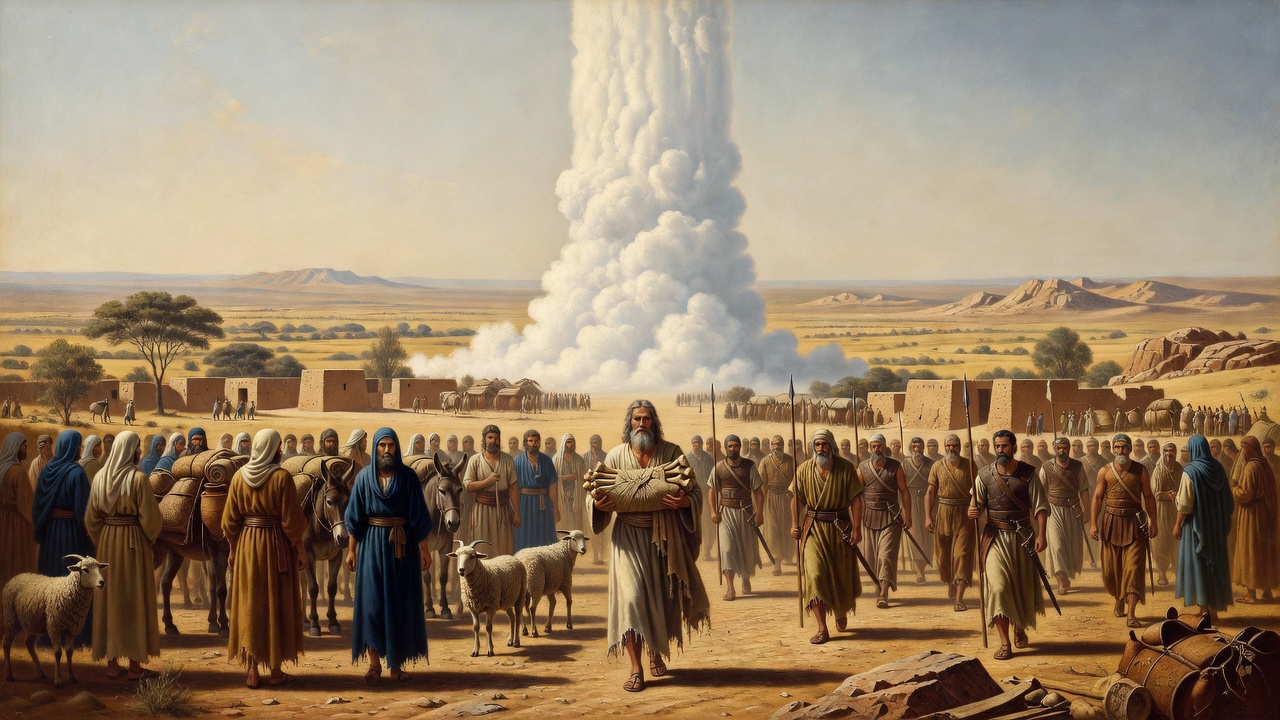
- God did not lead them by the shorter road through the land of the Philistines, lest war make them return to Egypt, but by the wilderness toward the Red Sea, which separates Asia from Africa. They set out from Succoth, the first encampment after leaving Ramesses and also the civil name of Pithom, and made their third camp at Etham, on the edge of the wilderness. Etham is perhaps another name for Khetam, or “fortress,” on the wall of Shur, which ran from the Mediterranean to the Gulf of Suez, and the camp was probably a little west of modern Ismailia.Sources: the Bible text itself · Succoth · Etham · Red Sea
- Moses took the bones of Joseph with him, because Joseph had made the sons of Israel swear that, when God attended to them, they must carry his bones from that place. Joseph was the elder of the two sons of Jacob by Rachel.Sources: the Bible text itself · Joseph (son of Jacob)
- The LORD told Moses to consecrate every firstborn male; the firstborn from every womb among the Israelites, both of people and of animals, belonged to him. Every firstborn donkey was to be redeemed with a lamb, or else have its neck broken, and every firstborn son was to be redeemed. When a son asked what this meant, he was to be told that Pharaoh had stubbornly refused to let them go, so the LORD killed every firstborn in Egypt, of people and of animals, and brought them out of the house of slavery.Sources: the Bible text itself
Notes written with AI assistance from open sources (Theographic Bible Metadata, CC BY-SA 4.0; Easton’s Bible Dictionary, public domain) and reviewed before publishing.
Places in this chapter
Only places identified with high confidence are shown (90% or more according to the scholarly sources compiled by OpenBible). Period map: DARE (Digital Atlas of the Roman Empire), CC BY 4.0; modern map: © OpenStreetMap contributors; places: OpenBible.info (CC BY 4.0).
Credits and license for this translation
I tnalù dwata
New Testament in Blaan, Sarangani
copyright © 1998 Wycliffe Bible Translators, Inc.
Language: Sarangani Blaan (Blaan, Sarangani)
Translation by: Wycliffe Bible Translators
Contributor: Wycliffe Bible Translators, Inc.
Copyright Information
© 1998, Wycliffe Bible Translators, Inc. All rights reserved.
This translation text is made available to you under the
terms of the Creative Commons License: Attribution-Noncommercial-No Derivative Works.
( http://creativecommons.org/licenses/by-nc-nd/3.0/ )
In addition, you have permission to port the text to different file formats, as long as you
do not change any of the text or punctuation of the Bible.
You may share, copy, distribute, transmit, and extract portions
or quotations from this work, provided that you include the above copyright
information:
You must give Attribution to the work.
You do not sell this work for a profit.
You do not make any derivative works that change any of the actual words or punctuation of the Scriptures.
Permissions beyond the scope of this license may be
available if you contact
us with your request.
The New Testament
in Blaan, Sarangani
© 1998, Wycliffe Bible Translators, Inc. All rights reserved.
This translation is made available to you under the terms of the
Creative Commons Attribution-Noncommercial-No Derivatives license 4.0.
You may share and redistribute this Bible translation or extracts from it in any format, provided that:
You include the above copyright and source information.
You do not sell this work for a profit.
You do not change any of the words or punctuation of the Scriptures.
Pictures included with Scriptures and other documents on this site are licensed just for use with those Scriptures and documents.
For other uses, please contact the respective copyright owners.
2015-03-17
Source: http://ebible.org/bps/ · eBible.org