Ruth 1
A Nitana Vure · Tap a verse to see its cross-references.
About this book
About Ruth
- The events are set in the days of the judges. A great famine led Elimelech, a man of the tribe of Judah and a kinsman of Boaz, to leave Bethlehem with his wife Naomi and their sons Mahlon and Chilion and settle in Moab, east of the Jordan and the Dead Sea. There Elimelech and both sons died.Sources: Elimelech · Moab · Mahlon · Chilion
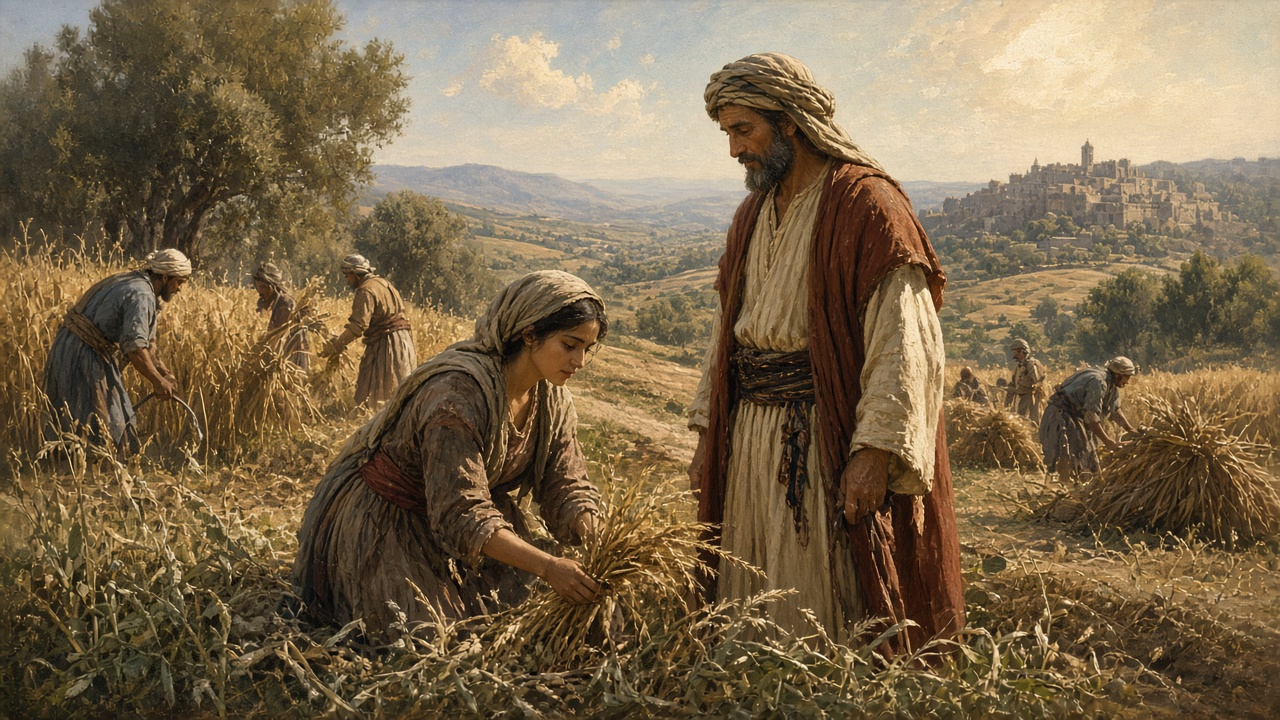
- Naomi then returned to Bethlehem with Ruth, a Moabite and the widow of Mahlon, who refused to leave her. Orpah, Chilion's widow, accompanied Naomi part of the way and then returned to Moab. In the valley east of the town, Ruth gleaned in the fields and was eventually married to Boaz, a wealthy relative.Sources: Easton: Ruth · Orpah · Bethlehem · Boaz
- Easton's Bible Dictionary (1897) says the story of the gleaner Ruth illustrates friendly relations between Boaz and his reapers, the land system, the way property was transferred, and the working of the Mosaic law for the relief of ruined families. By the levirate law, Boaz, a kinsman of Mahlon, took on the duty of marrying Ruth.Sources: Easton: Ruth · Boaz
- Ruth became the mother of Obed, the grandfather of David. The genealogy in Ruth 4:18-22 traces that line, and Matthew 1:5 includes Ruth, a Gentile, among the ancestors of Jesus. Easton also compares her with Tamar and Rahab, who likewise became ancestors of David.Sources: Easton: Ruth · Obed · Ruth
- Bethlehem, in the hill country of Judah, was originally called Ephrath; Ruth 1:2 calls it Bethlehem-Judah and its people Ephrathites. Easton's Bible Dictionary (1897) explains Ruth as meaning a friend, and Naomi as bitter or sad, a symbolic name she gave herself because of her misfortunes.Sources: Bethlehem · Ephrathah · Ruth · Naomi
Notes written with AI assistance from open sources (Theographic Bible Metadata, CC BY-SA 4.0; Easton’s Bible Dictionary, public domain) and reviewed before publishing.
E Rut, e Naomi
1Na tahuna e huriki a mari ni pelekado a ngava ri matakari e Israel, a pago i bele. Lakea a bakovi tara na tanga e Betlehem o Iuda i mariu lakea na malala ne huriki a Moab, turana e girihina, e tuna bakovi ala rua. 2A bakovi iea a rana e Elimelek. A rane girihina e Naomi. A rane tune rua e Malon, e Kilion. Re huriki nga, a kabu ne Epreti, na tanga e Betlehem o Iuda. Na tahuna ri bele o Moab, ri made vonga.
3Pali e Elimelek i mate vonga, lakea e girihina e Naomi i made kikeri turana e tuna rua. 4Muri e tuna rua ru parangi a ngatavine o Moab. A rane girihine rua e Orpa, e Rut. Ri made palupu na pida i ravulu. 5Muri i mate tabu e Malon rua e Kilion. Ngane e Naomi i uka e girihina, i uka e tuna, i made kikeri.
6Na tahuna i tababana ni made o Moab, e Naomi i longo a velengane huriki a kabu vona, e BAKOVI DAGI i rata kamumu ria i habi a kinani ne ria. Lakea ia, turane kana ala rua, to ngaru ni hamule lakea na tanga ne Naomi. 7Lakea i vano turana e kana ala rua, to laho hamule lakea o Iuda.
8Pali na bokona dala e Naomi i ta rike, i ta maea, “Muru hamule mai e kinane marua. A ngaru e BAKOVI DAGI ge rata kamumu marua, a vuhuna muru rata kamumu iau, muru rata kamumu e girihine marua ra ru mate pali. 9E BAKOVI DAGI ge habi tabu a bakovi ne marua, bara muru tahoka a nimalo kamumu turana e girihine marua na tanga ne rua.”
Muri i nguru rua, lakea ru haloho dagi. 10Ru takia ru ta maea, “Maria miri gi hamule turamu, miri gi made turana e huriki na kabu vomu.”
11Pali e Naomi i uka ma i longo ne rua, lakea i taki rua i ta maea, “Muru hamule lakea na tanga marua. I navai muru gu valai turagu? Iau i uka ma ga poda tabu a koma bakovi muru gu parangi ne rua. 12Muru hamule. Iau a gare hateka, i uka ma ga parangi tabu. Pali iau ngane ga parangi tabu, ga poda tabu a koma bakovi, 13muru gu dava navai rua ru gu dagi, muru gu parangi ne rua? Kagu rua, ge a ra? A dodo marua, pali iau bara matasia liu, a vuhuna e BAKOVI DAGI i rata hale hateka iau.”
14Muri ru tangi tabu, lakea e Orpa i tarulu purua e kana, i hamule. Pali e Rut i ege hateka ne Naomi.
15Muri e Naomi i ta maea, “E mahurumu i hamule mai a kabu vona, a maka vure vona. O hamule turana.”
16Pali e Rut i ta maea, “Naha ni tono iau ga hamule, ga ngalahere vomu. A hini o lakea vona, bara lakea vona. A hini o made vona, bara made vona. A kabu vomu, ga kabu nau. A Vure vomu, ga Vure nau. 17Iau ga mate na tanga o mate vona, ni gi tanu iau vonga. Iau a ta muholi vomu, i uka ma ga pe ioe, ge harena na matenga ge kalipida tarua. Iau bara pe ioe, a ngaru e BAKOVI DAGI ge ratapile iau.” 18Na tahuna e Naomi i masia i ta hinituhana, i uka ma i taki tabua ge hamule mai a viri vona.
E Naomi, e Rut Ru Lakea o Betlehem
19Lakea ru vano, ru bele o Betlehem. Na tahuna ru bele, e huriki lobo ri turutu ni matai rua. Lakea e huriki a ngatavine ri vanana, “E rei a viri iea? E Naomi muholi?”
20Pali e Naomi i ta maea, “Naha ni gale iau e Naomi. Mu gale iau ge iau e Mara, a vuhuna A Vure Tuhaka i ratea a nimade nau i hale hateka. 21Hosi, na tahuna a malaga koea a lakea o Moab, a tahoka a maki lobo. Pali na tahuna e BAKOVI DAGI i tuli hamule valai iau koea, a uka liu tara maki. Naha ni gale iau e Naomi. A Vure Tuhaka i rata hale iau.”
22A ngava iea a nuverei ne Naomi rua e kana e Rut, ra ngatavine o Moab. Ru pea e Moab, ru hamule o Betlehem. Na tahuna iea e huriki ri vakatubu ni mirio a hania na barli.
Did you know?
Naomi and Ruth Return to Bethlehem
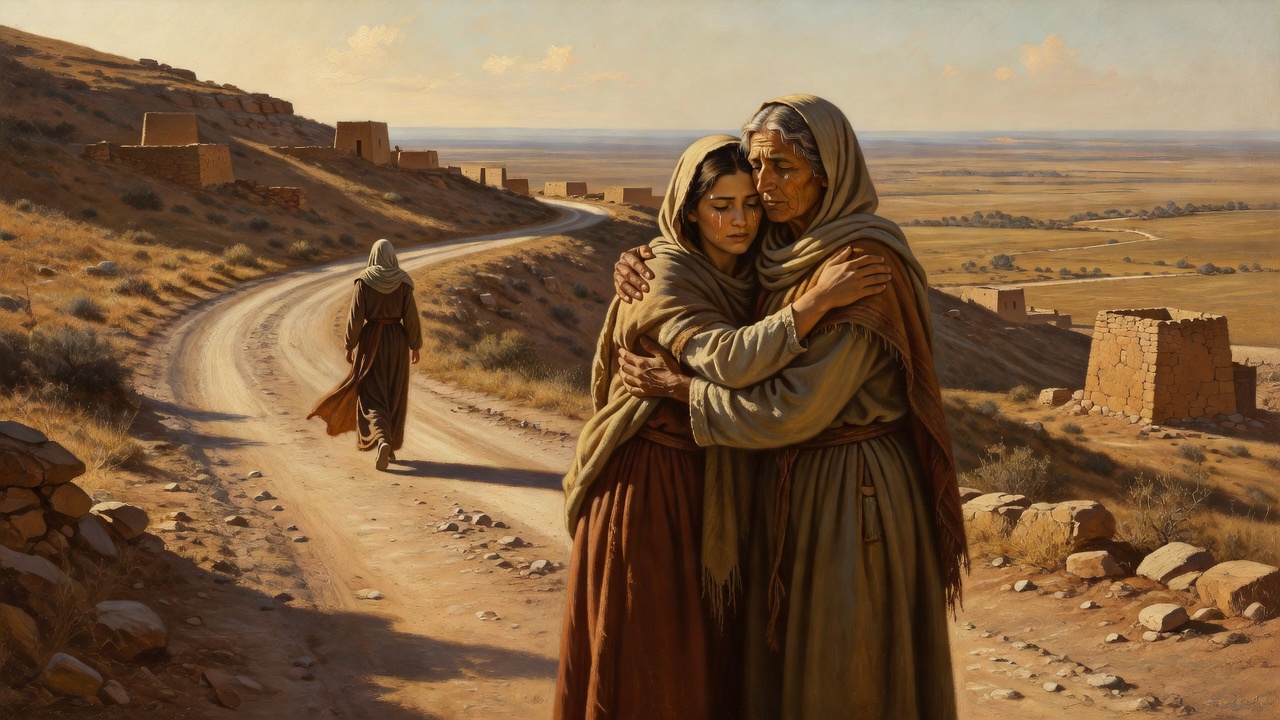
- In the days when the judges ruled, famine forced Elimelech and his family from Bethlehem in the hill country of Judah to migrate to the land of Moab, east of the Dead Sea. After the deaths of Elimelech and her two sons, Naomi decided to return to Bethlehem when she heard that food was once again available in Judah.Sources: the Bible text itself · Bethlehem · Moab · Elimelech
- While Orpah returned to her people and gods in Moab, Ruth clung to her mother-in-law and pledged loyalty to Naomi and her God. Ruth, a Moabite woman, traveled to Bethlehem and would later become an ancestor of King David.Sources: the Bible text itself · Ruth · Orpah
- Upon arriving in Bethlehem at the beginning of the barley harvest, Naomi asked the women of the city to call her Mara, meaning bitter, because she felt the Almighty had dealt bitterly with her. She had departed full with a husband and two sons, but returned empty after their deaths.Sources: the Bible text itself · Naomi
Notes written with AI assistance from open sources (Theographic Bible Metadata, CC BY-SA 4.0; Easton’s Bible Dictionary, public domain) and reviewed before publishing.
Places in this chapter
- Bethlehem · 31.704, 35.208 · verses 1, 2, 19, 22
- Moab · Today: Moab 1 · 31.181, 35.701 · verses 1, 2, 4, 6, 22
Only places identified with high confidence are shown (90% or more according to the scholarly sources compiled by OpenBible). Period map: DARE (Digital Atlas of the Roman Empire), CC BY 4.0; modern map: © OpenStreetMap contributors; places: OpenBible.info (CC BY 4.0).
Credits and license for this translation
A Nitana Vure
Genesis, Exodus, Leviticus, Numbers, Deuteronomy, Joshua, Ruth, Jonah, and the New Testament in the Bola language of Papua New Guinea
Sampela hap Buk Baibel long tokples Bola long Niugini
copyright © 2011 Wycliffe Bible Translators, Inc.
Language: Bola
Translation by: Wycliffe Bible Translators
This translation is made available to you under the terms of the
Creative Commons Attribution-Noncommercial-No Derivatives license 4.0.
You may share and redistribute this Bible translation or extracts from it in any format, provided that:
You include the above copyright and source information.
You do not sell this work for a profit.
You do not change any of the words or punctuation of the Scriptures.
Pictures included with Scriptures and other documents on this site are licensed just for use with those Scriptures and documents.
For other uses, please contact the respective copyright owners.
2014-12-03
Source: http://png.bible/bnp/ · eBible.org