Genesis 25
A Nitana Vure · Tap a verse to see its cross-references.
E Abraham i Mate
1E Abraham i bole tabua tara e girihina, a rana e Ketura. 2Ra ngatavine iea i poda e Simran, e Ioksan, e Medan, e Midian, e Isbak, e Sua. 3E Ioksan e tamane Seba rua Dedan. E huriki a Asuri, a Letusi, a Leumi ria a hamone Dedan. 4E huriki a bakovi e tune Midian a rane ria ra nga: e Epa, e Eper, e Hanok, e Abida, e Elda. Re huriki nga ria a hamone Ketura.
5E Abraham i pe mule ne Isak a mahala lobo vona. 6Pali na tahuna i tabana ni mahuri, i habi ranga mahala ne huriki e tuna bakovi, i poda e huriki e girihina ranga. Lakea i rudu ria ri gi made na robo na nirikena haro, basi ne tuna, e Isak.
7E Abraham I tahoka a pida i 175, 8i gare liu, i matai a maka pida i kamumu i kupo. Muri i taravango dilia a nilobona bangona, i mate. Ni bole, i made turana e huriki a viri vona ri mate pali. 9E Isak rua e Ismael ru tanua e tamane rua na babe o Makpela, tabukoi o Mamare na malala e Epron, e tune Sohar, ra kabune Hiti. 10Ra malala iea e Abraham i konea ne huriki a kabu ne Hiti. E Abraham ni tanu vonga turana e girihina, e Sara. 11Muri ne Abraham i mate, a Vure i gamaia e Isak. Muri e Isak i vano i made tabukoi o Bia Lahai Roi.
E Huriki e Tune Ismael
12A nita ne Ismael, e tune Abraham, i podea e Hagar, a ngatavine o Egipto ra vora ngatavine ne Sara.
13A rane huriki e tune Ismael i ramai a nipodane ria. A tabua ne Ismael e Nebaiot. Muri ni poda e Kedar, e Adbil, e Mibsam, 14e Misma, e Duma, e Masa, 15e Hadad, e Tema, e Ietur, e Napis, e Kedema. 16Re huriki a bakovi nga ria e tune Ismael, ra vuhuna a kabu i ravulu a polona i rua. A tanga, a robo ri rata a mada vona ni gale virihi mai ria vona. 17E Ismael i tahoka a pida i 137, muri i taravango dilia a nilobona bangona, i mate. Ni bole i made turana a viri vona ri mate pali. 18E huriki a hamona ri made vona a robo i vakatubu o Havila i lakea o Sur, i tabukoi na harena e Egipto na dala lakea o Asiria. Re huriki a kabu nga, i uka ma ri vamade kamumu. Ri vatepu.
E Iakop e Esau
19Iea a nitane Isak, e tune Abraham.
20E Isak i tahoka a pida i ravulu va i parangi vona e Rebeka, e tune Betuel. E Betuel ia a hamona kabune Aram, i made na robo e Padan-Aram re Mesapotamia. E Rebeka e kurabane Leban, ia tara a hamone Aram.
21E girihine Isak i lame, lakea e Isak i vasileki ne BAKOVI DAGI, ge tuhoria e girihina. E BAKOVI DAGI i longototoa a nivasileki vona, i singou e Rebeka. 22Na palona i tahoka a koma i rua, ru varata tuhare bala pololilo, lakea e Rebeka i ta maea, “I navai i bele maea nau a hini?” Pali i vano i vasileki ge nana e BAKOVI DAGI vona a naro iea.
23Muri e BAKOVI DAGI i takia, “A boge pololilo na palomu ru gu vakabele a kabu ge rua. Ra kabu i rua nga bara ru vapida. A kabu tara bara i tora hateka vona a kabu tara, a tabua bara ia a vora ne tarina.”
24I valai ngane a parava vona na ni poda, lakea i poda a boge bakovi ala rua. 25A tabua i vururu a kulina, a kakaina i vona lobo a vungana, lakea ni vunu e Esau. 26Na tahuna ni poda e tarina i tangotatea a vahane Esau, lakea ni gale e Iakop. E Isak i tahoka a pida i ravulu polotara ni poda ra boge nga.
27Na tahuna ru dagi pali, e Esau ia a bakovi ni laho na robo, i moro na pinango. Pali e Iakop i madoru, i made kunana na kape. 28E Isak i ngarua e Esau, a vuhuna i bole bala a kania, i kani. E Rebeka i ngarua e Iakop.
29Na parava tara, e Esau i hamule na pinango, i vitolo hateka. I masia e Iakop i nono a kania vona, 30lakea i takia e Iakop, “A vitolo iau. O malaviriri kunana o habi nau ranga kania vururu vomu ga kani.” Na naro iea kunana ni gale visi vona e Idom.
31E Iakop i koli mule i ta maea, “Tu gu vangoli taro a murine tarua. O taki iau ge iau a tabua.”
32Lakea e Esau i ta maea, “O longo valai, iau a mate na vitoloa, ra murigu a tabua, a ra i kamumu vona?”
33E Iakop i ta maea, “O kaba taro, o taki iau ge iau a tabua.” Lakea e Esau i ta muholi vona, ru vangoli a murine rua.
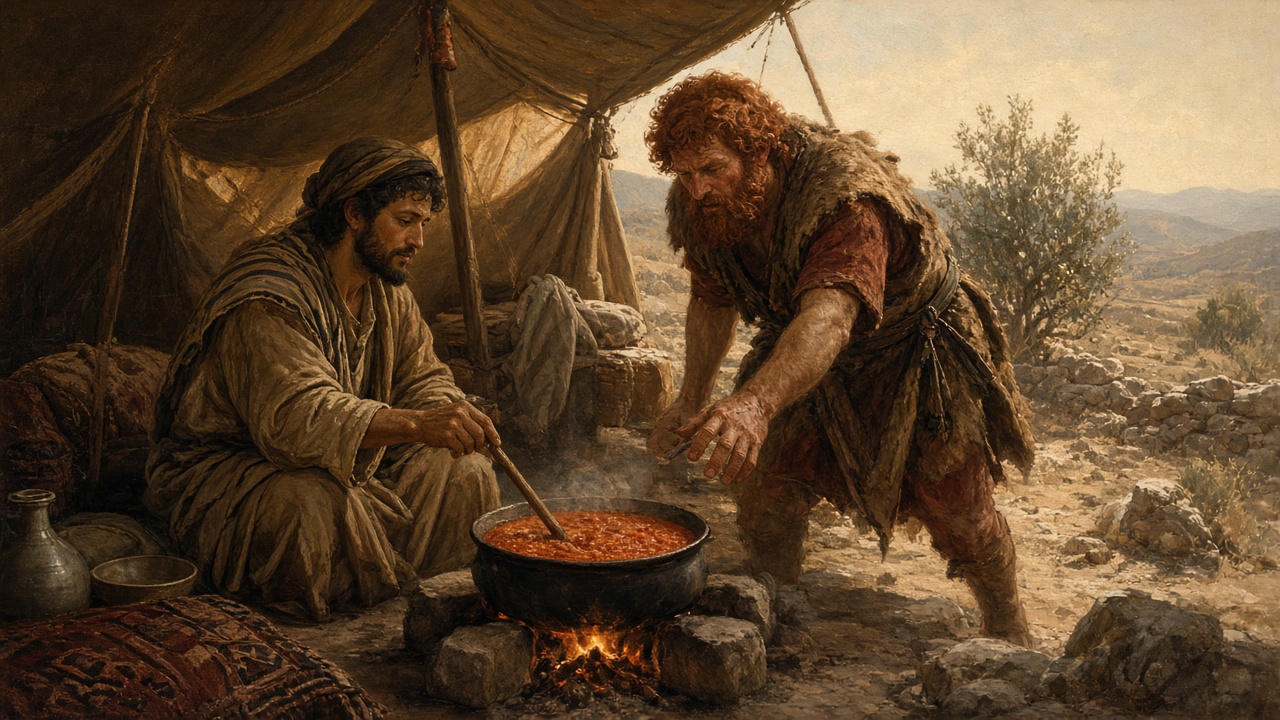
34Muri e Iakop i habi ne Esau ranga bret turana a naruna bin, lakea i kani i ninu. Muri i pesi rike i vano. Na naro iea kunana, e Esau i lohopile vona a murina, ia a tabua.
Did you know?
Abraham’s heirs and the twin brothers
- Keturah, whose name Easton's Bible Dictionary (1897) explains as “incense,” is introduced here as another wife of Abraham. That dictionary says he probably married her after Sarah’s death, though her nationality is unknown, and notes that 1 Chronicles calls her a concubine. She bore him six sons, including Jokshan and Midian, the father of the Midianites; while Abraham was still alive he gave gifts to the sons of his concubines and sent them away from Isaac to the land of the east.Sources: Keturah · Midian · the Bible text itself
- Isaac and Ishmael together buried Abraham in the cave of Machpelah near Mamre, in the field Abraham had bought from Ephron the Hittite, where Sarah already lay. Easton's Bible Dictionary (1897) explains Machpelah as “portion” or “double cave,” set on a hillside east of Hebron and facing Mamre, a place called the oaks—or, in a margin, the terebinths—of Mamre.Sources: Machpelah · Mamre · the Bible text itself
- Esau, Rebekah’s firstborn twin, was born red and covered with hair like a fur coat. Easton's Bible Dictionary (1897) links the further name Edom, “red,” to the red lentil stew for which he sold his birthright, and explains Jacob as “one who follows on another’s heels” or “supplanter,” matching the report that Jacob was born grasping Esau’s heel. Esau grew up as a skillful hunter and a man of the field, while Jacob was a quiet man who stayed at home.Sources: Esau (Edom) · Jacob (Israel) · the Bible text itself
Notes written with AI assistance from open sources (Theographic Bible Metadata, CC BY-SA 4.0; Easton’s Bible Dictionary, public domain) and reviewed before publishing.
Places in this chapter
- East · Today: region around Amman · 31.955, 35.934 · verse 6
- Machpelah · Today: Cave of the Patriarchs · 31.525, 35.111 · verse 9
- Negeb · 31.245, 34.841 · verse 11
- Assyria · 36.359, 43.153 · verse 18
- Egypt · 30.129, 31.308 · verse 18
Only places identified with high confidence are shown (90% or more according to the scholarly sources compiled by OpenBible). Period map: DARE (Digital Atlas of the Roman Empire), CC BY 4.0; modern map: © OpenStreetMap contributors; places: OpenBible.info (CC BY 4.0).
Credits and license for this translation
A Nitana Vure
Genesis, Exodus, Leviticus, Numbers, Deuteronomy, Joshua, Ruth, Jonah, and the New Testament in the Bola language of Papua New Guinea
Sampela hap Buk Baibel long tokples Bola long Niugini
copyright © 2011 Wycliffe Bible Translators, Inc.
Language: Bola
Translation by: Wycliffe Bible Translators
This translation is made available to you under the terms of the
Creative Commons Attribution-Noncommercial-No Derivatives license 4.0.
You may share and redistribute this Bible translation or extracts from it in any format, provided that:
You include the above copyright and source information.
You do not sell this work for a profit.
You do not change any of the words or punctuation of the Scriptures.
Pictures included with Scriptures and other documents on this site are licensed just for use with those Scriptures and documents.
For other uses, please contact the respective copyright owners.
2014-12-03
Source: http://png.bible/bnp/ · eBible.org