2 Chronicles 4
Azərbaycan dilində Müqəddəs Kitab · Tap a verse to see its cross-references.
1Süleyman tuncdan bir qurbangah tikdi. Onun uzunluğu və eni iyirmi qulac, hündürlüyü isə on qulac idi. 2O, tökülmüş dairəvi bir hovuz düzəltdi. Onun hündürlüyü beş qulac idi, bir kənarından digər kənarına qədər on qulac idi və otuz qulaclıq bir ip onun ətrafına dolanmışdı. 3Altının hər tərəfindən onu buğa təsvirləri əhatə edirdi. Hər qulacda on buğa vardı. Buğalar iki cərgə idi və onlar hovuzla birgə tökülmüşdü. 4Hovuz on iki tökmə buğanın üstündə dururdu: üçü şimala, üçü qərbə, üçü cənuba, üçü də şərqə baxırdı. Hovuz yuxarıda – onların üzərində idi və buğaların bütün sağrıları içəriyə doğru idi. 5Hovuzun qalınlığı bir ovuc idi. Onun kənarı kasa kənarı kimi düzəldilmişdi və açılan zanbağa bənzəyirdi. O, üç min bat su tuturdu. 6Süleyman on ləyən düzəltdi, onlarda yuyunmaq üçün beşini sağa, beşini sola qoydu. Yandırma qurbanı olacaq şeyləri onların içində yuyardılar. Ancaq hovuz kahinlərin yuyunması üçün idi.
7O, təsvirinə görə on qızıl çıraqdan düzəltdi, beşi sağda və beşi solda olmaqla onları məbədə qoydu. 8On masa düzəltdi, beşi sağda və beşi solda olmaqla onları məbədə qoydu. Qızıldan yüz piyalə də düzəltdi. 9Kahinlər həyətini, böyük həyəti, həyətin qapılarını düzəltdi və onların qapılarını tuncla örtdü. 10Hovuzu məbədin sağında, cənub-şərq küncündə yerləşdirdi. 11Xiram həmçinin qazanlar, kürəklər, piyalələr düzəltdi.
Xiram Allahın məbədi üçün padşah Süleymanın əmri ilə bütün bu işləri görüb qurtardı:
12iki sütun;
sütunların üstündə iki dəyirmi başlıq;
sütunların üstündəki başlıqları örtmək üçün iki hörmə tor;
13sütunların üstündə olan dəyirmi başlıqları örtən hər hörmə torun üzərində iki cərgədə dörd yüz nar;
14dayaqlar;
dayaqların üzərində on ləyən;
15bir hovuz;
onun altında on iki tökmə buğa;
16qazanlar, kürəklər və piyalələr.
Bütün bu əşyaları Xiram-Avi Rəbbin məbədi üçün padşah Süleymanın əmri ilə cilalanmış tuncdan tökmüşdü. 17Padşah bunları İordan çayının kənarındakı düzənlikdə, Sukkot ilə Seredata arasındakı gil torpaqlarda tökmüşdü. 18Süleyman bu əşyaların hamısından lap çox düzəltdi və onlara işlədilən tuncun çəkisini müəyyən etmədi.
19Süleyman Allahın məbədindəki bütün əşyaları düzəltdi:
qızıl qurbangah;
təqdis çörəkləri qoyulan masalar;
20qaydaya görə iç otağın önündə yandırmaq üçün xalis qızıldan çıraqdanlar və onların çıraqları;
21xalis qızıldan güllər, çıraqlar və maşalar;
22xalis qızıldan maqqaşlar, piyalələr, nimçələr və buxurdanlar;
məbədin qızıl qapıları, yəni Ən Müqəddəs yerə açılan içəri qapı tayları və məbədin böyük otağının qapı tayları.
Did you know?
Furnishings for the Temple
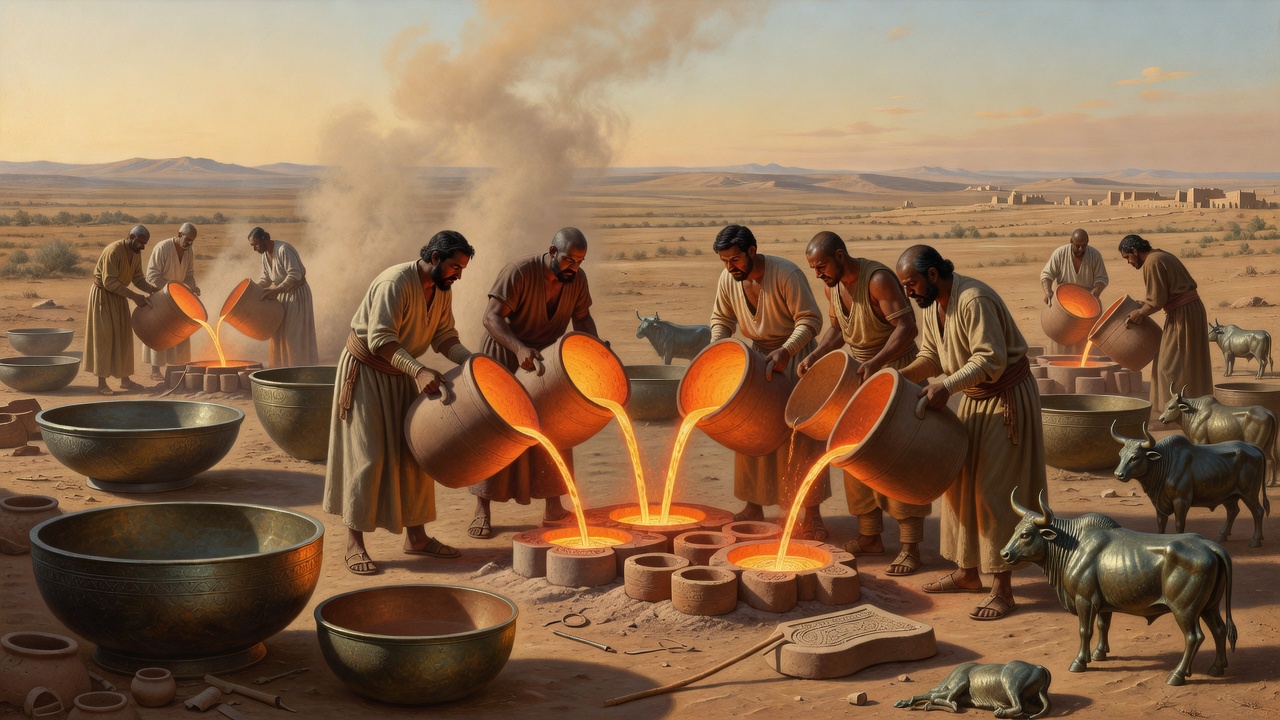
- The massive bronze furnishings for the temple, including the colossal basin known as the Sea and its twelve supporting oxen, were cast in clay molds in the Jordan Valley between Succoth and Zeredah (also called Zarthan). This complex metallurgical work was directed by the master artisan Huram-abi.Sources: the Bible text itself · Hiram · Zeredah
- The great cast metal Sea had a rim shaped like an open lily and held water exclusively for the priests to wash before performing sacred duties. Ten separate mobile basins were designated for rinsing the animal parts used in burnt offerings.Sources: the Bible text itself
- Inside the temple building, Solomon provided ten pure gold lampstands and ten tables for the Bread of the Presence, along with solid gold doors leading to the Most Holy Place and an abundance of gold utensils such as bowls, censers, and wick trimmers.Sources: the Bible text itself · Most Holy Place
Notes written with AI assistance from open sources (Theographic Bible Metadata, CC BY-SA 4.0; Easton’s Bible Dictionary, public domain) and reviewed before publishing.
Places in this chapter
- Jordan · Today: Jordan River · 31.761, 35.558 · verse 17
- Most Holy Place · Today: on Mount Moriah · 31.778, 35.236 · verses 20, 22
Only places identified with high confidence are shown (90% or more according to the scholarly sources compiled by OpenBible). Period map: DARE (Digital Atlas of the Roman Empire), CC BY 4.0; modern map: © OpenStreetMap contributors; places: OpenBible.info (CC BY 4.0).
Credits and license for this translation
Azərbaycan dilində Müqəddəs Kitab
The Holy Bible in the Azerbaijani language, also known as the Azeri language, of Azerbaijan, Iran, Iraq, Syria, and Turkey
Copyright © 2008 Müqəddəs Kitab Sirkəti
Language: Azeri (Azerbaijani, South)
Translation by: Institute for Bible Translation
Contributor: Bible Society of Azerbaijan
This translation text is made available to you under the
terms of the Creative Commons License: Attribution-Noncommercial-No Derivative Works.
( http://creativecommons.org/licenses/by-nc-nd/3.0/ )
In addition, you have permission to port the text to different file formats, as long as you
do not change any of the text or punctuation of the Bible.
You may share, copy, distribute, transmit, and extract portions
or quotations from this work, provided that you include the above copyright
information:
You must give Attribution to the work.
You do not sell this work for a profit.
You do not make any derivative works that change any of the actual words or punctuation of the Scriptures.
Permissions beyond the scope of this license may be
available if you contact
us with your request.
This translation is made available to you under the terms of the
Creative Commons Attribution-Noncommercial-No Derivatives license 4.0.
You may share and redistribute this Bible translation or extracts from it in any format, provided that:
You include the above copyright and source information.
You do not sell this work for a profit.
You do not change any of the words or punctuation of the Scriptures.
Pictures included with Scriptures and other documents on this site are licensed just for use with those Scriptures and documents.
For other uses, please contact the respective copyright owners.
2018-11-09
Source: http://ebible.org/azb/ · eBible.org