Genesis 25
Buk Baibel long Anuki · Tap a verse to see its cross-references.
Isso da Jeikap situbugha
19Abraham natuna Aisik da natunatuna yawata waragututudi mma naboni. Aisik tamananaki na Abraham 20bi raghanina Aisik kana bodu 40, na Rebeka irawayi. Touna Betuwel natuna, bi Leiban tiinaru wasike, na toudi Aram damdi bi Mesapotemiya kubure siyamakamake.
21Bi Rebeka ivigagara na Aisik, Yawe God biidi irupari da wavinena iyiwiiteni. Wasina bi Yawe God, Aisik yana rupari iwaiyaneni na wavinena wawaya bata imakeyedi. 22Bi muriye da siyatubugha na ededidi sinadinaki kamokamone siyiketokabivivirana, na Rebeka, Yawe God biidi ruparima ivitarakiiyana bo, “Awaki kiiravine bera naboni yatubutubugha tagu biidi?”
23Na Yawe God iwoneni bo,
“Nokodi ededa bata kamokamomve na kate dam sinatubugha
wawaya bata kunituvedi, bi siniaviya kabivivirana.
Tana inimaragata kirakii genaboni tana
Iyarokona touna murimurina inabigeni.”
24Raghanina Rebeka yana wiituwa gabudarina ipiika, na tomotomogha wawaya bata situbugha. 25Bi iyarokona itubugha na sinina idurina bi ere ghunighunina, ware kwama ghunighunina, noko biidi kana waghawagha sikwatuveni Isso. 26Bi noko murine na tomoyina tana itubugha imanama toghanaru kayegidune ikabikikita, na sikwatuveni Jeikap. Aisik kana bodu 60 bi wavinena mmkodi tomotomogha bata ivituvedi.
Isso iyaroko routotona miisena Jeikap ivereni
27Raghanina tomotomoyidi bata sivimagura murine, na Isso yebaye na wasina na nonowa iyanono garagaraye. Bi Jeikap na tomogha wawumina bi nonowa bareye iyamakamake. 28Aisik yana wiina, na Isso yayebagha na iyuvidi kam, noko biidi Isso ivinuwayuyunena kirakiiyeni bi Rebeka, na Jeikap ivinuwayuyuneni.
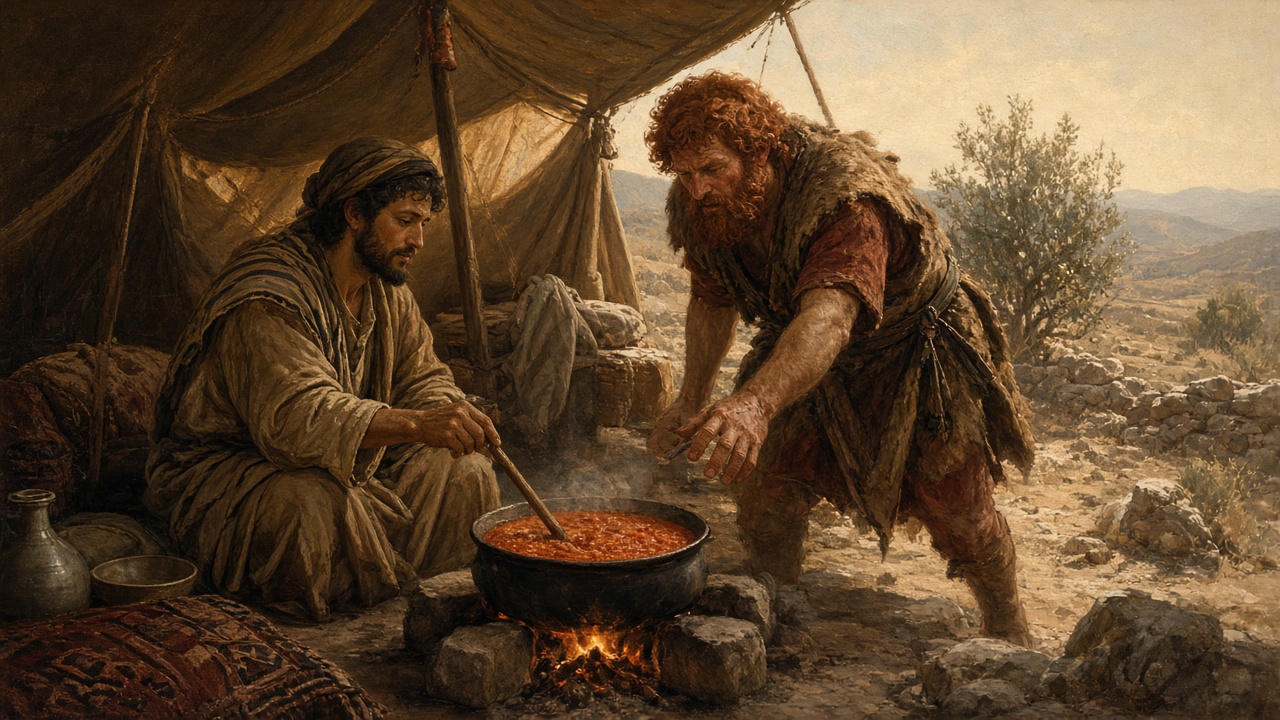
29Raghani tana gabudare Jeikap kiipeni monamonana iyimuyamuya, bi Isso garagarama iveramagha, vitonana irabobo da iyamameyeni. 30Na Jeikap iwoneni bo, “Tagu vitonana arabobo. Noko kiipenina idurina katota kuveregu anakani!” (Noko biidi sikwatuveni Idom).
31Bi Jeikap iwona bo, “Tamna iyarokom, muriye tamadanaki yana mourama reregha ghamana kunakabi. Kata kunawonegu da noko rereyina kunaveregu, na mmko kiipenina monamona anaverem.”
32Wasina Isso iwona bo, “Tagu vitonana araborabobo, na noko iyaroko rereyina kate gegha iniwiitegu! Na tam kabi.”
33Bi Jeikap iwona bo, “Katota wota kuwonakasiyaragha da noko iyaroko rereyina kunaveregu.” Na Isso wonakasiyaragha ibera da noko iyaroko rereyina Jeikap ivereni.
34Wasina bi Jeikap kiipeni monamonana muduna iyepataveni da Isso ivereni, bred viya teya, bi ikam iniuna bi igeghomiiri da inaghotaveyana. Wasina noko naboni kiiravine, Isso iyaroko rereyina miisena geiyakabikarawayenina da isinighiiyeni.
Did you know?
Abraham’s heirs and the twin brothers
- Keturah, whose name Easton's Bible Dictionary (1897) explains as “incense,” is introduced here as another wife of Abraham. That dictionary says he probably married her after Sarah’s death, though her nationality is unknown, and notes that 1 Chronicles calls her a concubine. She bore him six sons, including Jokshan and Midian, the father of the Midianites; while Abraham was still alive he gave gifts to the sons of his concubines and sent them away from Isaac to the land of the east.Sources: Keturah · Midian · the Bible text itself
- Isaac and Ishmael together buried Abraham in the cave of Machpelah near Mamre, in the field Abraham had bought from Ephron the Hittite, where Sarah already lay. Easton's Bible Dictionary (1897) explains Machpelah as “portion” or “double cave,” set on a hillside east of Hebron and facing Mamre, a place called the oaks—or, in a margin, the terebinths—of Mamre.Sources: Machpelah · Mamre · the Bible text itself
- Esau, Rebekah’s firstborn twin, was born red and covered with hair like a fur coat. Easton's Bible Dictionary (1897) links the further name Edom, “red,” to the red lentil stew for which he sold his birthright, and explains Jacob as “one who follows on another’s heels” or “supplanter,” matching the report that Jacob was born grasping Esau’s heel. Esau grew up as a skillful hunter and a man of the field, while Jacob was a quiet man who stayed at home.Sources: Esau (Edom) · Jacob (Israel) · the Bible text itself
Notes written with AI assistance from open sources (Theographic Bible Metadata, CC BY-SA 4.0; Easton’s Bible Dictionary, public domain) and reviewed before publishing.
Places in this chapter
- East · Today: region around Amman · 31.955, 35.934 · verse 6
- Machpelah · Today: Cave of the Patriarchs · 31.525, 35.111 · verse 9
- Negeb · 31.245, 34.841 · verse 11
- Assyria · 36.359, 43.153 · verse 18
- Egypt · 30.129, 31.308 · verse 18
Only places identified with high confidence are shown (90% or more according to the scholarly sources compiled by OpenBible). Period map: DARE (Digital Atlas of the Roman Empire), CC BY 4.0; modern map: © OpenStreetMap contributors; places: OpenBible.info (CC BY 4.0).
Credits and license for this translation
Buk Baibel long Anuki
Portions of the Holy Bible in the Anuki language of Papua New Guinea
Buk Baibel long tokples Anuki long Niugini
copyright © 2010-2016 Wycliffe Bible Translators, Inc.
Language: Anuki
Translation by: Wycliffe Bible Translators
This translation is made available to you under the terms of the
Creative Commons Attribution-Noncommercial-No Derivatives license 4.0.
You may share and redistribute this Bible translation or extracts from it in any format, provided that:
You include the above copyright and source information.
You do not sell this work for a profit.
You do not change any of the words or punctuation of the Scriptures.
Pictures included with Scriptures and other documents on this site are licensed just for use with those Scriptures and documents.
For other uses, please contact the respective copyright owners.
2014-06-02
Source: http://png.bible/aui/ · eBible.org