Genesis 25
Cishingini Agwara Kambari [asg] · Tap a verse to see its cross-references.
Ukpa̱ wi Ibirahi
1Ɗa Ibirahi u zuwai vuka vi yoku kula ku ni ku ɗa Ketura. 2Ɗa u matsakai ni Zimiran n Jokashan m Medan m Medan n Ishibaku koɓolo n Shuwa. 3Jokashan a̱yi ɗa esheku e Sheba n Dedanu. Muku n Dedanu ele ɗa aza a Ashurim n aza a Letushim n aza a LeꞋumim. 4Muku m Midiya ele ɗa anan Efa n Eferu n Hanoku, n Abida n Eleda. Dem vi le ntsukaya n Ketura n ɗa.
5Ibirahi u nekei Ishaku ili yu uka̱ni i ni i na wi n i ɗa dem. 6Ama muku n ali ma̱ a̱ma̱ci a na u zuwasai, ɗa u nekei le kuneꞋe, ali a̱yi biꞋi n wuma adama a na a̱ ka̱sukpa̱ Ishaku, ɗa o tonoi a kubana a iɗika i kasana.
7Ibirahi u yaꞋan ta̱ a̱ya̱ amangatawun n amangatatsunkupa n a tawun (175). Ɗa u kuwa̱i. 8Ibirahi u yinvikai ayinviki a ukocishi ɗa u kuwa̱i a̱ ka̱tsuma̱ ka̱ a̱ya̱ a singai. A̱ya̱ a̱ ni a yimkpa ta̱ ɗa u yongoi kpamu gbaga tsu na u gaꞋin. Ɗa u banai u cinai ikaya i ni. 9Muku n ni Ishaku n IsumaꞋilu a̱ ciɗa̱ngi ni a kaɓatsu ka Makapele kasana m Mamure a̱ ubuta̱ u Iforono maku ma Zoharu vuza va aza Hitiya. 10Ubuta̱ u na Ibirahi u tsulai wa aza a Hitiya, ta punu a̱ ciɗa̱ngi ni ubuta̱ u te n vuka vi ni. 11Ana Ibirahi u kuwa̱i, ɗa Ka̱shile ka zuwakai maku ma̱ ni Ishaku una̱singai. Vuza na u yongoi ɗevu m Biya-lahi-royi.
12Na va ɗaɗa arabali a̱ muku mi IsumaꞋilu, maku ma na maku mu usuki ma Saratu Hajara vuza va aza a Masar u matsakai Ibirahi.
13Na va ɗaɗa ula a̱ muku mi IsumaꞋilu, a ɗanai a ɗa uteku u na a matsai le, Nebatu a̱yi ɗa maku ma iyain ma IsumaꞋilu n Kedaru n Adabelu, m Mibisam kpamu, 14m Mishima n Duma koɓolo m Masa, 15n Hadadu koɓolo n Tema, n Jeturu, Nafishi n Kedema. 16Na va ɗaɗa muku mi IsumaꞋilu n ula e le, yaba dem n likuci n ka̱tsura̱ ka na wi a kulyaꞋa tsugono, ele ngono kupa ni n re n ɗa tsu na umaci u le wi. 17A̱yi IsumaꞋilu u yaꞋan ta̱ a̱ya̱ amangatawun n kamangankupa n e cindere (137) ɗa kpamu u yaꞋin ayinviki a ukocishi a̱ ni, ɗa wu uvukai n ikaya i ni. 18Ntsukaya n ni a̱ da̱sa̱ngi ta̱ a uɓon u Havila a kubana a Shuru a uɓon wu uteku m Masar, vu tono baci a kubana Asiriya. Ɗa o yongoi a tsurala n otoku i le.
A matsai Isuwa n Yakubu
19Na va ɗaɗa arabali a Ishaku maku mi Ibirahi.
Ibirahi ɗa esheku a Ishaku. 20Ayin a na Ishaku u yawai a̱ya̱ a amangere, ɗa a yaꞋin yolo n Rebeka, mekere ma Betuwe (vuza va aza a Aramiyan vu na wu uta̱i a Fada-aram). Rebeka kpamu taku vu Laban vuza va Aram ɗa.
21Ama Rebeka madari maꞋa, ɗa Ishaku u yaꞋankai ni kavasa. Vuzavaguɗu wi isai avasa a nanlo, ɗa Rebeka u ciya̱i ka̱tsuma̱. 22Muku n gita̱i punu kunekenei atakaci punu a̱ ka̱tsuma̱ ka uteku u le, ɗa u danai, <<Yiɗa̱i nannai a̱ kuciya̱ mu?>> U banai u Vuzavaguɗu n avasa adama a na u ciya̱ wu ushuki.
23Ɗa Vuzavaguɗu u danai ni, <<Iɗika i re yi ta̱ punu a̱ ka̱tsuma̱ ka̱ nu, mpeshe n na mi punu wa̱ nu va i ta̱ a kuyaꞋan tsurala. Vuza te u kulaꞋa ta̱ vuza ni, vuzagbayin va u kubono ta̱ o kutono vangu.>>
24Ana ayin a kumatsa a yawai, ɗa u matsai mpeshe olobo koci. 25Vuza na u gita̱i kuta̱ wu uta̱i ushili, ikyamba i ni adanshi motogu me cileme maꞋa u ukai. Ɗa e neꞋi ni kula Isuwa. 26Ɗaɗa yeve vuza ni u tonoi, n kukiye ku ni uka̱ni a̱ ka̱civa̱ ka Isuwa. Ɗa e neꞋi ni kula Yakubu. Ishaku wi ta̱ n a̱ya̱ amangatatsu ayin a na a matsai muku n nanlo.
Isuwa u dengei tsugbayin ci ni
27Ana olobo a o gbonguroi, ɗa Isuwa wo okpoi katain ku utsura, vuma vu ucigi u kakamba. Ama, Yakubu vuma vu ka̱bini ɗa n ucigi u kpaꞋa kpamu. 28Ishaku u laꞋa ta̱ n kuciga Isuwa, adama a inyama i na u tsu una ka̱ta̱ u bonoko a kpaꞋa. Ama, Rebeka u laꞋa ta̱ n kuciga Yakubu.
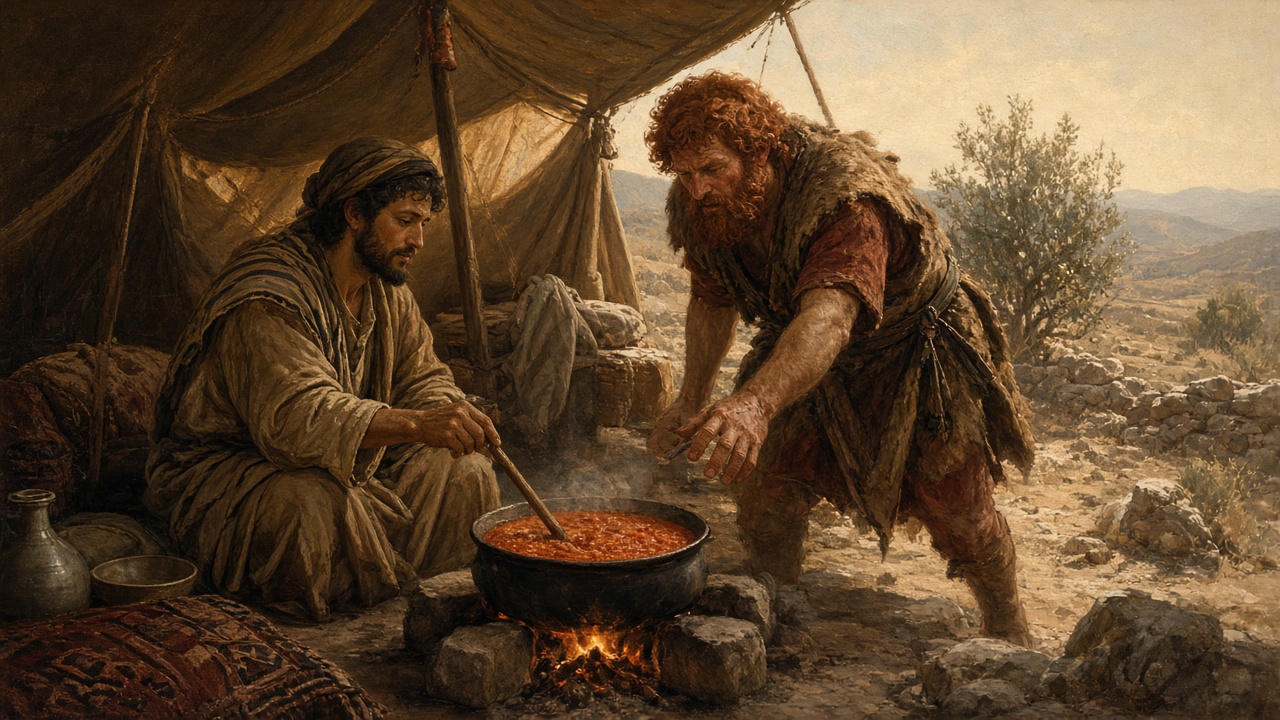
29Kanna ke te, ana Yakubu wi a ku suꞋwan kpayan, ɗa Isuwa u yawai wana ɗai wu uta̱ a kutambu. Wi ta̱ ta na a kupana kambulu. 30Ɗa u danai Yakubu, <<NeꞋe mu ilikulyaꞋa m kpayan ku shili, n lyaꞋa mi ta̱ a kupana kambulu.>> (Ɗaɗa i zuwai ɗa e ɗekei ni Edom.)
31Ɗa Yakubu wu ushuki, <<Mi ta̱ e kuneke wu, vi denke mu baci tsugbayin tsu nu, mo okpo vuza kelime vu nu.>>
32Isuwa u danai, <<U gaꞋan ta̱! Mi ta̱ ɗevu n ukpa̱, yi ɗa̱i tsugbayin tsa kuyaꞋanka mu?>>
33Ɗa Yakubu u danai, <<Kucina biꞋi, ve kudenke mu baci tsugbayin tsa.>>
Ɗa Isuwa u kucinai, ɗa u denke vangu va tsugbayin tsa.
34Ɗa Yakubu u nekei Isuwa boroji m kpayan. U lyaꞋi ɗa u soꞋi, yeve u ɗa̱nga̱i u lazai. Ta Isuwa u yaꞋin nannai ɗa u goyoi tsugbayin ci ni.
Did you know?
Abraham’s heirs and the twin brothers
- Keturah, whose name Easton's Bible Dictionary (1897) explains as “incense,” is introduced here as another wife of Abraham. That dictionary says he probably married her after Sarah’s death, though her nationality is unknown, and notes that 1 Chronicles calls her a concubine. She bore him six sons, including Jokshan and Midian, the father of the Midianites; while Abraham was still alive he gave gifts to the sons of his concubines and sent them away from Isaac to the land of the east.Sources: Keturah · Midian · the Bible text itself
- Isaac and Ishmael together buried Abraham in the cave of Machpelah near Mamre, in the field Abraham had bought from Ephron the Hittite, where Sarah already lay. Easton's Bible Dictionary (1897) explains Machpelah as “portion” or “double cave,” set on a hillside east of Hebron and facing Mamre, a place called the oaks—or, in a margin, the terebinths—of Mamre.Sources: Machpelah · Mamre · the Bible text itself
- Esau, Rebekah’s firstborn twin, was born red and covered with hair like a fur coat. Easton's Bible Dictionary (1897) links the further name Edom, “red,” to the red lentil stew for which he sold his birthright, and explains Jacob as “one who follows on another’s heels” or “supplanter,” matching the report that Jacob was born grasping Esau’s heel. Esau grew up as a skillful hunter and a man of the field, while Jacob was a quiet man who stayed at home.Sources: Esau (Edom) · Jacob (Israel) · the Bible text itself
Notes written with AI assistance from open sources (Theographic Bible Metadata, CC BY-SA 4.0; Easton’s Bible Dictionary, public domain) and reviewed before publishing.
Places in this chapter
- East · Today: region around Amman · 31.955, 35.934 · verse 6
- Machpelah · Today: Cave of the Patriarchs · 31.525, 35.111 · verse 9
- Negeb · 31.245, 34.841 · verse 11
- Assyria · 36.359, 43.153 · verse 18
- Egypt · 30.129, 31.308 · verse 18
Only places identified with high confidence are shown (90% or more according to the scholarly sources compiled by OpenBible). Period map: DARE (Digital Atlas of the Roman Empire), CC BY 4.0; modern map: © OpenStreetMap contributors; places: OpenBible.info (CC BY 4.0).
Credits and license for this translation
Cishingini Agwara Kambari [asg]
Cishingini: Cishingini Agwara Kambari [asg] (Bible)
copyright © 2025 Language Development and Translation Initiative (LDTI)
Language: (Cishingini)
Contributor: The Seed Company
This translation is made available to you under the terms of the
Creative Commons Attribution Share-Alike license 4.0.
You have permission to share and redistribute this Bible translation in any format and to make reasonable revisions and adaptations of this translation, provided that:
You include the above copyright and source information.
If you make any changes to the text, you must indicate that you did so in a way that makes it clear that the original licensor is not necessarily endorsing your changes.
If you redistribute this text, you must distribute your contributions under the same license as the original.
Pictures included with Scriptures and other documents on this site are licensed just for use with those Scriptures and documents.
For other uses, please contact the respective copyright owners.
Note that in addition to the rules above, revising and adapting God's Word involves a great responsibility to be true to God's Word. See Revelation 22:18-19.
2025-07-09
Source: http://ebible.org/asg/ · eBible.org