Exodus 13
Cishingini Agwara Kambari [asg] · Tap a verse to see its cross-references.
Kerengu ku maku ma iyain
1Vuzavaguɗu u danai Musa, 2<<Maku ma iyain ma vuma ma aza a Isaraila, ko vuma ko manama, ma̱ va̱ maꞋa, vu neke maꞋa a kubana wa̱ va̱.>>
3Ɗa Musa u danai uma a, <<Ciɓasai n kanna ka nampa ka na yu uta̱i a iɗika i Masar, a̱ ubuta̱ wu ugbashi, n utsura u Vuzavaguɗu wu uta̱ka̱i ɗa̱, ɗa u tuka̱i ɗa̱ na. Ka̱ta̱ i takuma boroji vu na vi n yisiti ba. 4A kanna ka nampa ko wotoi u Abibu ka ɗaɗa yu uta̱i a iɗika i Masar. 5A ayin a na baci Vuzavaguɗu u bankai ɗa̱ a iɗika i uma i KanaꞋana, n Hitiya n Amoriya n Hiviya n Jebusiya, i na u kucinakai ikaya i nu u kuneke wu i ɗa. Iɗika i na yi m maniꞋin n tsuta̱, ka̱ta̱ vi yaꞋan ka̱ɗiva̱ vu ciɓasa n kanna ko wotoi ka nampa ka a̱ ka̱ya̱ dem. 6I takuma boroji vu na a yaꞋin n yisiti ba ali ayin e cindere, a kanna ke cindere, i yaꞋan ka̱ɗiva̱ ka u Vuzavaguɗu. 7Yi ta̱ a kutakuma boroji vu babu yisiti va ali ayin e cindere, a̱ ka̱tsuma̱ ka ayin a nanlo, ka̱ta̱ a cina ili i na yi n yisiti a̱ ka̱tsuma̱ ka̱ ɗa̱, ko punu a̱ ubuta̱ u na yi dem ba. 8A kanna ka nanlo ka ɗa va kudana maku ma̱ nu, <Ili i na i zuwai ɗa mi kuyaꞋan ka̱ɗiva̱ ka nampa ka, ka ɗaɗa adama a ili i na Vuzavaguɗu u yaꞋankai mu, wu utuka̱i mu a iɗika i Masar.> 9Ka̱ɗiva̱ ka nampa ki ta̱ o kokpo an urotu e kukiye ku nu, n ili i kuciɓasa kpamu a̱ kuca̱n ku nu adama a na wila̱ u Vuzavaguɗu u yongo punu a̱ ka̱ɗu ka̱ nu, ka̱ta̱ vu dansa n una̱ u nu. Adama a na Vuzavaguɗu ɗa wu utuka̱i nu a iɗika i Masar n utsura u gbayin. 10Yi ta̱ a kuciɓasa n kanna ka̱ ka̱ɗiva̱ ka nampa ka a ayin a na a zuwai, a̱ ka̱ya̱ lakam.
11<<Ayin a na baci Vuzavaguɗu u tuka̱i ɗa̱ a iɗika i KanaꞋana, ɗa u nekei ɗa̱ i ɗa, uteku tsu na u yaꞋin uzuwakpani n a̱ɗa̱ n ikaya i ɗa̱ u kuneke ɗa̱ ta̱ iɗika ya, 12ka̱ta̱ i neke Vuzavaguɗu umaci u iyain u muku n ali n vuma, koɓolo n umaci u iyain u muku n ali wu nnama adama a na n Vuzavaguɗu n ɗa. 13Kogono ka majaki dem ka na a̱ gita̱i kumatsa vi ta̱ a kufuɗa va tsupa m maku ma malala. Ama vi ciga baci kuyaꞋan nannai ba, vu koɗo majaki ma kuɗeku. Ama maku ma vuma dem vi ta̱ a kufuɗa va tsupa maꞋa.
14<<A kubana a ayin o yoku maku ma̱ nu me ece wu baci, <Yiɗa̱i na va?> U shuku yi, <N utsura u Vuzavaguɗu u ɗa wu uta̱ka̱i tsu a iɗika i Masar, a̱ ubuta̱ u na ci ishi a tsugbashi. 15Ana FiriꞋauna u yaꞋin ugbamukaci, ɗa u iwain kuka̱sukpa̱ tsu tsu laza. Ɗa Vuzavaguɗu wu unai muku n ali n na a̱ gita̱i kumatsa n vuma nu nnama dem a Masar. I ɗaɗa i zuwai ɗa ci a kuyaꞋanka muku n iyain mu nnama alyuka u Vuzavaguɗu. Ka̱ta̱ tsu tsupaka maku ma iyain ma vuma dem a̱ ubuta̱ u Vuzavaguɗu.> 16Na va wi ta̱ o kokpo an urotu e kukiye ku nu n ili i kuciɓasa a̱ kuca̱n ku nu, a na Vuzavaguɗu wu uta̱ka̱i tsu a iɗika i Masar n utsura u gbayin u kukiye ku ni.>>
Uma a a̱ ka̱sukpa̱i Masar
17Ana FiriꞋauna u ka̱sukpa̱i uma a lazai, Ka̱shile ka̱ ka̱sukpa̱ le o tono n uye wa asuvu ba, u na u walai a iɗika ya aza a̱ Filisitiya. Adama a na Ka̱shile ka dana ta̱, <<I ta̱ a kufuɗa kusabaꞋa a̱ɗu e le ka̱ta̱ a suma o kubono a Masar ayin a na baci e enei kuvon.>> 18Ɗa Ka̱shile ko tonoi n ele a uye u na u tonoi m meremune u na u walai a Mala ma Shili. Ayin a na aza a Isaraila a̱ ka̱sukpa̱i Masar i ta̱ ufoɓushi a na osoji o kuvon.
19Ɗa Musa u ɗikai etele a̱ Isufu, adama a na a̱yi Isufu u zuwa ta̱ ɗe muku mi Isaraila a kucina u danai, <<Mayun Vuzavaguɗu wi ta̱ a̱ kuta̱wa̱ wa̱ ɓa̱nka̱ ɗa̱, ka̱ta̱ i ɗika etele a̱ va̱ ayin a na baci yi a kulaza kuka̱sukpa̱ ubuta̱ u nampa.>>
20Ɗa muku mi Isaraila n ka̱sukpa̱i Sukotu, ɗa a banai a̱ da̱sa̱ngi e Etam a̱ ka̱kina̱ kafu a uwa e meremune. 21N kanna Vuzavaguɗu u tsu wala ta̱ kelime ke le n kabashi ke keleshu adama a na u yotsongu le uye, n kayin tamkpamu u wala n ele n kabashi ke keleshu ka kutashi ka akina. Adama a na e ene ubuta̱, ciya̱ a fuɗa a yaꞋan nwalu n le n kanna n kayin dem. 22Vuzavaguɗu u takpa kabashi ke keleshu n kanna ko ka kutashi ka akina n kayin a̱ ubuta̱ u uma a̱ ni ba.
Did you know?
The Firstborn and the Departure from Egypt
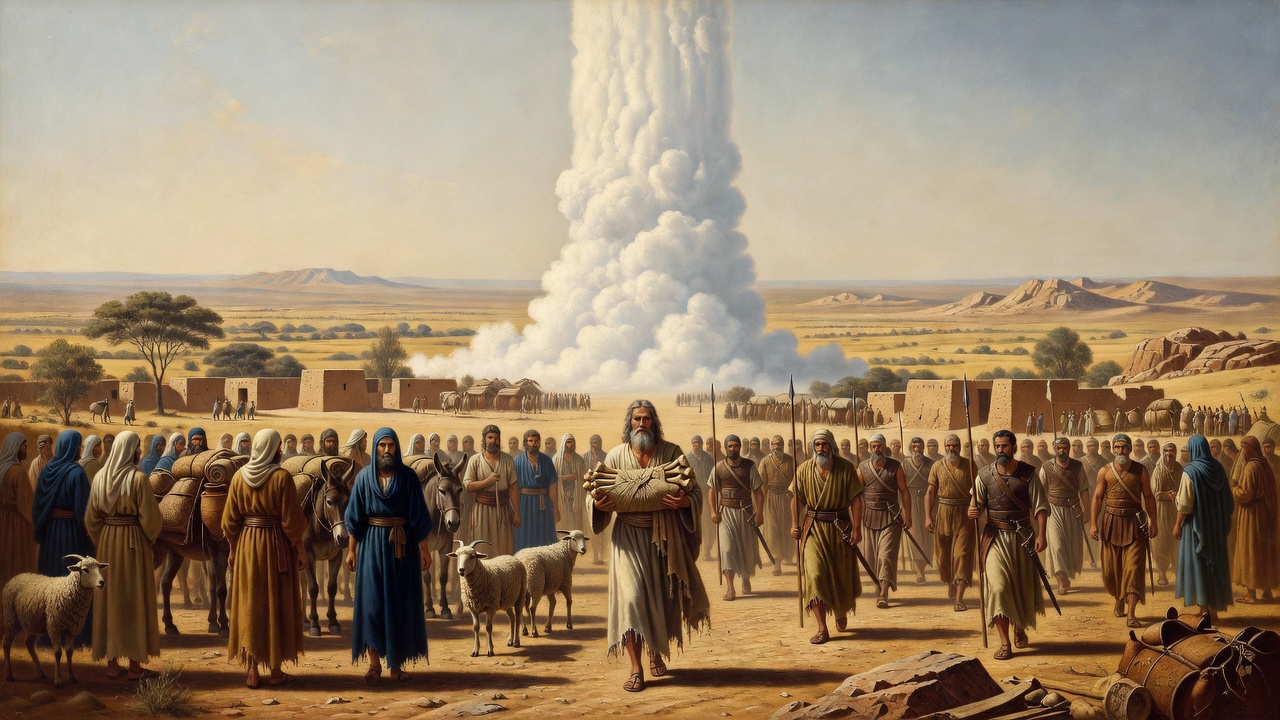
- God did not lead them by the shorter road through the land of the Philistines, lest war make them return to Egypt, but by the wilderness toward the Red Sea, which separates Asia from Africa. They set out from Succoth, the first encampment after leaving Ramesses and also the civil name of Pithom, and made their third camp at Etham, on the edge of the wilderness. Etham is perhaps another name for Khetam, or “fortress,” on the wall of Shur, which ran from the Mediterranean to the Gulf of Suez, and the camp was probably a little west of modern Ismailia.Sources: the Bible text itself · Succoth · Etham · Red Sea
- Moses took the bones of Joseph with him, because Joseph had made the sons of Israel swear that, when God attended to them, they must carry his bones from that place. Joseph was the elder of the two sons of Jacob by Rachel.Sources: the Bible text itself · Joseph (son of Jacob)
- The LORD told Moses to consecrate every firstborn male; the firstborn from every womb among the Israelites, both of people and of animals, belonged to him. Every firstborn donkey was to be redeemed with a lamb, or else have its neck broken, and every firstborn son was to be redeemed. When a son asked what this meant, he was to be told that Pharaoh had stubbornly refused to let them go, so the LORD killed every firstborn in Egypt, of people and of animals, and brought them out of the house of slavery.Sources: the Bible text itself
Notes written with AI assistance from open sources (Theographic Bible Metadata, CC BY-SA 4.0; Easton’s Bible Dictionary, public domain) and reviewed before publishing.
Places in this chapter
Only places identified with high confidence are shown (90% or more according to the scholarly sources compiled by OpenBible). Period map: DARE (Digital Atlas of the Roman Empire), CC BY 4.0; modern map: © OpenStreetMap contributors; places: OpenBible.info (CC BY 4.0).
Credits and license for this translation
Cishingini Agwara Kambari [asg]
Cishingini: Cishingini Agwara Kambari [asg] (Bible)
copyright © 2025 Language Development and Translation Initiative (LDTI)
Language: (Cishingini)
Contributor: The Seed Company
This translation is made available to you under the terms of the
Creative Commons Attribution Share-Alike license 4.0.
You have permission to share and redistribute this Bible translation in any format and to make reasonable revisions and adaptations of this translation, provided that:
You include the above copyright and source information.
If you make any changes to the text, you must indicate that you did so in a way that makes it clear that the original licensor is not necessarily endorsing your changes.
If you redistribute this text, you must distribute your contributions under the same license as the original.
Pictures included with Scriptures and other documents on this site are licensed just for use with those Scriptures and documents.
For other uses, please contact the respective copyright owners.
Note that in addition to the rules above, revising and adapting God's Word involves a great responsibility to be true to God's Word. See Revelation 22:18-19.
2025-07-09
Source: http://ebible.org/asg/ · eBible.org