Genesis 35
Uisneno In Kabin ma Prenat: Rais Manba'an Fe'u nok Reta' Ahun-hunut · Tap a verse to see its cross-references.
Naiꞌ Yakop sin naenan neu Betel
1Rarit Uisneno naꞌuab nok naiꞌ Yakop am nak, “Au reꞌ ia, Uisneno reꞌ nakriir On neu ko, oras ho maen muꞌko ho tataꞌ naiꞌ Esau. Oras ia, ho mfooꞌ nai muꞌko bare ia meu Betel. Amtea nee te, ambaik mei fuat ma mfee fuaꞌ-turuꞌ meu Kau. Rarit ho mutua mubaar ambi naan nai.”
2Rarit naiꞌ Yakop naꞌuab nok in uim je naan ee ok-okeꞌ mnak, “Oras ia, hit he tnao teu Betel. Unuꞌ te, oras au ꞌbi susat nanaꞌrenat, Uisneno nturun kau nbi nee. Au he ꞌmoeꞌ mei fuat aꞌbi bare naan. Onaim oras ia, hi mait imporin hi faut-fuat reꞌ maruun ein okeꞌ. Mikninuꞌ hi tuam, ma msekaꞌ hi baer paken, natuin hit he taꞌruriꞌ ma taꞌbees teu Uisneno.” 4Onaim sin nnonaꞌ sin faut-fuat reꞌ maruun ein ma sin faorn ein amsaꞌ. Rarit naiꞌ Yakop antoup sin ma nsuub sin nbi hau kouꞌ goes in uun, anpaumaak kuan Sikem. 5Oras naiꞌ Yakop sin nnaon nasaitan Sikem, Uisneno nfee rasi mtaus neu too pah anfuun am nateef, tar antea sin ka nabranin fa he ntaon rais reꞌuf neu naiꞌ Yakop sin.
6Onaim naiꞌ Yakop nok in too pukan naan, antean nok mamut anbin Betel et pah Kanaꞌan. (Betel naan, unuꞌ feꞌe te, in kaan ee, Lus.) 7Anbi naan, naiꞌ Yakop anbaik fatu njair mei fuat. Rarit in nakanab bare naan nak El Betel (reꞌ in oetn ii nak, ‘Betel in Uisneno’), natuin unuꞌ te Uisneno nakriir On neu naiꞌ Yakop anbi naan, oras in naen nasaitan in tataf.
8Anpaumaak kuan Betel, anmuiꞌ hau uuꞌ kouꞌ goes reꞌ atoniꞌ nakaanb ee, Aron Bakut. In aꞌmoufn ii nak, ‘hau meꞌ-meꞌur’. In napein kanaf naan, natuin oras bi Ripka in bifee atitus, es reꞌ bi Debora nmaet, sin nsuub ee nbi hau naan in uun.
9Neon goes ii, oras naiꞌ Yakop anfain neem naꞌko Padan Aram, Uisneno nakriir On antein, ma nfee ne tetus-athoen. 10Uisneno naꞌuab am nak, “Anmurai oras ia, ho kaan maan ka naiꞌ Yakop antein fa goen. Mes Au ukanab ko ꞌeik kaan feꞌu es, es reꞌ Israꞌel. 11Au reꞌ ia, Uisneno reꞌ Akuaas Reꞌuf. Onaim ho muhoniꞌ ma musuuf amfa-faun. Uuf-uuf ma pah-pah of anpoin ma nboran naꞌkon ho sufam ma ho kaꞌum sin. Ma ho of muhoniꞌ maan usif-usif amsaꞌ. 12Pah reꞌ nahunu te Au ꞌfee je ꞌeu ho naꞌi naiꞌ Abraham ma ho amaꞌ naiꞌ Isak naan, oras ia Au ꞌfee ko goe, ma ho sufam-kaꞌum sin.”
13Uisneno naꞌuab anrair on naan ate, naiꞌ Yakop nahakeꞌ fatu nbi naan, he njair tanar he namnau Uisneno In rais manbaꞌan. Rarit in nꞌoop tua min-kase, ma minaꞌ anbi fatu naan, ma nꞌonen neu Uisneno. 15In nakanab bare naan, Betel.
Naiꞌ Yakop in fee bi Rahel anmaet oras nahoniꞌ
16Rarit naiꞌ Yakop sin annaon nasaitan Betel. Oras sin he noi nhaumaak kuan Efrata (es reꞌ Betlehem), antea in oors aa goen he bi Rahel nahoniꞌ. Mes in nahoniꞌ nok susat. 17Oras in nakes-kees feꞌ, bifee atuis ee natoon ee mnak, “Ain Rahel! Amhaꞌtain ho neek maan. Ho aanh ii mone!” 18Oras bi Rahel he noi natfeek, in nakanab riꞌanaꞌ naan, naiꞌ Ben-Oni (reꞌ in aꞌmoufn ii, ‘riꞌanaꞌ naꞌko au susat-nanaꞌrenat’). Rarit in natfeek. Mes naiꞌ Yakop nakanab riꞌanaꞌ naan, naiꞌ Benjamin (reꞌ in oetn ii nak, ‘riꞌanaꞌ nbi au ꞌnimak aꞌneꞌu’).
19Rarit sin nsuub bi Rahel nbi ranan reꞌ he tnao teu Efrata in ninin, (reꞌ oras ia in kaan ee, Betlehem). 20Rarit naiꞌ Yakop nahakeꞌ faut natef es anbi naan. Bi Rahel in faut natef naan, et na feꞌ, tar antea oras ia.
Naiꞌ Yakop in aanh ein
21Rarit naiꞌ Yakop nananiꞌ bare piut-piut. Neot es, in nahakeꞌ tenas anbi tobe baik maꞌnopoꞌ Eder in aon bian. 22Oras sin nbin naan ate, naiꞌ Ruben antuup nok in aamf ee in fee panaꞌ bi Bilha. Naiꞌ Yakop nahiin rasi naan.
Naiꞌ Yakop in aan moen ein, tuaf boꞌes am nua.
23Bi Lea in aanh ein esan reꞌ: naiꞌ Ruben (naiꞌ Yakop in aan moen unu), naiꞌ Simeon, naiꞌ Lewi, naiꞌ Yahuda, naiꞌ Isaskar, ma naiꞌ Sebulon.
24Bi Rahel in aanh ein esan reꞌ: naiꞌ Yusuf ma naiꞌ Benjamin.
25Bi Rahel in ate bi Bilha in aanh ein esan reꞌ: naiꞌ Dan ma naiꞌ Naftali.
26Rarit bi Lea in ate bi Silpa in aanh ein esan reꞌ: naiꞌ Gat ma naiꞌ Aser.
Nahonis riꞌaan ein naan anbin Padan Aram.
Naiꞌ Yakop in amaf naiꞌ Isak anmaet
27Rarit naiꞌ Yakop nnao nmakius in amaf naiꞌ Isak anbi Mamre anpaumaak kuan Kiryat-Arba (kuan naan, oras ia, in kaan ee, Hebron). Unuꞌ te, in naꞌif naiꞌ Abraham natua nbi bare naan amsaꞌ. 28Naiꞌ Isak anmoin naan toon nautn es boꞌ fanu te (180), naꞌ in nmaet. Rarit in anah naiꞌ Esau ma naiꞌ Yakop, ansuub ee.
Did you know?
Jacob's Return to Bethel
- God tells Jacob to go up to Luz, also called Bethel, in the land of Canaan, and to build an altar to the God who appeared to him when he fled from his brother Esau. Luz was the ancient name of a royal Canaanite city; the name Bethel was at first apparently given to a sanctuary nearby, and only later to the city itself, after the tribe of Ephraim conquered it. Jacob had halted there and received a prophetic vision, and on this return he builds an altar and calls the place El-bethel.Sources: the Bible text itself · Luz · Bethel (of Palestine)
- Before they set out, Jacob tells his household to get rid of the foreign gods among them, purify themselves, and change their garments; they give him the gods and their earrings, and he buries them under the oak near Shechem. Shechem stood in a narrow sheltered valley between Ebal on the north and Gerizim on the south, mountains only some five hundred yards apart at their base. After returning from Mesopotamia, Jacob had bought a field there from the children of Hamor, and Rachel, Laban's daughter, had taken her father's teraphim when the family left.Sources: the Bible text itself · Shechem · Rachel
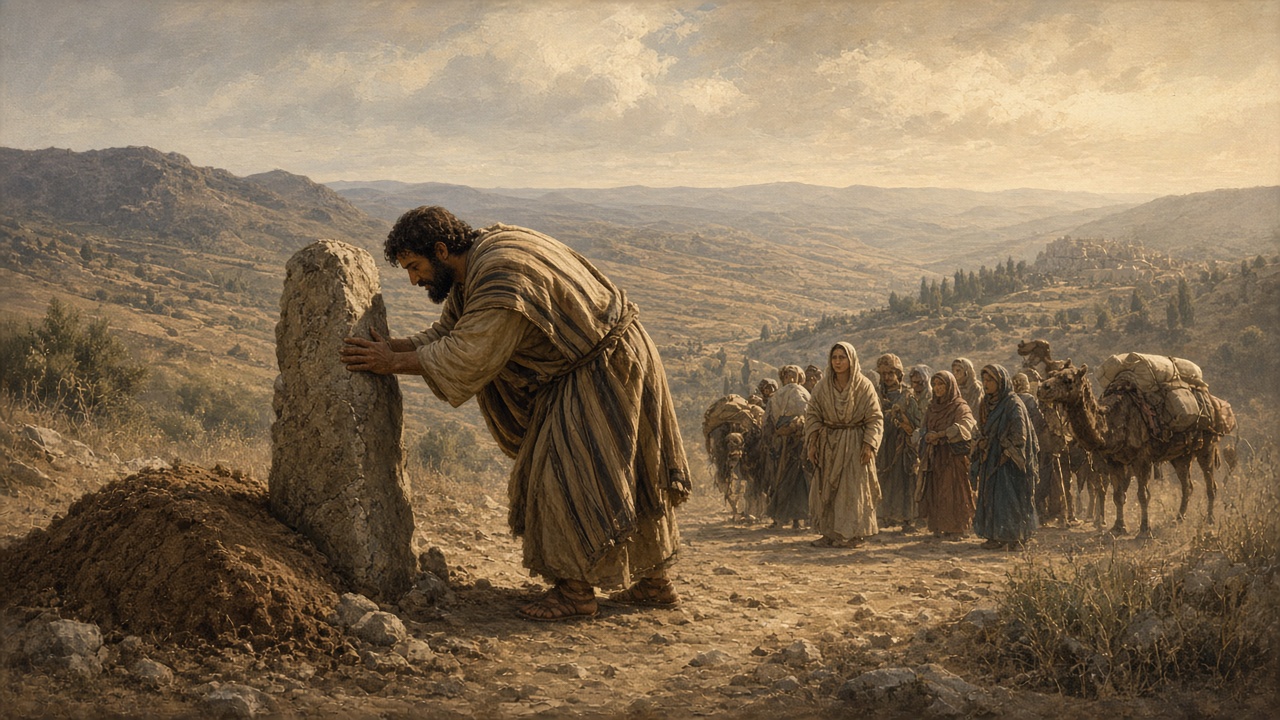
- On the journey from Bethel, while they are still some distance from Ephrath, Rachel dies giving birth to Benjamin, on the road between Bethel and Bethlehem. With her last breath she names him Ben-oni, 'son of my pain,' but Jacob calls him Benjamin. He buries her on the way to Ephrath, that is, Bethlehem, and sets a pillar on her grave.Sources: the Bible text itself · Rachel · Benjamin (patriarch)
Notes written with AI assistance from open sources (Theographic Bible Metadata, CC BY-SA 4.0; Easton’s Bible Dictionary, public domain) and reviewed before publishing.
Places in this chapter
- Shechem · Today: Tell Balatah · 32.214, 35.282 · verse 4
- Canaan · 32.767, 35.333 · verse 6
- Luz · Today: Beitin · 31.923, 35.241 · verse 6
- El-bethel · Today: in Beitin · 31.923, 35.241 · verse 7
- Allon-bacuth · Today: within 1 km of Beitin · 31.923, 35.241 · verse 8
- Ephrath · Today: Bethlehem · 31.704, 35.208 · verses 16, 19
- Bethlehem · 31.704, 35.208 · verse 19
- Hebron · Today: Tel Rumeida · 31.525, 35.102 · verse 27
Only places identified with high confidence are shown (90% or more according to the scholarly sources compiled by OpenBible). Period map: DARE (Digital Atlas of the Roman Empire), CC BY 4.0; modern map: © OpenStreetMap contributors; places: OpenBible.info (CC BY 4.0).
Credits and license for this translation
Uisneno In Kabin ma Prenat: Rais Manba'an Fe'u nok Reta' Ahun-hunut
Genesis and the New Testament in the Amarasi language of Indonesia
Kejadian dan Perjanjian Baru dalam bahasa Amarasi dari
copyright © 1999-2014 Unit Bahasa dan Budaya, Kupang NTT, Indonesia
Language: Amarasi
Translation by: Wycliffe Bible Translators
This translation is made available to you under the terms of the
Creative Commons Attribution-No Derivatives license 4.0.
You may share and redistribute this Bible translation or extracts from it in any format, provided that:
You include the above copyright and source information.
You do not make any derivative works that change any of the actual words or punctuation of the Scriptures.
Pictures included with Scriptures and other documents on this site are licensed just for use with those Scriptures and documents.
For other uses, please contact the respective copyright owners.
2022-03-11
Source: http://ebible.org/aaz/ · eBible.org