Isaías 64
De Heilige Schrift, Petrus Canisiusvertaling, 1939 · Toque num versículo para ver as referências cruzadas.
1Ach, scheur toch de hemel vaneen, en daal neer, Zodat de bergen voor uw aangezicht rillen; 2Als een vuur, dat brandhout doet vlammen, Een vuur, dat het water doet stomen: Om uw vijanden uw Naam te doen kennen, En volken voor U te doen beven, 3Als Gij de grootse dingen doet, waarop we niet durfden hopen, 4En waarvan men nog nooit had gehoord! Neen, geen oor heeft gehoord, Geen oog ooit gezien: Een God, buiten U, Die helpt, die op U hopen; 5Die vreugde bereidt voor wie gerechtigheid doet, En uw wegen gedenkt! Maar nu zijt Gij toornig: wij hebben gezondigd; Zo lang al vergramd: wij waren afvallig. 6Allen zijn wij als onreinen geworden, Heel onze deugd als een doek, door stonden bezoedeld; Als bladeren vallen wij allemaal af, Onze zonden jagen ons voort als de wind. 7Er is niemand, die uw Naam nog aanroept, Of die op U nog durft steunen; Want Gij hebt voor ons uw aanschijn verborgen, Ons prijs gegeven aan onze schuld. 8Toch blijft Gij, Jahweh, onze Vader! Wij zijn het leem, Gij onze boetseerder; Wij allen het werk uwer handen! 9Ach, Jahweh, wees toch niet al te vergramd, Niet altijd onze misdaad indachtig. Ach, zie op ons neer: Wij blijven toch allen uw volk! 10Uw heilige steden zijn een steppe geworden, Sion een wildernis, Jerusalem een woestijn. 11Onze heilige en heerlijke tempel, Waarin onze vaderen U hebben geloofd, Is een prooi der vlammen geworden; Al wat ons dierbaar was, ligt in puin! 12Kunt Gij dit alles maar toezien, o Jahweh; Maar zwijgen, ten einde toe ons vernederen?
Você sabia?
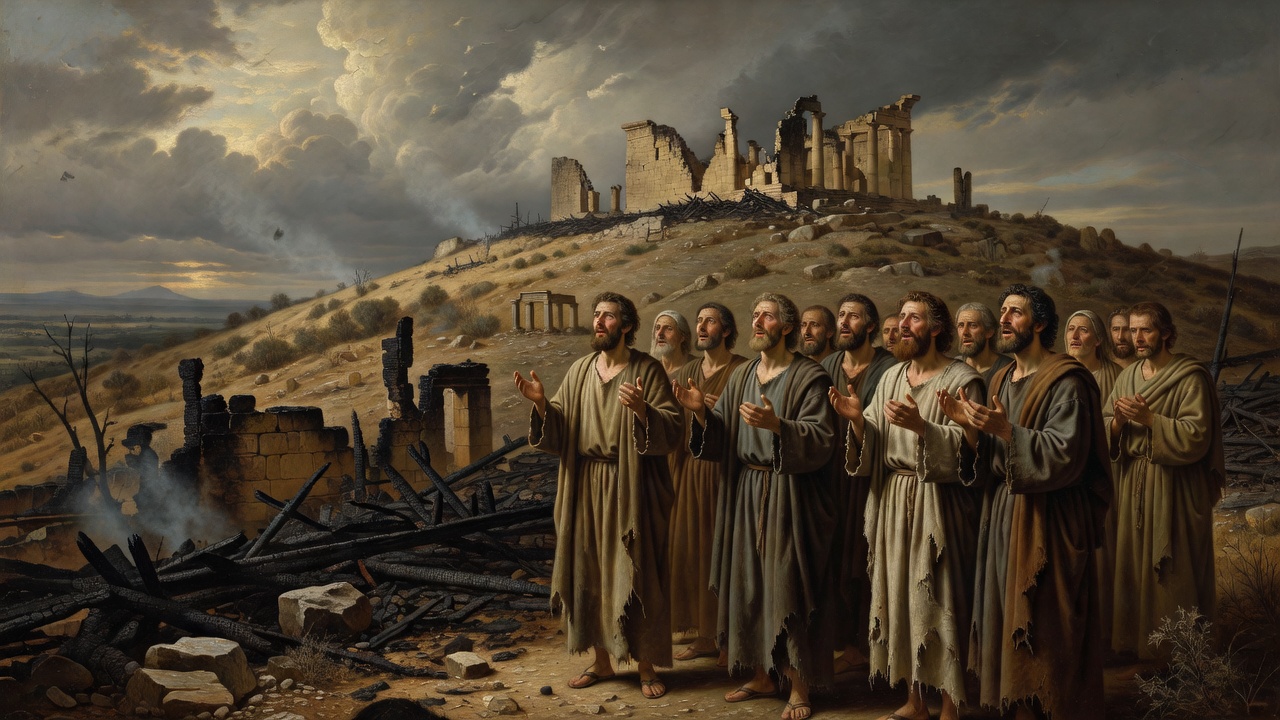
Uma Oração por Misericórdia em Meio às Ruínas
- A passagem começa com uma súplica para que Deus fenda os céus e desça com poder abalador, como fogo que acende a lenha. Contudo, contrasta esse desejo pela presença de Deus com uma confissão da indignidade humana, comparando as pessoas a folhas secas levadas por suas próprias iniquidades.Fontes: o próprio texto bíblico
- Em Isaías 64, a comunidade apela a Deus como Pai e artesão, declarando: "nós somos o barro, e tu és o nosso oleiro". Essa metáfora enfatiza a fragilidade humana e a total dependência de Deus, suplicando por misericórdia divina apesar do reconhecimento de suas culpas.Fontes: o próprio texto bíblico
- O capítulo lamenta a destruição dos espaços sagrados, descrevendo Sião e Jerusalém como desertos e desolações. O texto lamenta especificamente o incêndio e a ruína do templo sagrado onde as gerações passadas haviam prestado louvor.Fontes: o próprio texto bíblico · Zion · Jerusalem
Notas escritas com auxílio de IA a partir de fontes abertas (Theographic Bible Metadata, CC BY-SA 4.0; Easton’s Bible Dictionary, domínio público) e revisadas antes de publicar.
Lugares deste capítulo
Só aparecem lugares com identificação de alta confiança (90% ou mais segundo as fontes acadêmicas reunidas pelo OpenBible). Mapa da época: DARE (Digital Atlas of the Roman Empire), CC BY 4.0; mapa atual: © colaboradores do OpenStreetMap; lugares: OpenBible.info (CC BY 4.0).
Créditos e licença desta tradução
De Heilige Schrift, Petrus Canisiusvertaling, 1939
The Holy Bible in Dutch, Petrus Canisius translation, 1939
Public Domain
Language: Nederlandse taal (Dutch)
Eerste uitgave: Het Spectrum, Utrecht, Brussel, 1939
De Petrus Canisiusvertaling is een Nederlandse rooms-katholieke bijbelvertaling, waarvan de eerste complete uitgave verscheen in 1939. De volledige naam luidt: "De Heilige Schrift, vertaling uit de grondtekst met aantekeningen, in opdracht van de Apologetische Vereniging 'Petrus Canisius' ondernomen met goedkeuring van de hoogwaardige bisschoppen van Nederland". De Petrus Canisiusvertaling is de eerste Nederlandse katholieke vertaling die gebaseerd is op de grondteksten in hun oorspronkelijke taal. Andere vertalingen gingen uit van de Vulgaat. Het taalgebruik van de uitgave is naar hedendaagse normen licht archaïsch te noemen, maar nog steeds vlot verstaanbaar.
Verantwoording in verband met de auteursrechten
In verband met de auteursrechten is contact opgenomen met de oorspronkelijke uitgever (1), de Katholieke Vereniging voor Oecume (2) en de Katholieke Bijbelstichting (3) en werden geen bezwaren gevonden tegen deze publicatie. Rekening houdend met de wettelijke termijnen, kan deze uitgave beschouwd worden als vrij van auteursrechten.
First publication: Het Spectrum, Utrecht, Brussel, 1939
The translation "Petrus Canisius" is a dutch roman catholic bible translation, that was first published in 1939. Its full title is "The Holy Scripture, translation of the original texts with annotations, commissioned by the Apologetical Society 'Petrus Canisius' and executed with the approval of the most reverend bishops of the Netherlands". The translation "Petrus Canisius" is the first dutch catholic translation that was based on the scripture texts in their original language. Other translations were based on the Vulgate. The language of this edition is to current standards moderately archaic, but still easily understood.
Accountability in relation to copyright
Concerning the copyright contacts have been made with the original publisher (1), the Katholieke Vereniging voor Oecumene (Catholic Society for Ecumenism) (2) and the Katholieke Bijbelstichting (Catholic Bible Foundation) (3) and no objections have been found against this publication. Taking into account the legal terms, this edition can be considered to be in the public domain.
UITGEVERIJ UNIEBOEK|HET SPECTRUM BV, HOUTEN, THE NETHERLANDS
KATHOLIEKE VERENIGING VOOR OECUMENE, 'S HERTOGENBOSCH, THE NETHERLANDS
KBS, HOEVEN, THE NETHERLANDS
2024-08-06
Fonte: http://ebible.org/nld1939/ · eBible.org