2 Crônicas 27
De Heilige Schrift, Petrus Canisiusvertaling, 1939 · Toque num versículo para ver as referências cruzadas.
1Jotam was vijf en twintig jaar, toen hij koning werd, en heeft zestien jaar in Jerusalem geregeerd. Zijn moeder heette Jeroesja, en was de dochter van Sadok. 2Hij deed wat goed was in de ogen van Jahweh, juist zoals zijn vader Ozias gedaan had; behalve dan, dat hij het heiligdom van Jahweh niet binnendrong. Maar het volk bleef zich nog altijd slecht gedragen. 3Hij liet de Hoge Poort van de tempel van Jahweh bouwen, en de muur van de Ofel versterken. 4Hij liet verder steden bouwen op het gebergte van Juda, en in de wouden burchten en torens aanleggen. 5Hij voerde oorlog met den koning der Ammonieten, en overwon hen. De Ammonieten moesten hem dat jaar een schatting betalen van honderd talenten zilver, tienduizend kor tarwe en tienduizend kor gerst; dit betaalden de Ammonieten hem ook in de beide volgende jaren. 6Zo werd Jotam steeds machtiger, omdat hij de paden van Jahweh, zijn God, bleef bewandelen. 7De verdere geschiedenis van Jotam, met al zijn oorlogen en ondernemingen, staat opgetekend in het boek van de koningen van Israël en Juda. 8Hij was vijf en twintig jaar, toen hij koning werd, en heeft zestien jaar in Jerusalem geregeerd. 9Toen ging Jotam bij zijn vaderen te ruste; men begroef hem in de Davidstad. Zijn zoon Achaz volgde hem op.
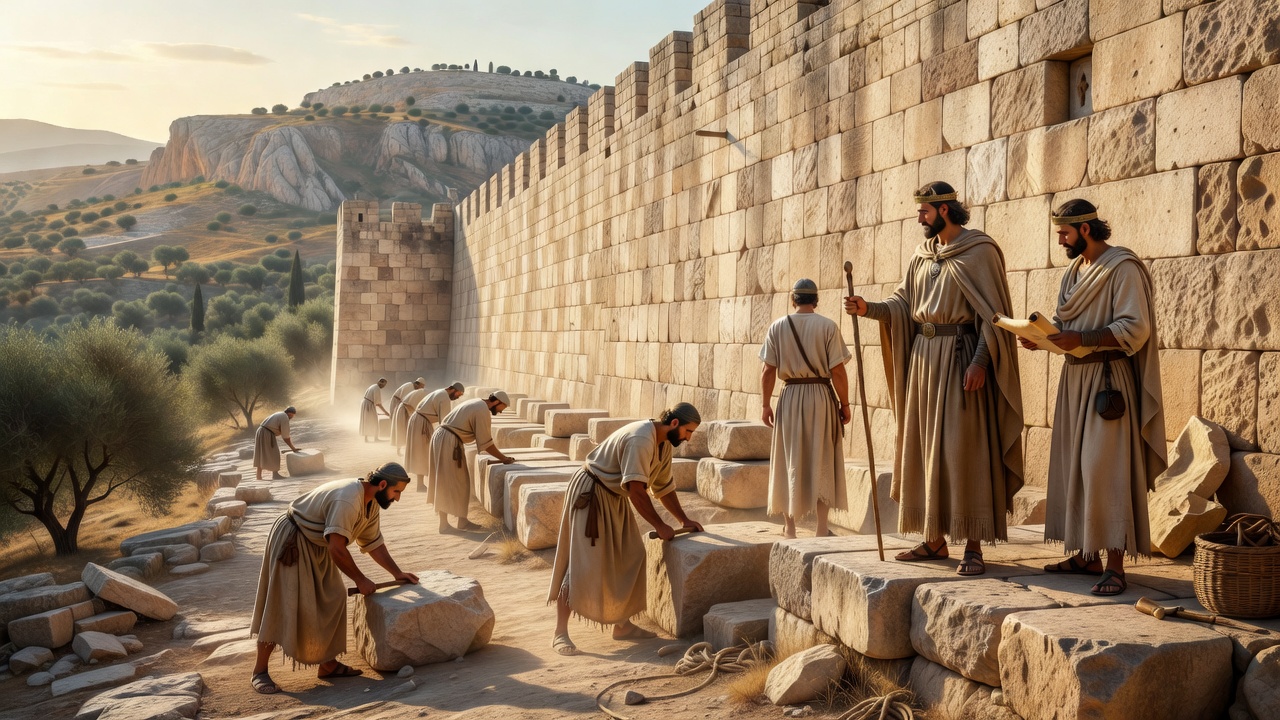
Você sabia?
O Reinado do Rei Jotão
- Embora Jotão tenha seguido os bons exemplos de seu pai Uzias, o texto destaca expressamente que ele não entrou no templo do Senhor, evitando a transgressão presunçosa que havia resultado na lepra de Uzias.Fontes: o próprio texto bíblico · Uzziah · Jotham
- Jotão realizou importantes obras defensivas, reconstruindo a Porta Superior do templo e fortificando a muralha de Ofel, a elevação na encosta sul da colina do templo entre os vales do Tiropeon e do Cedrom.Fontes: o próprio texto bíblico · Ophel
- Sob a liderança de Jotão, Judá derrotou os amonitas e os obrigou a pagar um tributo anual de cem talentos de prata, dez mil coros de trigo e dez mil coros de cevada durante três anos consecutivos.Fontes: o próprio texto bíblico
Notas escritas com auxílio de IA a partir de fontes abertas (Theographic Bible Metadata, CC BY-SA 4.0; Easton’s Bible Dictionary, domínio público) e revisadas antes de publicar.
Lugares deste capítulo
- Jerusalem · 31.777, 35.234 · versículos 1, 8
- Ophel · 31.775, 35.236 · versículo 3
- Ammon · 31.955, 35.934 · versículo 5
- City of David · 31.774, 35.236 · versículo 9
Só aparecem lugares com identificação de alta confiança (90% ou mais segundo as fontes acadêmicas reunidas pelo OpenBible). Mapa da época: DARE (Digital Atlas of the Roman Empire), CC BY 4.0; mapa atual: © colaboradores do OpenStreetMap; lugares: OpenBible.info (CC BY 4.0).
Créditos e licença desta tradução
De Heilige Schrift, Petrus Canisiusvertaling, 1939
The Holy Bible in Dutch, Petrus Canisius translation, 1939
Public Domain
Language: Nederlandse taal (Dutch)
Eerste uitgave: Het Spectrum, Utrecht, Brussel, 1939
De Petrus Canisiusvertaling is een Nederlandse rooms-katholieke bijbelvertaling, waarvan de eerste complete uitgave verscheen in 1939. De volledige naam luidt: "De Heilige Schrift, vertaling uit de grondtekst met aantekeningen, in opdracht van de Apologetische Vereniging 'Petrus Canisius' ondernomen met goedkeuring van de hoogwaardige bisschoppen van Nederland". De Petrus Canisiusvertaling is de eerste Nederlandse katholieke vertaling die gebaseerd is op de grondteksten in hun oorspronkelijke taal. Andere vertalingen gingen uit van de Vulgaat. Het taalgebruik van de uitgave is naar hedendaagse normen licht archaïsch te noemen, maar nog steeds vlot verstaanbaar.
Verantwoording in verband met de auteursrechten
In verband met de auteursrechten is contact opgenomen met de oorspronkelijke uitgever (1), de Katholieke Vereniging voor Oecume (2) en de Katholieke Bijbelstichting (3) en werden geen bezwaren gevonden tegen deze publicatie. Rekening houdend met de wettelijke termijnen, kan deze uitgave beschouwd worden als vrij van auteursrechten.
First publication: Het Spectrum, Utrecht, Brussel, 1939
The translation "Petrus Canisius" is a dutch roman catholic bible translation, that was first published in 1939. Its full title is "The Holy Scripture, translation of the original texts with annotations, commissioned by the Apologetical Society 'Petrus Canisius' and executed with the approval of the most reverend bishops of the Netherlands". The translation "Petrus Canisius" is the first dutch catholic translation that was based on the scripture texts in their original language. Other translations were based on the Vulgate. The language of this edition is to current standards moderately archaic, but still easily understood.
Accountability in relation to copyright
Concerning the copyright contacts have been made with the original publisher (1), the Katholieke Vereniging voor Oecumene (Catholic Society for Ecumenism) (2) and the Katholieke Bijbelstichting (Catholic Bible Foundation) (3) and no objections have been found against this publication. Taking into account the legal terms, this edition can be considered to be in the public domain.
UITGEVERIJ UNIEBOEK|HET SPECTRUM BV, HOUTEN, THE NETHERLANDS
KATHOLIEKE VERENIGING VOOR OECUMENE, 'S HERTOGENBOSCH, THE NETHERLANDS
KBS, HOEVEN, THE NETHERLANDS
2024-08-06
Fonte: http://ebible.org/nld1939/ · eBible.org