Mateus 3
Parmeswar ke naawa poestak · Toque num versículo para ver as referências cruzadas.
Johaanas dopoe kare waala
1Koetjh dien baad Johaanas dopoe kare waala Joedea ke maidaan me partjaar kare lagal aur bolies kie: 2„Bhaai log, swarag ke raadj nagietj aai gail hai! Aapan paap pastaaike Parmeswar ke rasta par tjal!” 3Sanesia Jasaaja pahiele ehie Johaanas ke baare me bolies raha kie:
„Maidaan me koi djor se boliega:
‘Parmeswar khaatien rasta tajaar kar djeme oe siedha rasta par tjal sake!’ ”
4Johaanas oet ke baar waala kapra pahienat raha. Oe ekgo tjamra ke tjamotie aapan karhiaaw me lagaawat raha. Oe phatienga khaat raha aur maidaan me madh tjaatat raha.
5Tab Jeroesaalem sahar aur sab Joedea diehaat aur Jordaan nadie ke galie ke log okar paas aail. 6Aur oesab okar baat maanke bolies kie: „Hamlog paapie baatie.” Aur oelog apane ke Jordaan nadie me Johaanas se dopoe karwaais. 7Tab dher Fariesie aur Sadoesie log bhie aail dopoe lewe khaatien. Bakie djab Johaanas oelogke dekhies tab oesabke daate lagal aur bolies: „Are, dhokhaabaadj log! Ke toelogse bataais hai kie toelog Parmeswar ke goessa me se batj sake hai? 8Bestar hai kie toelog aapan tjaal-tjalan se dekhaihe kie toelog maange hai aapan djiewan badale aur bietaawe djaise Parmeswar ke parsand howe hai. 9Toelog na sotjiehe kie: ‘Hamlog Parmeswar ke bieswaasie Aabraaham ke aulaad baatie, ohie se hamlog Parmeswar ke goessa me se batj djaab.’ Ham toelogse boliela kie Parmeswar Aabraaham khaatien ie patthar se aulaad banaai sake hai. 10Taanga per ke lage rakhaai gail. Djab ek per attjha phal na dewe hai, tab oe kaatal djaai aur aagie me djaraawal djaaiga.
11Ham toelogke paanie se dopoe kariela dekhaawe khaatien kie toelog aapan paap pastaaike ek naawa djiewan soeroe karle hai. Bakie hamare baad ek Aadmie aaiga djaun ke hamse djaada saktie hai. Ham okar djoeta oethaawe laaik na baatie. Oe toelogke Pawietr Aatma aur aagie se dopoe kariega. 12Oe iensaan logan ke faisala kariega djaise ek khetiar dhaan osaaike bakhaar me rakhie aur paija ke aagie me djaraai dei. Aur oe aagie kabhie na boetiega.”
Jiesoe kaise dopoe karal gail
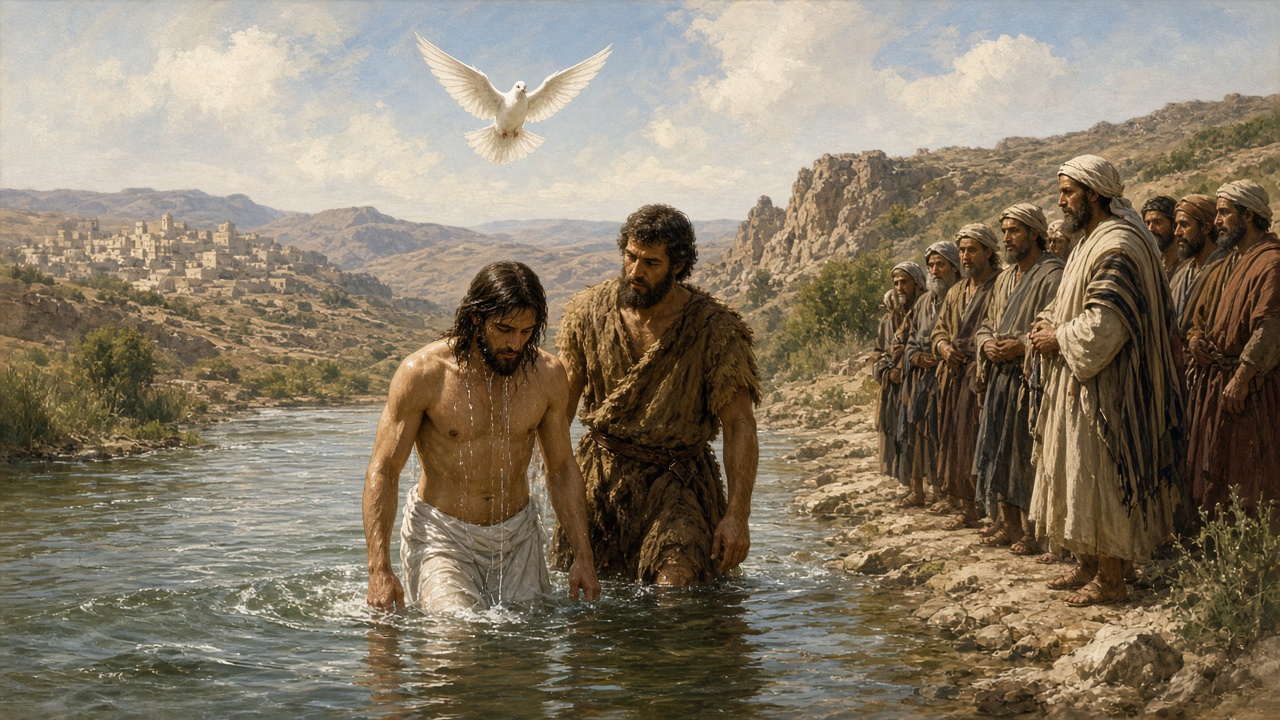
13Tab Jiesoe Gaalielea ke diehaat tjhorke Johaanas ke paas gail Jordaan nadie me apane ke dopoe karwaawe ke. 14Bakie Johaanas na maangat raha aur bolies: „Toe hamare paas aile? Hamke tjaahie tose dopoe karwaawe ke.” 15Tab Jiesoe bolies: „Hamlogke tjaahie Parmeswar ke sab hiettjha poera kare ke. Ohie se toe hamme dopoe kar.” Tab Johaanas oke dopoe karies.
16Toerant Jiesoe dopoe hoike paanie me se nieksal. Aur dekh, swarag khoel gail aur Johaanas dekhies kaise Parmeswar ke Aatma ek kaboettar ke roep me oetarke Jiesoe ke oeppar aawe hai. 17Aur swarag me se bhie ek aawaadj soenaail. Pieta Parmeswar bolies: „Ie hamaar pjaara Beta hai aur hamme bahoet parsand howe hai.”
Você sabia?
Arrependimento e batismo no Jordão
- Mateus identifica João Batista como aquele de quem falou o profeta Isaías: uma voz que clama no deserto: “Preparem o caminho do Senhor”. O Dicionário Bíblico de Easton (1897) registra que a missão de João foi objeto de profecia, citando este trecho, Isaías 40:3 e Malaquias 3:1, e que ele era de descendência sacerdotal — o pai, Zacarias, sacerdote da turma de Abias, e a mãe, Isabel, das filhas de Arão. Uma cronologia data tanto o início do ministério de João quanto o batismo de Jesus no ano 26 d.C.Fontes: o próprio texto bíblico · John the Baptist · John the Baptist Begins Ministry · John Baptizes Jesus
- João veio pregando no deserto da Judeia, e pessoas de Jerusalém, de toda a Judeia e de toda a região ao redor do Jordão foram ao seu encontro, confessando os pecados e sendo batizadas no rio Jordão. O Dicionário Bíblico de Easton (1897) observa que, sob os romanos, no tempo de Cristo, Judeia designava a mais meridional das três divisões da Palestina, distinta da Galileia e da Samaria, e incluía os territórios de Judá, Benjamim, Dã, Simeão e parte de Efraim. Jesus veio da Galileia — chamada Galil pelos judeus — ao Jordão para ser batizado por João.Fontes: o próprio texto bíblico · Judea · Galilee
- João advertiu os fariseus e os saduceus a não se fiarem da afirmação “Temos a Abraão por pai”, dizendo que Deus podia suscitar filhos para Abraão a partir das pedras. O Dicionário Bíblico de Easton (1897) explica o nome Abraão como “pai de uma multidão” e o descreve como filho de Terá, nomeado antes dos irmãos mais velhos porque era o herdeiro das promessas.Fontes: o próprio texto bíblico · Abraham
Notas escritas com auxílio de IA a partir de fontes abertas (Theographic Bible Metadata, CC BY-SA 4.0; Easton’s Bible Dictionary, domínio público) e revisadas antes de publicar.
Lugares deste capítulo
- Judea · Hoje: Judea 1 · 31.777, 35.234 · versículos 1, 5
- Jerusalem · 31.777, 35.234 · versículo 5
- Jordan · Hoje: Jordan River · 31.761, 35.558 · versículos 5, 6, 13
- Galilee · 32.760, 35.527 · versículo 13
Só aparecem lugares com identificação de alta confiança (90% ou mais segundo as fontes acadêmicas reunidas pelo OpenBible). Mapa da época: DARE (Digital Atlas of the Roman Empire), CC BY 4.0; mapa atual: © colaboradores do OpenStreetMap; lugares: OpenBible.info (CC BY 4.0).
Créditos e licença desta tradução
Parmeswar ke naawa poestak
New Testament in Hindustani, Caribbean (NS:hns:Hindustani, Caribbean)
copyright © 2010 Wycliffe Bible Translators, Inc.
Language: Hindustani, Caribbean
Translation by: Wycliffe Bible Translators, Inc.
Hindustani, Caribbean [hns], Suriname
Copyright Information
© 2010, Wycliffe Bible Translators, Inc. All rights reserved.
This translation text is made available to you under the
terms of the Creative Commons License: Attribution-Noncommercial-No Derivative Works.
( http://creativecommons.org/licenses/by-nc-nd/3.0/ )
In addition, you have permission to port the text to different file formats, as long as you
do not change any of the text or punctuation of the Bible.
You may share, copy, distribute, transmit, and extract portions
or quotations from this work, provided that you include the above copyright
information:
You must give Attribution to the work.
You do not sell this work for a profit.
You do not make any derivative works that change any of the actual words or punctuation of the Scriptures.
Permissions beyond the scope of this license may be
available if you contact
us with your request.
The New Testament
in Hindustani, Caribbean
© 2010, Wycliffe Bible Translators, Inc. All rights reserved.
This translation is made available to you under the terms of the
Creative Commons Attribution-Noncommercial-No Derivatives license 4.0.
You may share and redistribute this Bible translation or extracts from it in any format, provided that:
You include the above copyright and source information.
You do not sell this work for a profit.
You do not change any of the words or punctuation of the Scriptures.
Pictures included with Scriptures and other documents on this site are licensed just for use with those Scriptures and documents.
For other uses, please contact the respective copyright owners.
2014-04-25
Fonte: http://ebible.org/hnsNT/ · eBible.org