Jó 2
Biblica® Se aɖeke mebla Biblia zazã o Agbenya La™ · Toque num versículo para ver as referências cruzadas.
Hiob ƒe dodokpɔ evelia
1Gbe bubu gbe la, dziƒodɔlawo va do ɖe Yehowa ŋkume eye Satana hã va do kpli wo ɖe Mawu ƒe ŋkume. 2Yehowa bia Satana be, “Afi ka nètso va do?”
Satana ɖo eŋu be, “Metso tsatsa ge le anyigba dzi eye menɔ yiyim, nɔ gbɔgbɔm le edzi.”
3Tete Yehowa bia Satana be, “Èlé ŋku ɖe nye dɔla Hiob ŋua? Ame aɖeke mele anyigba dzi de enu o, enye ame maɖifɔ kple ame dzɔdzɔe, ame si vɔ̃a Yehowa eye wòtsri vɔ̃. Togbɔ be ède adã menye ɖe eŋu be magblẽ edome esi mewɔ naneke o hã la, egalé eƒe blibodede la me ɖe asi ko.”
4Satana ɖo eŋu na Yehowa be, “Ŋutilã ɖe ŋutilã teƒe, ekema ame atsɔ nu sia nu si le esi la katã ana ɖe eƒe agbe ta. 5Do wò asi ɖa eye nàtu nu kple eƒe ŋutilã kple eƒe ƒuwo, ekema nàkpɔe ɖa be mado ɖiŋu na wò le wò ŋutɔ wò ŋkume o mahã?”
6Yehowa gblɔ na Satana be, “Enyo ŋutɔ. Kpɔ ɖa, ele asiwò me, gake mègaka asi eƒe agbe ya ŋu o.”
7Ale Satana dzo le Yehowa ŋkume hekplɔ abi vɔ̃ɖi aɖewo ƒu Hiob, tso eƒe afɔgɔme va se ɖe eƒe dzodome. 8Tete Hiob tsɔ ze kakɛ nɔ ŋuti kum esi wònɔ anyi ɖe afi me.
9Srɔ̃a va egbɔ biae be, “Ɖe nègalé wò blibodede la me ɖe asi koa? Do ɖiŋu na Mawu ne nàku!”
10Hiob ɖo eŋu nɛ be, “Èle nu ƒom abe nyɔnu bometsila ene. Ɖe míaxɔ nu nyuiwo ko tso Mawu gbɔ eye menye vɔ̃ hã oa?”
Le nu siawo katã me la, Hiob mewɔ nu vɔ̃ le eƒe nuƒoƒo me o.
Hiob xɔlɔ̃ etɔ̃awo
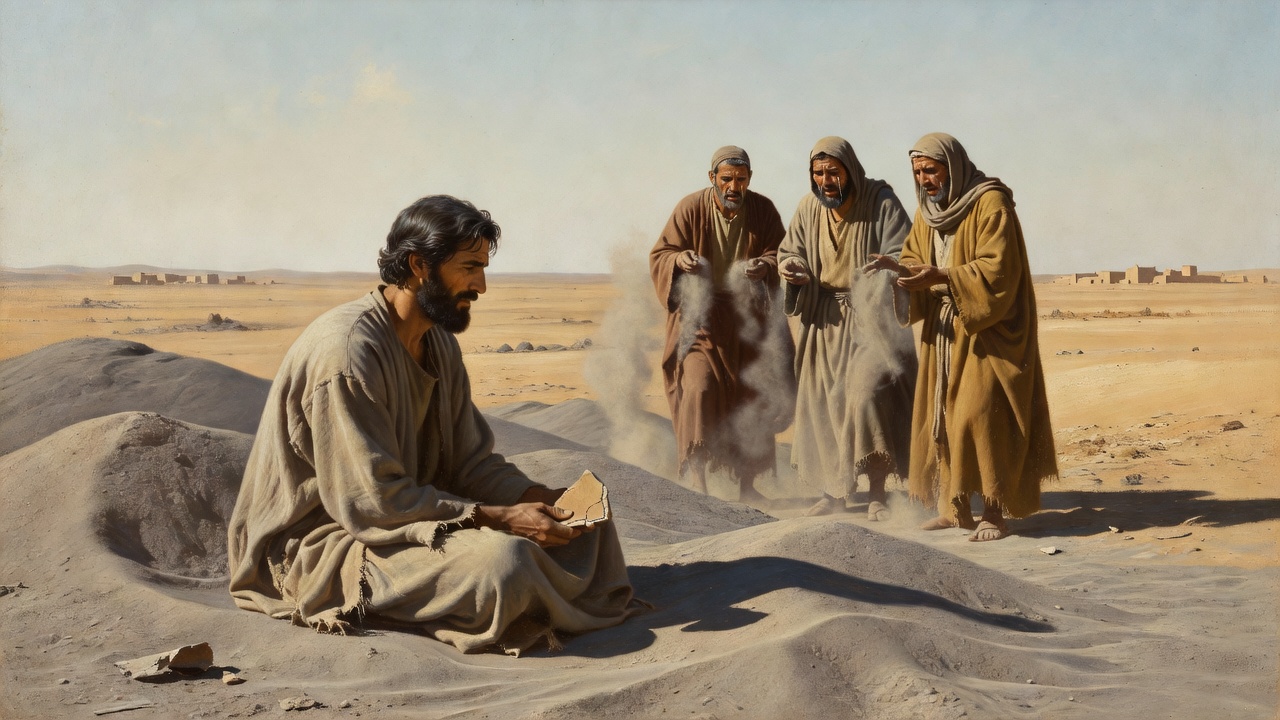
11Esi Hiob xɔlɔ̃ etɔ̃awo, Temanitɔ Elifaz, Suhitɔ, Bildad kple Naamatitɔ, Zofar se dzɔgbevɔ̃e siwo katã dzɔ ɖe Hiob dzi la wodze mɔ tso woƒe aƒewo me le ŋkeke si woɖo ɖi la dzi be woaɖafa nɛ eye woafa akɔ nɛ. 12Esi wokpɔe le adzɔge la, womete ŋu dze sii o, ale wowo avi gboo kple ɣli, wodze woƒe awu ʋlayawo eye wolɔ ke kɔ ɖe tame. 13Ale wonɔ anyi ɖe egbɔ le anyigba ŋkeke adre kple zã adre sɔŋ. Ame aɖeke mebia nya aɖekee o elabena wokpɔ ale si wònɔ veve semii.
Você sabia?
A Aflição de Jó e a Chegada de Seus Amigos
- No texto hebraico de Jó, o termo traduzido como Satanás aparece com o artigo definido como o adversário ou acusador. Nesse segundo conselho celestial, o adversário argumenta que, embora Jó tenha suportado a perda de seus bens e família, ferir sua própria carne e ossos o faria abandonar sua integridade.Fontes: Satan · o próprio texto bíblico
- Os companheiros de Jó — Elifaz, o temanita, Bildade, o suíta, e Zofar, o naamatita — vieram de regiões distantes associadas à Arábia. A origem de Bildade é ligada a Suá, filho de Abraão com Quetura, enquanto a antiga tradução grega Septuaginta conecta Zofar aos mineus do sul da Arábia.Fontes: Bildad · Zophar · o próprio texto bíblico
- Ao verem o sofrimento extremo de Jó, seus três amigos rasgaram seus mantos, lançaram pó ao ar sobre suas cabeças e sentaram-se com ele no chão em total silêncio por sete dias e sete noites. Essa vigília compartilhada refletia costumes antigos de profundo luto quando a dor era intensa demais para palavras.Fontes: o próprio texto bíblico
Notas escritas com auxílio de IA a partir de fontes abertas (Theographic Bible Metadata, CC BY-SA 4.0; Easton’s Bible Dictionary, domínio público) e revisadas antes de publicar.
Créditos e licença desta tradução
Biblica® Se aɖeke mebla Biblia zazã o Agbenya La™ Éwé: Biblica® Se aɖeke mebla Biblia zazã o Agbenya La™ (Bible) of Ghana copyright © 1988, 2006, 2020 Biblica, Inc. Language: eʋegbe Contributor: Biblica, Inc. Dɔwɔƒe si na wò asi ka agbalẽ sia lae nye Creative Commons Attribution-ShareAlike 4.0 International License (CC BY-SA). Ne èdi be yeakpɔ laisensi alo mɔɖegbalẽ sia la, yi ɖe http://creativecommons.org/licenses/by-sa/4.0 alo ŋlɔ agbalẽ na Creative Commons Dɔwɔƒea to adrɛsi sia dzi: Creative Commons, PO Box 1866, Mountain View, CA 94042, USA. Biblica, Inc. na wode Biblica® kple eƒe dzesidenu agbalẽ me, eye woaŋlɔ agbalẽ axɔ mɔɖeɖe tso Biblica, Inc. gbɔ hafi woawɔ Biblica® ƒe dzesidenu la ŋu dɔ. Le CC BY-SA ƒe mɔɖeɖe ƒe sewo nu la, àte ŋu azã agbalẽ sia me nyawo le dɔ bubuwo wɔwɔ me gake ele be nàde dzesi Biblica ƒe dzesidenu la abe ale si wòle ene. Ne ètrɔ asi le agbalẽ sia ŋu alo zãe le mɔ bubu nu la, ele be nàɖe Biblica® ƒe dzesidenu la ɖa. Ele be nàde dzesi tɔtrɔ siwo nèwɔ la ɖe agbalẽ la me eye nàde dzesii be: “Àte ŋu akpɔ Biblica, Inc. ƒe dɔ gbãtɔ le www.biblica.com kple open.bible femaxee.” Ele be nutɔnyenye ƒe dzeside nadze le agbalẽ la ƒe axa si tanya alo nutɔnyenye ƒe dzesi nɔna la ale: Biblica® Se aɖeke mebla Biblia zazã o Agbenya La™ Nutɔnyenye © 1988, 2006, 2020 Biblica, Inc. Biblica® Open Ewe Contemporary Scriptures™ Copyright © 1988, 2006, 2020 by Biblica, Inc. Biblica, Inc. na Dɔwɔƒe si Kpɔa Nutɔnyenye kple Adzɔdodo ƒe Nyawo dzi le Amerika la de “Biblica” kple eƒe dzesidenu agbalẽ me. Woaxɔ mɔɖeɖe na ezazã. “Biblica” is a trademark registered in the United States Patent and Trademark Office by Biblica, Inc. Used with permission. Ele be nàna míaƒe asi naka wò agbalẽ la le laisensi alo mɔɖeɖe ƒe se (CC BY-SA) sia nu. Ne èdi be yeana nyanya Biblica, Inc. tso agbalẽ sia zazã ŋu la, anyo be nàdo ta ɖe mía gbɔ le https://open.bible/contact-us. This work is made available under the Creative Commons Attribution-ShareAlike 4.0 International License (CC BY-SA). To view a copy of this license, visit http://creativecommons.org/licenses/by-sa/4.0 or send a letter to Creative Commons, PO Box 1866, Mountain View, CA 94042, USA. Biblica® is a trademark registered by Biblica, Inc., and use of the Biblica® trademark requires the written permission of Biblica, Inc. Under the terms of the CC BY-SA license, you may copy and redistribute this unmodified work as long as you keep the Biblica® trademark intact. If you modify a copy or translate this work, thereby creating a derivative work, you must remove the Biblica® trademark. On the derivative work, you must indicate what changes you have made and attribute the work as follows: “The original work by Biblica, Inc. is available for free at www.biblica.com and open.bible.” Notice of copyright must appear on the title or copyright page of the work as follows: Biblica® Se aɖeke mebla Biblia zazã o Agbenya La™ Nutɔnyenye © 1988, 2006, 2020 Biblica, Inc. Biblica® Open Ewe Contemporary Scriptures™ Copyright © 1988, 2006, 2020 by Biblica, Inc. Biblica, Inc. na Dɔwɔƒe si Kpɔa Nutɔnyenye kple Adzɔdodo ƒe Nyawo dzi le Amerika la de “Biblica” kple eƒe dzesidenu agbalẽ me. Woaxɔ mɔɖeɖe na ezazã. “Biblica” is a trademark registered in the United States Patent and Trademark Office by Biblica, Inc. Used with permission. You must also make your derivative work available under the same license (CC BY-SA). If you would like to notify Biblica, Inc. regarding your translation of this work, please contact us at https://open.bible/contact-us. This translation is made available to you under the terms of the Creative Commons Attribution Share-Alike license 4.0. You have permission to share and redistribute this Bible translation in any format and to make reasonable revisions and adaptations of this translation, provided that: You include the above copyright and source information. If you make any changes to the text, you must indicate that you did so in a way that makes it clear that the original licensor is not necessarily endorsing your changes. If you redistribute this text, you must distribute your contributions under the same license as the original. Pictures included with Scriptures and other documents on this site are licensed just for use with those Scriptures and documents. For other uses, please contact the respective copyright owners. Note that in addition to the rules above, revising and adapting God's Word involves a great responsibility to be true to God's Word. See Revelation 22:18-19. 2025-05-01
Fonte: http://ebible.org/ewe/ · eBible.org