Lamentações 4
Young's Literal Translation · Toque num versículo para ver as referências cruzadas.
The Distress of Zion
1How is the gold become dim, Changed the best — the pure gold? Poured out are stones of the sanctuary At the head of all out-places. 2The precious sons of Zion, Who are comparable with fine gold, How have they been reckoned earthen bottles, Work of the hands of a potter. 3Even dragons have drawn out the breast, They have suckled their young ones, The daughter of my people is become cruel, Like the ostriches in a wilderness. 4Cleaved hath the tongue of a suckling unto his palate with thirst, Infants asked bread, a dealer out they have none. 5Those eating of dainties have been desolate in out-places, Those supported on scarlet have embraced dunghills. 6And greater is the iniquity of the daughter of my people, Than the sin of Sodom, That was overturned as [in] a moment, And no hands were stayed on her. 7Purer were her Nazarites than snow, Whiter than milk, ruddier of body than rubies, Of sapphire their form. 8Darker than blackness hath been their visage, They have not been known in out-places, Cleaved hath their skin unto their bone, It hath withered — it hath been as wood. 9Better have been the pierced of a sword Than the pierced of famine, For these flow away, pierced through, Without the increase of the field. 10The hands of merciful women have boiled their own children, They have been for food to them, In the destruction of the daughter of my people. 11Completed hath Jehovah His fury, He hath poured out the fierceness of His anger, And he kindleth a fire in Zion, And it devoureth her foundations. 12Believe not did the kings of earth, And any of the inhabitants of the world, That come would an adversary and enemy Into the gates of Jerusalem. 13Because of the sins of her prophets, The iniquities of her priests, Who are shedding in her midst the blood of the righteous, 14They have wandered naked in out-places, They have been polluted with blood, Without [any] being able to touch their clothing, 15'Turn aside — unclean,' they called to them, 'Turn aside, turn aside, touch not,' For they fled — yea, they have wandered, They have said among nations: 'They do not add to sojourn.' 16The face of Jehovah hath divided them, He doth not add to behold them, The face of priests they have not lifted up, Elders they have not favoured. 17While we exist — consumed are our eyes for our vain help, In our watch-tower we have watched for a nation [that] saveth not. 18They have hunted our steps from going in our broad-places, Near hath been our end, fulfilled our days, For come hath our end. 19Swifter have been our pursuers, Than the eagles of the heavens, On the mountains they have burned [after] us, In the wilderness they have laid wait for us. 20The breath of our nostrils — the anointed of Jehovah, Hath been captured in their pits, of whom we said: 'In his shadow we do live among nations.' 21Joy and rejoice, O daughter of Edom, Dwelling in the land of Uz, Even unto thee pass over doth a cup, Thou art drunk, and makest thyself naked. 22Completed [is] thy iniquity, daughter of Zion, He doth not add to remove thee, He hath inspected thy iniquity, O daughter of Edom, He hath removed [thee] because of thy sins!
Você sabia?
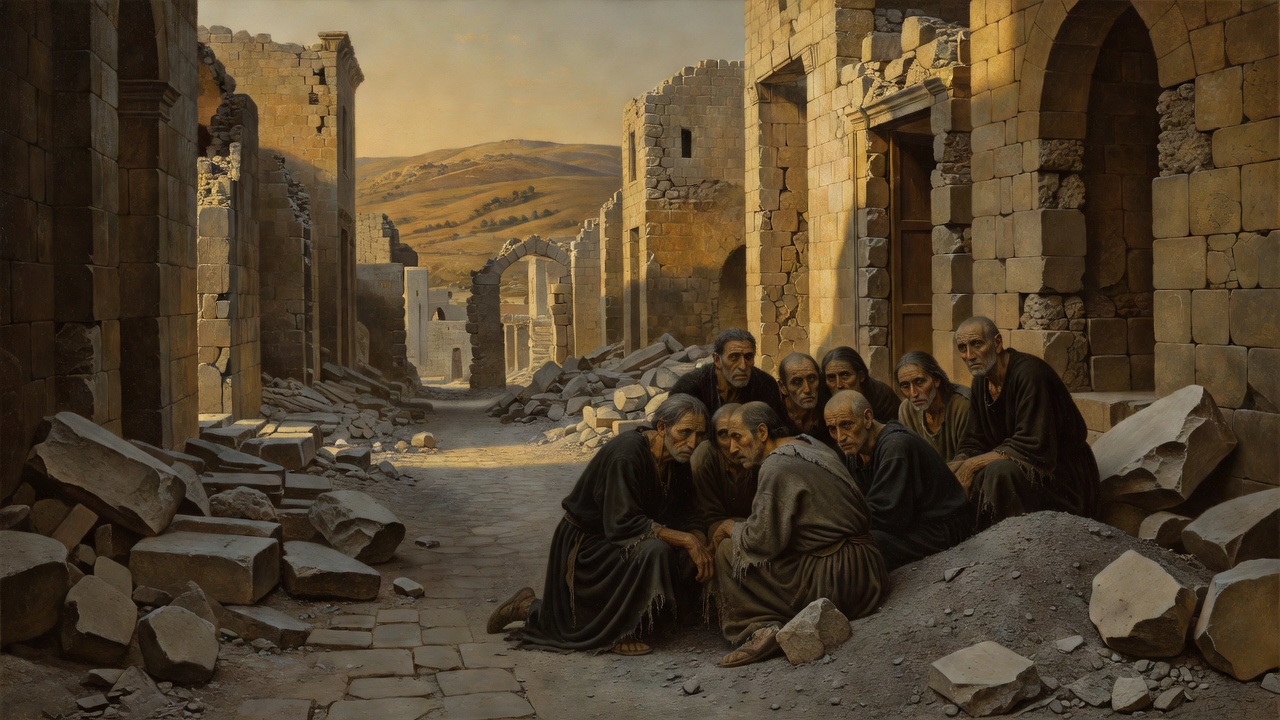
A Agonia da Cidade Caída
- O poeta considera o sofrimento prolongado de Jerusalém pior do que o destino de Sodoma. Enquanto Sodoma foi destruída em um instante por fogo divino, os habitantes de Jerusalém suportaram o tormento lento e doloroso do cerco e da fome.Fontes: o próprio texto bíblico · Sodom
- Antes de sua queda, Jerusalém era amplamente vista como uma cidade montanhosa impenetrável. O texto observa que os reis estrangeiros e as nações vizinhas nunca imaginaram que um inimigo pudesse romper seus portões fortificados.Fontes: o próprio texto bíblico · Jerusalem
- O capítulo se encerra com uma mensagem dirigida a Edom, que habitava na terra de Uz, advertindo que o juízo logo a alcançaria. A terra de Uz é mencionada em apenas três livros bíblicos: Jó, Jeremias e Lamentações.Fontes: o próprio texto bíblico · Uz · Edom
Notas escritas com auxílio de IA a partir de fontes abertas (Theographic Bible Metadata, CC BY-SA 4.0; Easton’s Bible Dictionary, domínio público) e revisadas antes de publicar.
Lugares deste capítulo
- Zion · Hoje: Jerusalem · 31.777, 35.234 · versículos 2, 11, 22
- Jerusalem · 31.777, 35.234 · versículo 12
- Edom · 30.746, 35.604 · versículos 21, 22
Só aparecem lugares com identificação de alta confiança (90% ou mais segundo as fontes acadêmicas reunidas pelo OpenBible). Mapa da época: DARE (Digital Atlas of the Roman Empire), CC BY 4.0; mapa atual: © colaboradores do OpenStreetMap; lugares: OpenBible.info (CC BY 4.0).
Créditos e licença desta tradução
Young's Literal Translation
Young's Literal Translation of the Holy Bible
Public Domain
Language: ENGLISH (English)
Dialect: archaic British
Translation by: Robert Young
This public domain Bible translation is brought to you courtesy of eBible.org.
If you would like to make a donation to help keep free Bible access like this going, please visit https://eBible.org/give.php .
2019-10-20
Títulos de seção adaptados da Berean Standard Bible (domínio público); não fazem parte do texto bíblico desta tradução.
Fonte: http://ebible.org/engylt/ · eBible.org