Jó 5
Young's Literal Translation · Toque num versículo para ver as referências cruzadas.
Eliphaz Continues: God Blesses those Who Seek Him
1Pray, call, is there any to answer thee? And unto which of the holy ones dost thou turn? 2For provocation slayeth the perverse, And envy putteth to death the simple, 3I — I have seen the perverse taking root, And I mark his habitation straightway, 4Far are his sons from safety, And they are bruised in the gate, And there is no deliverer. 5Whose harvest the hungry doth eat, And even from the thorns taketh it, And the designing swallowed their wealth. 6For sorrow cometh not forth from the dust, Nor from the ground springeth up misery. 7For man to misery is born, And the sparks go high to fly. 8Yet I — I inquire for God, And for God I give my word, 9Doing great things, and there is no searching. Wonderful, till there is no numbering. 10Who is giving rain on the face of the land, And is sending waters on the out-places. 11To set the low on a high place, And the mourners have been high [in] safety. 12Making void thoughts of the subtile, And their hands do not execute wisdom. 13Capturing the wise in their subtilty, And the counsel of wrestling ones was hastened, 14By day they meet darkness, And as night — they grope at noon. 15And He saveth the wasted from their mouth, And from a strong hand the needy, 16And there is hope to the poor, And perverseness hath shut her mouth. 17Lo, the happiness of mortal man, God doth reprove him: And the chastisement of the Mighty despise not, 18For He doth pain, and He bindeth up, He smiteth, and His hands heal. 19In six distresses He delivereth thee, And in seven evil striketh not on thee. 20In famine He hath redeemed thee from death, And in battle from the hands of the sword. 21When the tongue scourgeth thou art hid, And thou art not afraid of destruction, When it cometh. 22At destruction and at hunger thou mockest, And of the beast of the earth, Thou art not afraid. 23(For with sons of the field [is] thy covenant, And the beast of the field Hath been at peace with thee.) 24And thou hast known that thy tent [is] peace, And inspected thy habitation, and errest not, 25And hast known that numerous [is] Thy seed, And thine offspring as the herb of the earth; 26Thou comest in full age unto the grave, As the going up of a stalk in its season. 27Lo, this — we searched it out — it [is] right, hearken; And thou, know for thyself!
Você sabia?
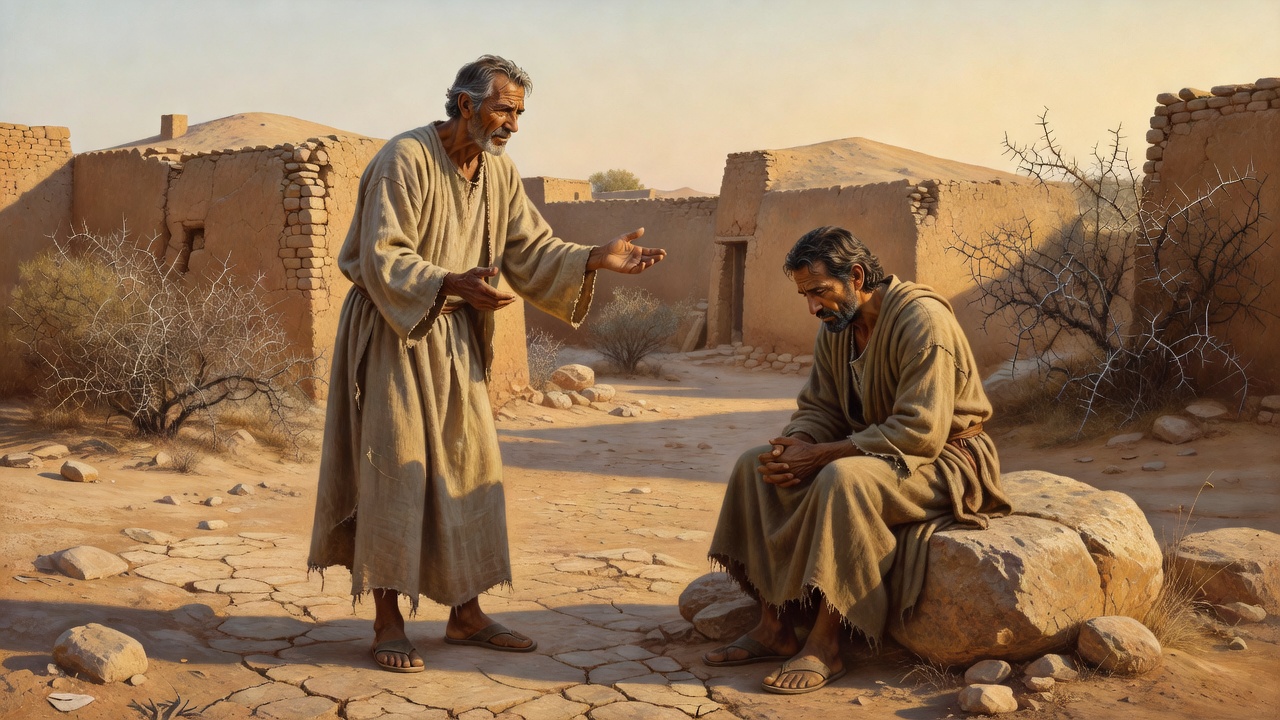
O Conselho de Elifaz sobre o Sofrimento e a Correção Divina
- Elifaz retrata o sofrimento como uma disciplina divina com propósito, e não como mera desgraça casual, afirmando que a aflição não brota do solo sem motivo. Ele exorta Jó a não desprezar a correção do Todo-Poderoso, que fere apenas para depois curar e restaurar.Fontes: o próprio texto bíblico
- Ao prometer livramento de seis calamidades e até mesmo de sete, Elifaz utiliza uma fórmula poética tradicional de paralelismo numérico progressivo. Esse recurso retórico, comum na poesia de sabedoria do Antigo Oriente Próximo, intensifica a ênfase para transmitir a ideia de proteção total e completa.Fontes: o próprio texto bíblico
- Elifaz descreve a restauração final com imagens agrícolas e pastoris, retratando uma vida em que os animais selvagens e o solo pedregoso deixam de ser hostis. Ele projeta uma morte serena na maturidade da vida, comparada a um feixe de cereais colhido no tempo certo.Fontes: o próprio texto bíblico
Notas escritas com auxílio de IA a partir de fontes abertas (Theographic Bible Metadata, CC BY-SA 4.0; Easton’s Bible Dictionary, domínio público) e revisadas antes de publicar.
Créditos e licença desta tradução
Young's Literal Translation
Young's Literal Translation of the Holy Bible
Public Domain
Language: ENGLISH (English)
Dialect: archaic British
Translation by: Robert Young
This public domain Bible translation is brought to you courtesy of eBible.org.
If you would like to make a donation to help keep free Bible access like this going, please visit https://eBible.org/give.php .
2019-10-20
Títulos de seção adaptados da Berean Standard Bible (domínio público); não fazem parte do texto bíblico desta tradução.
Fonte: http://ebible.org/engylt/ · eBible.org