Provérbios 30
Wycliffe's Bible with Modern Spelling (Enhanced) · Toque num versículo para ver as referências cruzadas.
The Words of Agur
1The words of him that gathereth, of the son spewing. The prophecy which a man spake, with whom God was, and which man was comforted by God dwelling with him, and said, (The words of Agur, the son of Jakeh. The prophecy which a man spoke unto Ithiel, yea, unto Ithiel and Ucal,)
2I am the most fool of men; and the wisdom of men is not with me. (I am the most foolish of men; and I have no common sense.)
3I learned not wisdom; and I knew not the knowing of holy men.
4Who ascended into heaven, and came down (again)? Who held together the spirit in his hands? who bound together waters as in a cloth? (or Who held together the wind in his hands? who bound up the waters in a cloak?) Who raised (up) all the ends of [the] earth? What is the name of him? and what is the name of his son, if thou knowest?
5Each word of God is a shield set afire, to all that hope in him. (Each word of God is fired, and he is a shield for all who hope in him.)
6Add thou not anything to the words of him, and thou be reproved, and be found a liar. (Do not thou add anything to his words, lest thou be rebuked, and be found a liar.)
7I prayed (of) thee two things; deny not thou them to me, before that I die.
8Make thou far from me vanity and words of leasing; give thou not to me begging and riches; but give thou only necessaries to my lifelode; (Make thou far from me emptiness and futility, or uselessness, and words of lying, or lies; give thou not to me begging or riches; but give thou only the necessities for my sustenance;)
9lest peradventure I be full-filled, and be drawn to deny, and say, Who is the Lord? and lest I be compelled by neediness, and steal, and forswear the name of my God. (lest perhaps I be filled full, and be drawn to deny, and then say, Who is the Lord? or lest I be compelled by neediness, and steal, and forswear the name of my God.)
10Accuse thou not a servant to his lord, lest peradventure he curse thee, and thou fall down.
11(There is) A generation that curseth his father, and that blesseth not his mother. (There be people who curse their fathers, and do not bless their mothers.)
12(There is) A generation that seemeth clean to itself, and nevertheless is not washed from his filths. (There be people who seem clean to themselves, yet nevertheless be not washed from their filths.)
13(There is) A generation whose eyes be high, and the eyelids thereof be raised [up] into high things. (There be people whose eyes be haughty, and whose glances be raised up, or disdainful.)
14(There is) A generation that hath swords for teeth, and eateth with his cheek teeth; that it eat [the] needy men of [the] earth, and the poor-alls of men. (There be people who have swords for teeth, and eat with their molars; and they eat the needy of the earth, and those who be all-poor, or without anything.)
15The water leach hath two daughters, saying, Bring, bring. Three things be unable to be filled, and the fourth, that saith never, It sufficeth, (or and the fourth, that never saith, It sufficeth);
16hell; and the mouth of the womb; and the earth that is never filled with water; but fire (that) saith never, It sufficeth. (Sheol, or the land of the dead, or the grave; and the mouth of the womb; and the land that is never filled with water; and the fire that never saith, It sufficeth.)
17(Let the) Crows of the strand peck out that eye, that scorneth the father, and that despiseth the child-bearing of his mother; and (let) the young of an eagle eat that eye.
18Three things be hard to me, and utterly I know not the fourth thing (or and the fourth thing I utterly know not);
19the way of an eagle in (the) heaven (s); the way of a serpent on a stone; the way of a ship in the middle of the sea; and the way of a man in (his) young waxing age.
20Such is the way of a woman adulteress, which eateth, and wipeth her mouth, and saith, I wrought not evil. (Such is the way of an adulterous woman, who eateth, and wipeth her mouth, and then saith, I have done nothing wrong.)
21The earth is moved by three things, and by the fourth thing, which it may not sustain;
22by a servant, when he reigneth; by a fool, when he is filled with meat, (or by a fool, when he is filled full with food);
23by an hateful woman, when she is taken in matrimony; and by an handmaid, when she is heir of her lady, (or and by a servantess, when she is her lady’s heir).
24Four [things] be the least things of [the] earth, and those be wiser than wise men;
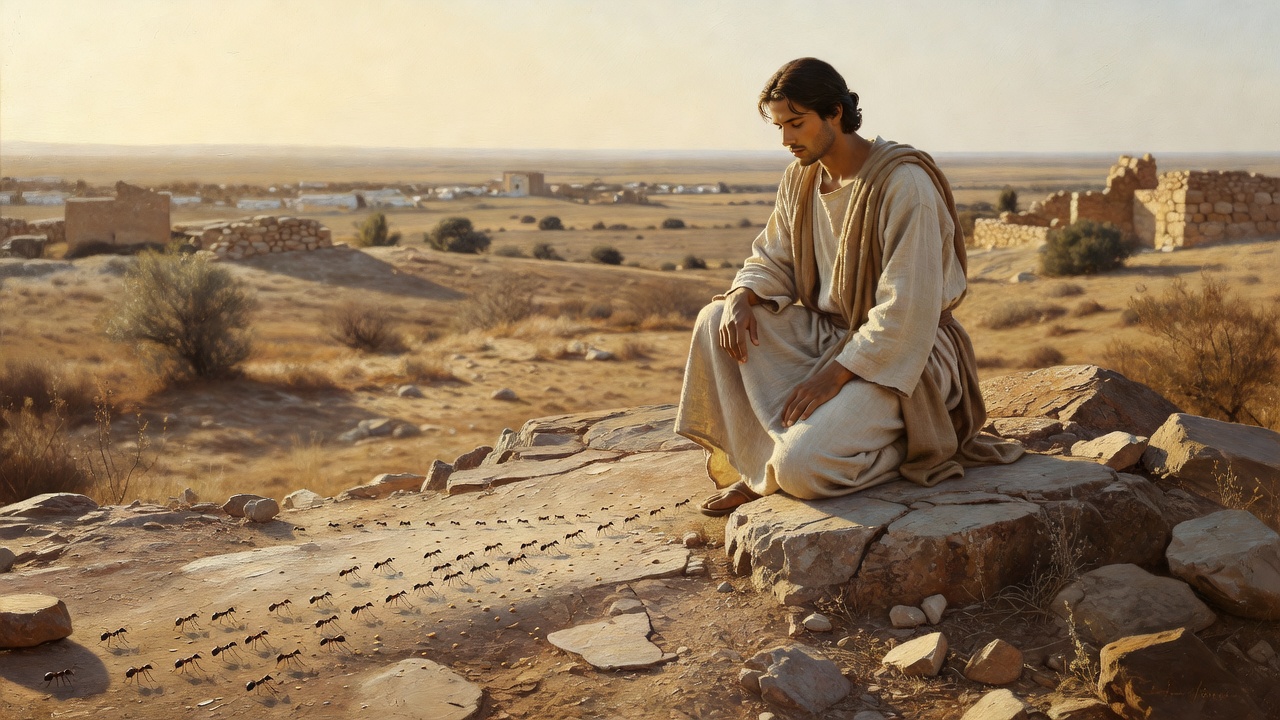
25ants, a feeble people, that make ready meat in harvest to themselves; (ants, a weak, or a lowly, people, that store up food for themselves at harvest time;)
26a hare, a people unmighty, that setteth his bed in a stone; (rock badgers, also an unmighty people, who make their beds among the rocks;)
27a locust, (that) hath no king, and (yet) all goeth out by companies;
28a lizard, enforceth with hands, and dwelleth in the houses of kings. (and a lizard, that endeavoureth with his hands, and liveth in palaces.)
29Three things there be, that go well, (or And there be three things, that go well), and the fourth thing, that goeth richly, or wellsomely.
30A lion, strongest of beasts, shall not dread, at the meeting of any man; (A lion, the strongest of beasts, that shall not fear the meeting of any man;)
31a cock, girded [up] the loins; and a ram, (and a king), and none there is that shall against-stand him. (a strutting rooster; and a ram; and a king for whom there is no one who shall stand up against him.)
32He that appeareth a fool, after that he is raised [up] on high; for if he had understood, he had set (his) hand on his mouth. (Now, if thou hath been a fool, and hath raised up thyself on high, and hath imagined evil; then set thy hand upon thy mouth, and be silent.)
33Forsooth he that thrusteth strongly teats, to draw out milk, thrusteth out butter; and he that smiteth greatly, draweth out blood; and he that stirreth ires, bringeth forth discords. (For he who strongly thrusteth teats to draw out milk, thrusteth out butter; and he who greatly striketh, draweth out blood; and he who stirreth up anger, bringeth forth discords.)
Você sabia?
Os Ditos de Agur
- Provérbios 30 é atribuído a Agur, filho de Jaque, que dirigiu suas palavras a Itiel e Ucal. Além do que está registrado neste capítulo, nada mais se sabe sobre a vida de Agur ou de seu pai.Fontes: Agur · Jakeh · Ucal · o próprio texto bíblico
- O capítulo utiliza frequentemente um padrão numérico graduado ('três coisas... quatro que...') para agrupar observações sobre a natureza e o comportamento humano. Agur aplica essa estrutura a maravilhas da criação, perturbações sociais, seres de porte imponente e quatro pequenas criaturas que exibem notável sabedoria: formigas, lebres-das-rochas, gafanhotos e lagartos.Fontes: o próprio texto bíblico
- Agur faz um pedido específico de duas partes, suplicando que não receba nem pobreza nem riquezas, mas apenas a sua porção diária de pão. Ele explica que ter em excesso poderia levar alguém a negar o Senhor, enquanto a extrema pobreza poderia induzir a pessoa a furtar.Fontes: o próprio texto bíblico
Notas escritas com auxílio de IA a partir de fontes abertas (Theographic Bible Metadata, CC BY-SA 4.0; Easton’s Bible Dictionary, domínio público) e revisadas antes de publicar.
Créditos e licença desta tradução
Wycliffe's Bible with Modern Spelling (Enhanced)
English: Wycliffe's Bible Modern Spelling (Enhanced) (with Deuterocanon)
Copyright © 2001,2010,2011,2012,2013,2015 Terry Noble
Language: English
Dialect: Archaic
Translation by: Terry Noble
Wycliffe's Bible with Modern Spelling (Enhanced)
Wycliffe’s Bible with Modern Spelling (Enhanced) is a composite of my Wycliffe’s Bible, a modern-spelling version of the 14th century Middle English translation, consisting of Wycliffe’s Old Testament and Wycliffe’s New Testament, and my modern-spelling version of Wycliffe’s Apocrypha. These books contain literally tens of thousands of rewritten verses, presented in parentheses “( ) “, to provide help in comprehending the 14th century Middle English vocabulary and grammar. Wycliffe’s Apocrypha also includes the books of the Apocrypha from the 1st edition of the King James Version of the Bible.
This translation is made available to you under the terms of the
Creative Commons Attribution-Noncommercial-No Derivatives license 4.0.
You may share and redistribute this Bible translation or extracts from it in any format, provided that:
You include the above copyright and source information.
You do not sell this work for a profit.
You do not change any of the words or punctuation of the Scriptures.
Pictures included with Scriptures and other documents on this site are licensed just for use with those Scriptures and documents.
For other uses, please contact the respective copyright owners.
2019-09-25
Títulos de seção adaptados da Berean Standard Bible (domínio público); não fazem parte do texto bíblico desta tradução.
Fonte: http://ebible.org/engwyc2018/ · eBible.org