Mateus 13
Wycliffe's Bible with Modern Spelling (Enhanced) · Toque num versículo para ver as referências cruzadas.
The Parable of the Sower
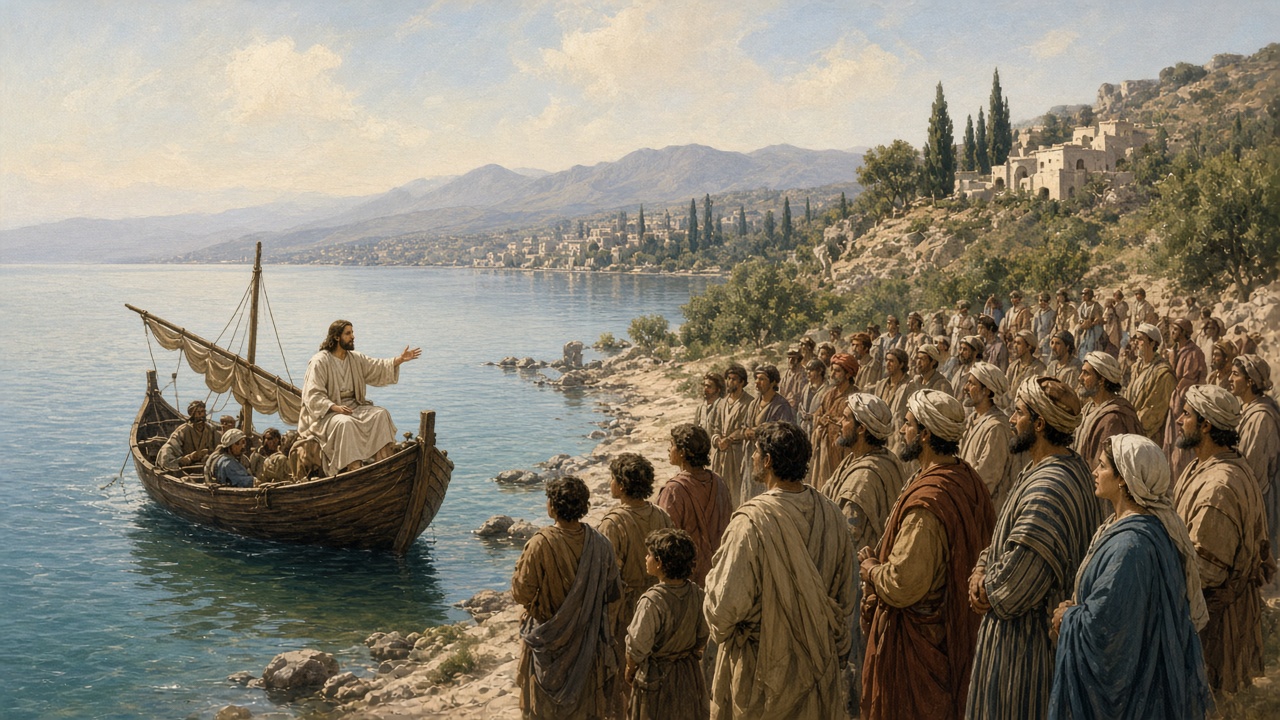
1In that day Jesus went out of the house, and sat beside the sea.
2And much people was gathered to him, so that he went up into a boat, and sat; and all the people stood on the brink (or and all the people stood on the shore).
3And he spake to them many things in parables, and said, Lo! he that soweth, went out to sow his seed.
4And while he soweth, some seeds felled beside the way, and (the) birds of the air came, and ate them.
5But other seeds felled into stony places, where they had not much earth; and anon they sprung up (or and at once they sprouted), for they had not (any) deepness of earth.
6But when the sun was risen, they sweltered, [or they burned for the heat], (or they were parched), and for they had not root, they dried up.
7And other seeds felled among thorns; and the thorns waxed up (or and the thorns grew up), and strangled them.
8But other seeds felled into good land, and gave fruit; some an hundredfold, another sixtyfold, another thirtyfold.
9He that hath ears of hearing, hear he.
The Purpose of Jesus’ Parables
10And the disciples came nigh, and said to him, Why speakest thou in parables to them?
11And he answered, and said to them, For to you it is given to know the privates [or the mysteries] of the kingdom of heavens, (or For to you it is given to know the secrets of the Kingdom of Heaven); but it is not given to them.
12For it shall be given to him that hath, and he shall have plenty; but if a man hath not, also that thing that he hath shall be taken away from him.
13Therefore I speak to them in parables, for they seeing see not, and they hearing hear not, neither understand;
14that the prophecy of Esaias saying be fulfilled in them (or so that the prophecy of Isaiah be fulfilled in them, saying), With hearing ye shall hear, and ye shall not understand; and ye seeing shall see, and ye shall not see;
15for the heart of this people is greatly fatted, and they heard heavily with (their) ears, and they have closed their eyes, lest sometime they see with eyes, and with ears hear, and understand in heart, and they be converted, and I heal them.
16But your eyes that see be blessed, and your ears that hear.
17Forsooth I say to you, that many prophets and just men coveted to see those things that ye see, and they saw not, and to hear those things that ye hear, and they heard not.
The Parable of the Sower Explained
18Therefore hear ye the parable of the sower.
19Each that heareth the word of the realm, and understandeth (it) not, the evil spirit cometh, and ravisheth (or snatcheth up) that that is sown in his heart; this it is [or this is he], that is sown beside the way.
20But this that is sown on the stony land, this it is, that heareth the word of God, and anon with joy taketh it (or and at once receiveth it with joy). [Forsooth he that is sown in stony land, is this, that heareth the word of God, and anon with joy taketh it.]
21And he hath not root in himself, but is temporal. For when tribulation and persecution is made for the word, anon he is slandered. (But it hath no root in him, and is but temporary. For when tribulation and persecution cometh because of this word, at once he is caused to stumble.)
22But he that is sown in thorns, is this that heareth the word, and the busyness (or the concerns) of this world, and the fallacy [or the falseness] of riches strangleth the word, and it is made without fruit.
23But he that is sown into good land, is this that heareth the word, and understandeth (it), and bringeth forth fruit. And some maketh an hundredfold, truly another sixtyfold and another thirtyfold.
The Parable of the Weeds
24Another parable Jesus put forth to them, and said, The kingdom of heavens is made like to a man, that sowed good seed in his field.
25And when men slept, his enemy came, and sowed above tares in the middle of (the) wheat, [+or and sowed above darnels, or cockles, in the midst of the wheat], and (then) went away.
26But when the herb was grown, and made fruit, then the tares, [or the darnels, or (the) cockles], appeared.
27And the servants of the husbandman came, and said to him, Lord, whether hast thou not sown good seed in thy field? whereof then hath it tares, [or darnels, or cockles]?
28And he said to them, An enemy hath done this thing. And the servants said to him, Wilt thou that we go, and gather them?
29And he said, Nay, lest peradventure ye in gathering (the) tares, [or the darnels, or (the) cockles], draw up with them [also] the wheat by the root.
30Suffer ye them both to wax into reaping time; and in the time of ripe corn, I shall say to the reapers, (or Allow them both to grow until harvest time; and at harvest time, I shall say to the harvesters), First gather ye together the tares, [or the darnels, or (the) cockles], and bind them together in knitches, [or small bundles], to be burnt, but gather ye the wheat into my barn.
The Parable of the Mustard Seed
31Another parable Jesus put forth to them, and said, The kingdom of heavens is like to a corn of sinapi, which a man took, and sowed in his field. (Jesus put forth another parable to them, and said, The Kingdom of Heaven is like a kernel, or a grain, of mustard seed, which a man took, and sowed in his field.)
32Which [truly] is the least of all seeds, but when it hath waxen, it is the most of all worts, (or but when it hath grown, it is the largest of all herbs, or all plants), and is made (into) a tree; so that [the] birds of the air come, and dwell in the boughs [or in the branches] thereof.
The Parable of the Leaven
33Another parable Jesus spake to them [or He spake another parable to them], The kingdom of heavens is like to sourdough (or is like yeast), which a woman took, and hid in three measures of meal, till it were all soured (or until it was all leavened).
I Will Open My Mouth in Parables
34Jesus spake all these things in parables to the people, and he spake not to them without parables,
35(so) that it should be fulfilled, that is said by the prophet, saying, I shall open my mouth in parables; I shall tell out hid things [or things hid] from the making of the world (or I shall tell out hidden things from the creation of the world).
The Parable of the Weeds Explained
36Then he left the people (or Then he dismissed the people, or let them go), and came into an house; and his disciples came to him, and said, Expound to us the parable of the tares, [or the darnels, or (the) cockles], of the field.
37Which answered, and said, He that soweth good seed is man’s Son;
38the field is the world; but the good seed, these be the sons of the kingdom, but (the) tares, these be (the) evil children, [or forsooth (the) darnels, or (the) cockles, these be (the) sons of the wicked (one)];
39the enemy that soweth them is the fiend [or the devil]; and the ripe corn (or the harvest) is the ending of the world, the reapers be (the) angels.
40Therefore as (the) tares, [or (the) darnels, or (the) cockles], be gathered together, and be burnt in [the] fire, so it shall be in the ending of the world.
41Man’s Son shall send his angels, and they shall gather from his realm all causes of stumbling, and them that do wickedness;
42and they shall send them into the chimney of fire; there shall be weeping, and beating together of teeth (or and grinding of teeth).
43Then just men shall shine as the sun, in the realm of their Father (or in their Father’s Kingdom). He that hath ears of hearing, hear he.
The Parables of the Treasure and the Pearl
44The kingdom of heavens is like to (a) treasure hid in a field (or The Kingdom of Heaven is like a treasure hidden in a field), which a man that findeth, hideth; and for (the) joy of it he goeth, and selleth all (the) things that he hath, and buyeth that field.
45Again the kingdom of heavens is like to a merchant, that seeketh good margarites [or good pearls];
46but when he hath found one precious margarite (or one precious pearl), he went, and sold all (the) things that he had, and bought it.
The Parable of the Net
47Again the kingdom of heavens is like to a net cast into the sea, and that gathereth together of all kinds of fishes;
48which when it was full, they drew it up, and sat by the brink, and chose the good into their vessels, but the evil they cast out. (which when it was full, they drew it up, and sat on the shore, and chose the good ones for their pails, or their baskets, but the bad ones they threw away.)
49So it shall be in the end (ing) of the world. Angels shall go out, and shall separate evil men from the middle [or from the midst] of just men.
50And they shall send them into the chimney of fire; there shall be weeping, and grinding of teeth.
51Have ye understood all these things? They say to him, Yea.
52He saith to them, Therefore every wise man of [the] law [taught] in the kingdom of heavens, is like to an husbandman, that bringeth forth of his treasure new things and old.
The Rejection at Nazareth
53And it was done, when Jesus had ended these parables, he passed from thence (or he went away from there).
54And he came into his country, and taught them in their synagogues, so that they wondered, and said, From whence this wisdom and virtues, (or works of power, or miracles), came to this? [or Whereof to him this wisdom and virtues?] (or From where did he get such wisdom and power to work such miracles?)
55Whether this is not the son of a carpenter? Whether his mother be not said Mary? (or Is not his mother called Mary?), and his brethren, James, and Joseph, and Simon, and Judas?
56and his sisters, whether they all be not among us? From whence then all these things come or came to this? [and his sisters, whether they be not all among us? Therefore whereof to him all these things?]
57And so they were offended in him. But Jesus said to them, A prophet is not without honour, [no] but in his own country, and in his own house. (And so they were offended by him, or they were contemptuous of him. And Jesus said to them, A prophet is not without honour, except in his own hometown, and among his own family.)
58And he did not there many virtues, for the unbelief of them. (And he did not do many works of power, or miracles, there, because of their unbelief.)
Você sabia?
Parábolas do Reino dos Céus
- No dia que este capítulo descreve, Jesus saiu de casa e sentou-se à beira do mar. A multidão ficou tão grande que ele entrou num barco e ensinou dali, enquanto o povo permanecia em pé na praia, e não lhes falou nada senão em parábolas. Uma cronologia data essas parábolas à beira-mar em 28 d.C.Fontes: o próprio texto bíblico · Seaside Parables and Miracle
- Quando os discípulos perguntaram por que ele falava ao povo em parábolas, Jesus respondeu que o conhecimento dos mistérios do reino dos céus lhes tinha sido dado, mas não às multidões. Disse que a profecia de Isaías se cumpria nas multidões: continuariam ouvindo e vendo, mas jamais entenderiam ou perceberiam, porque o coração delas se havia endurecido. O Easton’s Bible Dictionary (1897) descreve Isaías como filho de Amoz, que profetizou durante os reinados de Uzias, Jotão, Acaz e Ezequias.Fontes: o próprio texto bíblico · Isaiah
- Mais tarde, Jesus chegou à sua cidade natal, ensinou na sinagoga, e o povo se ofendeu com ele. Perguntaram se ele era o filho do carpinteiro, nomearam sua mãe Maria e seus irmãos Tiago, José, Simão e Judas, e observaram que suas irmãs viviam entre eles; por causa da incredulidade deles, ele não fez muitos milagres ali. Maria é identificada como esposa de José e mãe de Jesus, Simão como um dos irmãos do Senhor, e uma cronologia data essa segunda rejeição em Nazaré no ano 29 d.C.Fontes: o próprio texto bíblico · Mary (Mother of Jesus) · Simon · 2nd Rejection at Nazareth
Notas escritas com auxílio de IA a partir de fontes abertas (Theographic Bible Metadata, CC BY-SA 4.0; Easton’s Bible Dictionary, domínio público) e revisadas antes de publicar.
Lugares deste capítulo
- Nazareth · 32.702, 35.298 · versículo 54
Só aparecem lugares com identificação de alta confiança (90% ou mais segundo as fontes acadêmicas reunidas pelo OpenBible). Mapa da época: DARE (Digital Atlas of the Roman Empire), CC BY 4.0; mapa atual: © colaboradores do OpenStreetMap; lugares: OpenBible.info (CC BY 4.0).
Créditos e licença desta tradução
Wycliffe's Bible with Modern Spelling (Enhanced)
English: Wycliffe's Bible Modern Spelling (Enhanced) (with Deuterocanon)
Copyright © 2001,2010,2011,2012,2013,2015 Terry Noble
Language: English
Dialect: Archaic
Translation by: Terry Noble
Wycliffe's Bible with Modern Spelling (Enhanced)
Wycliffe’s Bible with Modern Spelling (Enhanced) is a composite of my Wycliffe’s Bible, a modern-spelling version of the 14th century Middle English translation, consisting of Wycliffe’s Old Testament and Wycliffe’s New Testament, and my modern-spelling version of Wycliffe’s Apocrypha. These books contain literally tens of thousands of rewritten verses, presented in parentheses “( ) “, to provide help in comprehending the 14th century Middle English vocabulary and grammar. Wycliffe’s Apocrypha also includes the books of the Apocrypha from the 1st edition of the King James Version of the Bible.
This translation is made available to you under the terms of the
Creative Commons Attribution-Noncommercial-No Derivatives license 4.0.
You may share and redistribute this Bible translation or extracts from it in any format, provided that:
You include the above copyright and source information.
You do not sell this work for a profit.
You do not change any of the words or punctuation of the Scriptures.
Pictures included with Scriptures and other documents on this site are licensed just for use with those Scriptures and documents.
For other uses, please contact the respective copyright owners.
2019-09-25
Títulos de seção adaptados da Berean Standard Bible (domínio público); não fazem parte do texto bíblico desta tradução.
Fonte: http://ebible.org/engwyc2018/ · eBible.org