Lucas 6
Wycliffe's Bible with Modern Spelling (Enhanced) · Toque num versículo para ver as referências cruzadas.
The Lord of the Sabbath
1And it was done in the second first sabbath [or Forsooth it was done in the first second sabbath], when he passed by the corns, his disciples plucked (some) ears of corn; and they rubbing (them) with their hands, ate (them).
2And some of the Pharisees said to them, What do ye that, that is not leaveful in the sabbaths? (or Why do ye that, which is not lawful on the Sabbath?)
3And Jesus answered, and said to them, Have ye not read, what David did, when he hungered, and they that were with him;
4how he entered into the house of God, and took (the) loaves of proposition, and ate (them), and gave to them that were with him; which loaves it was not leaveful to eat, (no) but only to priests [or no but to priests alone]. (how he entered into God’s House, and took the loaves of the showbread, and ate them, and gave them to those who were with him; which bread it was not lawful to eat, except for the priests.)
5And he said to them, For man’s Son is Lord, yea, of the sabbath.
Jesus Heals on the Sabbath
6And it was done in another sabbath (or on another Sabbath), that he entered into a synagogue, and taught. And a man was there, and his right hand was dry.
7And the scribes and the Pharisees espied him, if he would heal him in the sabbath (or if he would heal him on the Sabbath), (so) that they should find cause, whereof they should accuse him.
8And he knew the thoughts of them, and he said to the man that had a dry hand, Rise up, and stand in the middle (of us). And he rose, and stood (there).
9And Jesus said to them, I ask you, if it is leaveful to do well in the sabbath [day], or evil? to make a soul safe, or to lose? (And Jesus said to them, I ask you, is it lawful to do good on the Sabbath day, or evil? to save a life, or a soul, or to destroy it?)
10And when he had beheld all men about, he said to the man, Hold forth thine hand. And he held (it) forth, and his hand was restored to health.
11And they were full-filled with unwisdom [or Soothly they were filled with unwisdom], and spake together, what they should do of Jesus (or what they would do about Jesus).
The Twelve Apostles
12And it was done in those days, he went out into an hill to pray (or he went up onto a hill to pray); and he was all night dwelling in the prayer of God.
13And when the day was come, he called his disciples, and chose twelve of them, which he called [or he named] also apostles;
14Simon, whom he called Peter, and Andrew, his brother, James and John, Philip and Bartholomew,
15Matthew and Thomas, James Alphaeus, and Simon, that is called Zelotes (or the Zealot),
16Judas of James, and Judas Iscariot, that was (the) traitor.
Jesus Heals the Multitudes
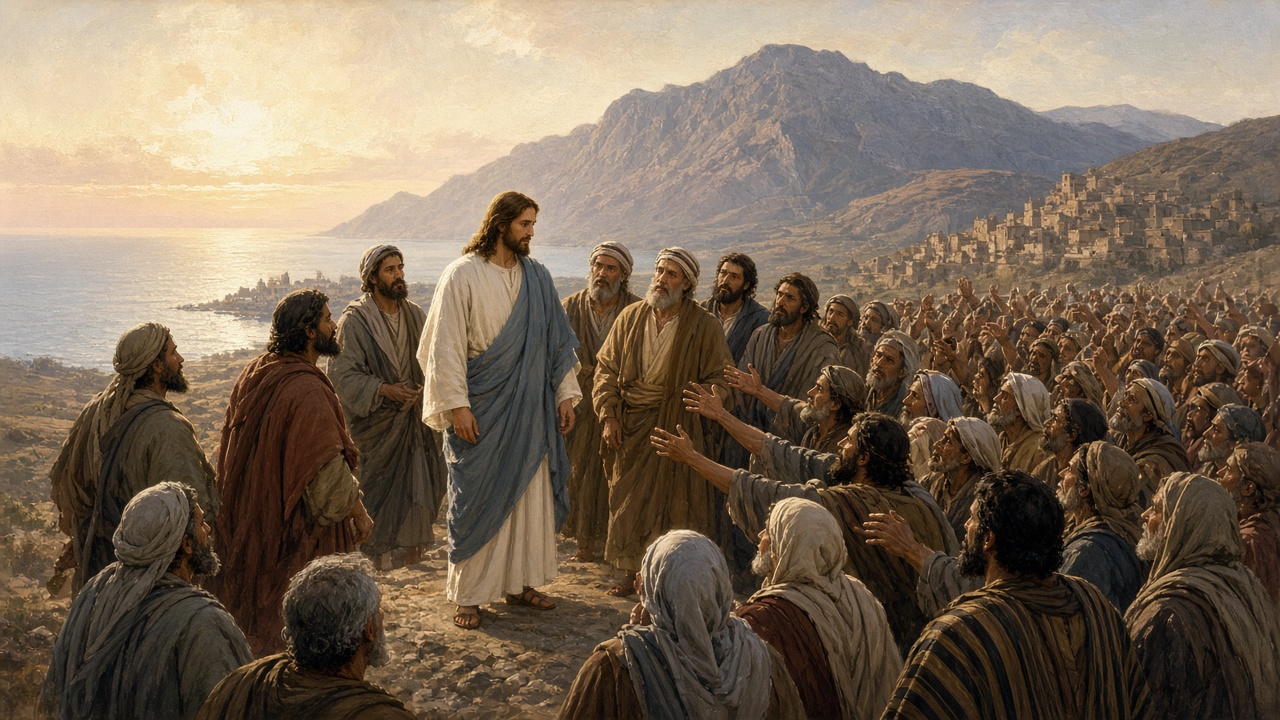
17And Jesus came down from the hill with them, and stood in a field place; and the company of his disciples, and a great multitude of people, of all Judea, and Jerusalem, and of the sea coasts, and of Tyre and Sidon, (or from all of Judea, and Jerusalem, and from the sea coasts, and from Tyre and Sidon), that came to hear him, and to be healed of their sicknesses;
18and they that were travailed of [or with] unclean spirits, were healed. (and those who were troubled by unclean spirits, or devils and demons, were healed.)
19And all the people sought to touch him, for virtue went out of him (or for power went out of him), and healed all.
The Beatitudes
20And when his eyes were cast up, into his disciples, he said, (or And he turned his eyes upon his disciples, and he said), Blessed be ye, poor men [+or Blessed be ye, (the) poor], for the kingdom of God is yours.
21Blessed be ye, that now hunger, for ye shall be full-filled. Blessed be ye, that now weep, for ye shall laugh. [Blessed be ye that hunger now, for ye shall be filled. Blessed be ye that weep now, for ye shall laugh.]
22Ye shall be blessed, when men shall hate you, and separate you away, and put reproof to you [or and shall put shame on you], and cast out your name as evil, for man’s Son.
23Joy ye in that day, and be ye glad; for lo! your meed is much in heaven; for after these things the fathers of them did to (the) prophets. (Rejoice on that day, and be glad; for behold! your reward is great in heaven; for thus their fathers did to the prophets.)
Woes to the Satisfied
24Nevertheless woe to you, rich men, that have your comfort.
25Woe to you that be full-filled, for ye shall hunger. Woe to you that now laugh, for ye shall mourn, and weep. [Woe to you that be filled, for ye shall hunger. Woe to you that laugh now, for ye shall mourn, and weep.]
26Woe to you, when all men shall bless you; after these things the fathers of them did to [false] prophets (or for thus their fathers did to the false prophets).
Love Your Enemies
27But I say to you that hear, love ye your enemies, do ye well to them that hated you [or do ye well to them that hate you];
28bless ye men that curse you, pray ye for men that defame you [or that falsely challenge you].
29And to him that smiteth thee on the one cheek, show also the other [or give also the tother]; and from him that taketh away from thee a cloth, do not thou forbid the coat, (or and as for him who taketh away a cloak from thee, give also thy coat to him).
30And give to each that asketh thee, and if a man taketh away those things that be thine, ask thou not again (for them).
31And as ye will that men do to you (or And as ye desire that men do to you), do ye also to them in like manner.
32And if ye love them that love you, what thank (s), [or what grace], is to you? for sinful men love men that love them. (And if ye love those who love you, what credit is that to you? for sinners love those who love them.)
33And if ye do well to them that do well to you, what grace, [or what thank (s)], is to you? for sinful men do this thing. (And if ye do good to those who do good to you, what credit is that to you? for sinners do this same thing.)
34And if ye lend to them of which ye hope to take again, what thank (s), [or what grace], is to you? for sinful men lend to sinful men, to take again as much. (And if ye lend to those from whom ye hope to receive back, what credit is that to you? for sinners lend to sinners, to receive back as much.)
35Nevertheless love ye your enemies, and do ye well, and lend ye, hoping nothing thereof, and your meed shall be much (or and your reward shall be great), and ye shall be the sons of the Highest, for he is benign, [or of good will], on unkind men and evil men.
36Therefore be ye merciful, as your Father is merciful.
Judging Others
37Do not ye deem, and ye shall not be deemed, (or Do not judge, and ye shall not be judged). Do not ye condemn, and ye shall not be condemned; forgive ye, and it shall be forgiven to you.
38Give ye, and it shall be given to you. They shall give into your bosom a good measure, and well-filled, and shaken together, and overflowing; for by the same measure, by which ye mete, it shall be meted again to you, (or for by the same measure, by which ye measure, it shall be measured unto you).
39And he said to them a likeness (or a parable), Whether the blind may lead the blind? nor fall they not both into the ditch? [or whether they fall not both into the ditch?]
40A disciple is not above his master (or A student is not above his teacher); but each shall be perfect, if he be as his master.
41And what seest thou in thy brother’s eye a mote (or And why seest thou a speck in thy brother’s eye), but thou beholdest not a beam, that is in thine own eye?
42Or how mayest thou say to thy brother, Brother, suffer, (and) I shall cast out the mote of thine eye, (or Brother, allow me, and I shall take out the speck from thine eye), and thou beholdest not a beam that is in thine own eye? Hypocrite, first take out [or cast out] the beam of thine eye, and then thou shalt see to take out the mote of thy brother’s eye.
A Tree and Its Fruit
43It is not a good tree, that maketh evil fruits, neither an evil tree, that maketh good fruits;
44for every tree is known of his fruit. And men gather not figs of thorns, neither men gather a grape of a bush of briers. (for every tree is known by its fruit. And people do not gather figs from thorns, nor do they gather grapes from a briar bush.)
45A good man (out) of the good treasure of his heart bringeth forth good things, and an evil man (out) of the evil treasure bringeth forth evil things; for (out) of the plenty of the heart the mouth speaketh.
The House on the Rock
46And what call ye me, Lord, Lord, (or And why do ye call me, Lord, Lord), and do not (do) those things that I say.
47Each that cometh to me, and heareth my words, and doeth them, I shall show to you, to whom he is like.
48He is like to a man that buildeth an house, that digged deep, and set [or put] the foundament on a stone (or and laid its foundation on a stone). And when a great flood was made, the flood was hurled to that house, and it might not move it, for it was founded on a firm stone.
49But he that heareth, and doeth not, is like to a man building his house on [the] earth, without (a) foundament, (or upon the ground, without a foundation); into which the flood was hurled, and anon it fell down (or and at once it fell down); and the falling down of that house was made great.
Você sabia?
O sábado, os Doze e a planície
- Num sábado, enquanto Jesus passava pelas plantações, os discípulos colhiam espigas, esfregavam os grãos nas mãos e os comiam, e alguns fariseus disseram que isso era ilícito. Jesus lembrou que Davi e seus companheiros, com fome, comeram o pão consagrado da casa de Deus, permitido apenas aos sacerdotes, e disse que o Filho do Homem é Senhor do sábado. Noutro sábado, restaurou na sinagoga a mão direita atrofiada de um homem, enquanto escribas e fariseus o observavam em busca de um motivo para acusá-lo; uma cronologia data os dois episódios em 28 d.C.Fontes: o próprio texto bíblico · Corn on the Sabbath · Healing a Withered Hand
- Depois de passar a noite em oração no monte, Jesus chamou os discípulos e escolheu doze, aos quais designou apóstolos. Entre eles estavam Simão, a quem deu o nome de Pedro, e André, irmão de Pedro, pescadores de Betsaida, na costa ocidental do mar da Galileia, e Mateus, cobrador de impostos em Cafarnaum, antes conhecido como Levi.Fontes: o próprio texto bíblico · Simon Peter · Andrew · Matthew
- Jesus desceu com eles e parou num lugar plano, onde havia gente da Judeia, de Jerusalém e do litoral de Tiro e Sidom para ouvi-lo e ser curada. Tiro e Sidom eram antigas cidades fenícias no Mediterrâneo; Sidom, a mais antiga, ficava a cerca de vinte e cinco milhas ao norte de Tiro. Uma cronologia data esse ensinamento em 28 d.C. e o intitula Sermão da Montanha, embora a narrativa coloque Jesus em terreno plano depois de descer do monte.Fontes: o próprio texto bíblico · Tyre · Sidon · Sermon on the Mount
Notas escritas com auxílio de IA a partir de fontes abertas (Theographic Bible Metadata, CC BY-SA 4.0; Easton’s Bible Dictionary, domínio público) e revisadas antes de publicar.
Lugares deste capítulo
- Jerusalem · 31.777, 35.234 · versículo 17
- Judea · Hoje: Judea 1 · 31.777, 35.234 · versículo 17
- Sidon · Hoje: Sandikli archaeological site in Sidon · 33.561, 35.372 · versículo 17
- Tyre · 33.271, 35.196 · versículo 17
Só aparecem lugares com identificação de alta confiança (90% ou mais segundo as fontes acadêmicas reunidas pelo OpenBible). Mapa da época: DARE (Digital Atlas of the Roman Empire), CC BY 4.0; mapa atual: © colaboradores do OpenStreetMap; lugares: OpenBible.info (CC BY 4.0).
Créditos e licença desta tradução
Wycliffe's Bible with Modern Spelling (Enhanced)
English: Wycliffe's Bible Modern Spelling (Enhanced) (with Deuterocanon)
Copyright © 2001,2010,2011,2012,2013,2015 Terry Noble
Language: English
Dialect: Archaic
Translation by: Terry Noble
Wycliffe's Bible with Modern Spelling (Enhanced)
Wycliffe’s Bible with Modern Spelling (Enhanced) is a composite of my Wycliffe’s Bible, a modern-spelling version of the 14th century Middle English translation, consisting of Wycliffe’s Old Testament and Wycliffe’s New Testament, and my modern-spelling version of Wycliffe’s Apocrypha. These books contain literally tens of thousands of rewritten verses, presented in parentheses “( ) “, to provide help in comprehending the 14th century Middle English vocabulary and grammar. Wycliffe’s Apocrypha also includes the books of the Apocrypha from the 1st edition of the King James Version of the Bible.
This translation is made available to you under the terms of the
Creative Commons Attribution-Noncommercial-No Derivatives license 4.0.
You may share and redistribute this Bible translation or extracts from it in any format, provided that:
You include the above copyright and source information.
You do not sell this work for a profit.
You do not change any of the words or punctuation of the Scriptures.
Pictures included with Scriptures and other documents on this site are licensed just for use with those Scriptures and documents.
For other uses, please contact the respective copyright owners.
2019-09-25
Títulos de seção adaptados da Berean Standard Bible (domínio público); não fazem parte do texto bíblico desta tradução.
Fonte: http://ebible.org/engwyc2018/ · eBible.org