Levítico 21
Wycliffe's Bible with Modern Spelling (Enhanced) · Toque num versículo para ver as referências cruzadas.
Holiness Required of Priests
1And the Lord said to Moses, Speak thou to [the] priests, the sons of Aaron, and thou shalt say to them, A priest be not defouled in the dead men of his citizens (or A priest shall not be defiled with the dead among his fellow citizens),
2no but only in his kinsmen, and nigh of blood, that is, on father, and mother, and son, and daughter, and brother, (only with his own relatives, and next of kin, that is, with his father, and mother, and son, and daughter, and brother,)
3and sister, (who is) a virgin, that is not wedded to man;
4but neither he shall be defouled in the prince of his people. (but he shall not be defiled even with the ruler of his people.)
5Priests shall not shave their head, neither beard, neither they shall make (any) carvings in their fleshes;
6they shall be holy to their God, and they shall not defoul his name; for they offer incense of the Lord, and the loaves of their God, and therefore they shall be holy. (they shall be holy to their God, and they shall not defile his name; for they offer incense to the Lord, and the loaves to their God, and so they shall be holy.)
7A priest shall not wed (for) a wife a corrupt woman, and a foul whore, neither he shall wed her that is forsaken of the husband, for he is hallowed to his God, (A priest shall not wed for a wife any corrupt woman, or a foul whore, nor shall he wed she who is forsaken by her husband, for he is holy to his God,)
8and offereth the loaves of setting forth; therefore be he holy, for I am the holy Lord that halloweth you. (and offereth the loaves of proposition; and so regard him as holy, for I am holy, the Lord who maketh you holy.)
9If the daughter of a priest is taken in defouling of virginity, and defouleth the name of her father, she shall be burnt in fire. (If a priest’s daughter is caught in defiling her own virginity, and so defileth her father’s name, she shall be burned in the fire.)
10The bishop, that is the most priest among his brethren, upon whose head the oil of anointing is poured, and whose hands be (made) sacred in priesthood, and he is clothed in holy clothes, shall not discover his head, he shall not tear his clothes, (The High Priest, who is the highest priest among his brothers, on whose head the anointing oil was poured, who is consecrated in priesthood, and who is clothed in holy clothes, shall not uncover his head, and he shall not tear his clothes,)
11and utterly he shall not enter [in] to any dead man; and he shall not be defouled on his father, and mother, (or and he shall not even be defiled for his father, or his mother),
12neither he shall go out of [the] holy places, lest he defoul the saintuary of the Lord, for the oil of holy anointing of his God is on him; I am the Lord. (nor shall he go out of the holy place, lest he defile the Lord’s sanctuary, for the holiness of the anointing oil of his God is upon him; I am the Lord.)
13He shall wed to wife a virgin; (He shall wed a virgin for his wife;)
14he shall not take a widow, and a forsaken woman, and a foul woman, and (a) whore, but a virgin of his people; (he shall not wed a widow, or a forsaken woman, or a defiled woman, or a whore, but only a virgin out of his people;)
15meddle he not the generation of his kin to the common people of his folk, for I am the Lord, that halloweth him. (and so he shall not mix together, or dishonour, any of the generation of his kin among the common people, for I am the Lord, who maketh him holy.)
Restrictions against Those with Blemishes
16And the Lord spake to Moses, and said,
17Speak thou to Aaron; a man of thy seed, by families, that hath a wem, that is, a notable foulness, shall not offer bread to his God, (Say thou to Aaron, A man of thy seed, among thy families, who hath a blemish, that is, a notable foulness, shall not offer the bread, or the loaves, to his God,)
18neither shall nigh to his service; (nor), if he is blind; if he is crooked; if he is either of little, either of great, or wrong nose; (nor shall he come to do his service; nor, as well, if he is blind, or lame; or too small, or too big;)
19if he is of broken foot, either hand; (if he hath a crippled, or deformed, hand or foot;)
20if he hath a botch, or a bulge, on his back; either if he is bleary-eyed; if he hath white colour, or a pearl, in his eye, that hindereth his sight; if he hath (a) continual scab; if he hath a dry scab in his body (or if he hath a dry scab on his body); either if he be bruised in (the) privy members.
21Each man of the seed of Aaron the priest, that hath a wem (or who hath any blemish, or any fault), shall not nigh to offer sacrifices to the Lord, neither to offer loaves to his God;
22nevertheless he shall (still) eat the loaves that be offered in the saintuary,
23so only that he enter not within the veil; he shall not nigh to the altar, for he hath a wem, and he shall not defoul my saintuary; I am the Lord, that hallow them. (so only that he not come within the Veil; he shall not approach the altar, for he hath a blemish, or a fault, and he shall not defile my sanctuary; I am the Lord who maketh them holy.)
24Therefore Moses spake to Aaron, and to his sons, and to all Israel, all things that were commanded to him. (And so Moses spoke to Aaron, and to his sons, and to all the Israelites, all that was commanded to him.)
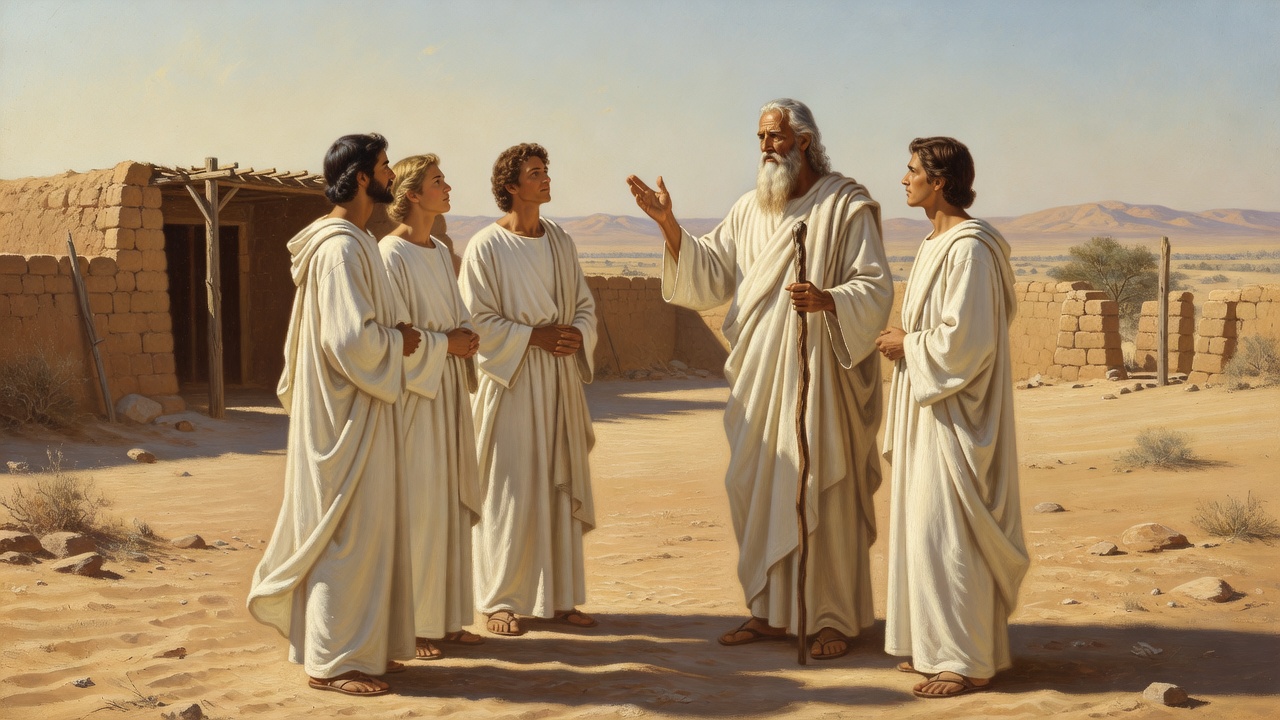
Você sabia?
Santidade e Requisitos para o Sacerdócio
- Os sacerdotes comuns só podiam guardar luto por parentes consanguíneos imediatos — pais, filhos e irmãos solteiros —, enquanto o sumo sacerdote era estritamente proibido de se contaminar por qualquer cadáver, incluindo seus próprios pais, e não podia rasgar suas vestes em sinal de luto.Fontes: o próprio texto bíblico
- Enquanto os sacerdotes comuns eram proibidos de se casar com mulheres divorciadas ou prostitutas, o sumo sacerdote tinha uma exigência ainda mais rigorosa: só podia se casar com uma virgem do seu próprio povo.Fontes: o próprio texto bíblico
- Os descendentes de Arão com defeitos físicos ou lesões eram impedidos de apresentar ofertas queimadas no altar, mas ainda tinham permissão plena para comer das porções de alimentos santos e santíssimos.Fontes: o próprio texto bíblico
Notas escritas com auxílio de IA a partir de fontes abertas (Theographic Bible Metadata, CC BY-SA 4.0; Easton’s Bible Dictionary, domínio público) e revisadas antes de publicar.
Créditos e licença desta tradução
Wycliffe's Bible with Modern Spelling (Enhanced)
English: Wycliffe's Bible Modern Spelling (Enhanced) (with Deuterocanon)
Copyright © 2001,2010,2011,2012,2013,2015 Terry Noble
Language: English
Dialect: Archaic
Translation by: Terry Noble
Wycliffe's Bible with Modern Spelling (Enhanced)
Wycliffe’s Bible with Modern Spelling (Enhanced) is a composite of my Wycliffe’s Bible, a modern-spelling version of the 14th century Middle English translation, consisting of Wycliffe’s Old Testament and Wycliffe’s New Testament, and my modern-spelling version of Wycliffe’s Apocrypha. These books contain literally tens of thousands of rewritten verses, presented in parentheses “( ) “, to provide help in comprehending the 14th century Middle English vocabulary and grammar. Wycliffe’s Apocrypha also includes the books of the Apocrypha from the 1st edition of the King James Version of the Bible.
This translation is made available to you under the terms of the
Creative Commons Attribution-Noncommercial-No Derivatives license 4.0.
You may share and redistribute this Bible translation or extracts from it in any format, provided that:
You include the above copyright and source information.
You do not sell this work for a profit.
You do not change any of the words or punctuation of the Scriptures.
Pictures included with Scriptures and other documents on this site are licensed just for use with those Scriptures and documents.
For other uses, please contact the respective copyright owners.
2019-09-25
Títulos de seção adaptados da Berean Standard Bible (domínio público); não fazem parte do texto bíblico desta tradução.
Fonte: http://ebible.org/engwyc2018/ · eBible.org