Jó 5
Wycliffe's Bible with Modern Spelling (Enhanced) · Toque num versículo para ver as referências cruzadas.
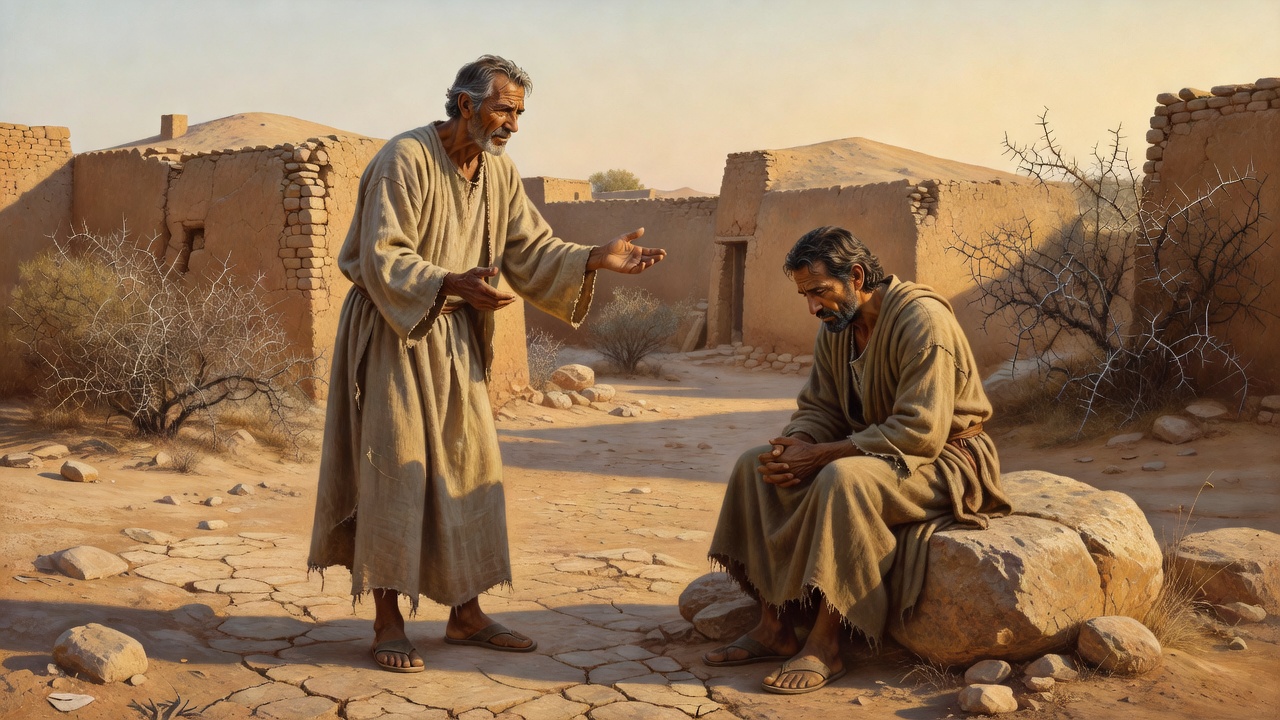
Eliphaz Continues: God Blesses those Who Seek Him
1Therefore, Job, call thou, if there is any man that shall answer thee, and turn thou to some of [the] saints. (And so, Job, call thou out, but is there anyone who shall answer thee? and to whom of the saints shalt thou turn?)
2Wrathfulness slayeth a fond man, and envy slayeth a little child. (Anger killeth the foolish, and envy killeth the childish.)
3I saw a fool with [a] steadfast root, and I cursed his fairness anon (or and at once I cursed his dwelling place).
4His sons shall be made far from health, and they shall be defouled in the gate, and there shall be none that shall deliver them. (Yea, his sons shall be made far from help, and they shall be reviled in the court, and there shall be no one who shall save them.)
5Whose ripe corn an hungry man shall eat, and an armed man shall ravish him, and they, that thirst, shall drink his riches. (A hungry man shall eat his harvest, and an armed man shall rob him, and they, who thirst, shall drink his riches.)
6Nothing is done in [the] earth without cause, and sorrow shall not go out of the earth, that is, adversity befalleth not to any man without cause. (Nothing is done on the earth without a reason, and trouble groweth not out of the earth, that is, adversity befalleth not to anyone without a reason.)
7A man is born to labour, and a bird to flight.
8Wherefore I shall beseech the Lord, and I shall set my speech to my God (or and I shall put my case before my God).
9That maketh great things, and that may not be sought out, and wonderful things without number. (Who maketh great things, which may not be sought out, and wonderful things without number.)
10The which God giveth rain upon the face of the earth, and moisteth all things with waters (or and moisteneth everything with water).
11Which setteth meek men on high, and raiseth with health them that mourn. (Who putteth the humble upon high, and raiseth to victory those who mourn.)
12Which destroyeth the thoughts of evil-willed men (or Who destroyeth the thoughts of the evil-willed), (so) that their hands may not fulfill those things that they have begun.
13Which taketh sly cautelous men in their own fellness, and he destroyeth the counsel of shrews. (Who catcheth the sly and the shrewd in their own craftiness, and he destroyeth the counsel of the depraved.)
14By day they shall run into darknesses, and as in night, so they shall grope in midday. (In the daylight they shall run to the darkness, and at midday they shall grope, like in the night.)
15Certainly God shall make safe a needy man from the sword of their mouth, and a poor man from the hand of the violent, either raveners. (But God shall make the needy safe from the mouth of their sword, and the poor from the hand of the violent, or of the raveners.)
16And hope shall be to a needy man, but wickedness shall draw together his mouth. (And the needy shall have hope, and the mouths of the wicked shall be drawn together, or closed.)
17Blessed is the man, which is chastised of the Lord; therefore reprove thou not the blaming of the Lord. (Blessed is the man, who is chastised by the Lord; and so do not thou reprove the Lord’s rebuke.)
18For he woundeth, and (then he) doeth medicine; he smiteth (or he striketh), and (then) his hands shall make whole.
19In six tribulations he shall deliver thee, and in the seventh tribulation evil shall not touch thee.
20In hunger he shall deliver thee from death, and in battle from the power of (the) sword.
21Thou shalt be hid from the scourge of an evil tongue, and thou shalt not dread mis-ease, either wretchedness, when it cometh.
22In destroying made of enemies and in hunger thou shalt laugh, and thou shalt not dread the beasts of [the] earth. (In destruction made by enemies, and in hunger, thou shalt laugh, and thou shalt not fear the beasts of the earth.)
23But thy covenant shall be with the stones of (the) earth, and (the) beasts of (the) earth shall be peaceable to thee. (And thou shalt make a covenant with the stones of the earth, and the beasts of the earth shall be at peace with thee.)
24And thou shalt know, that thy tabernacle hath peace, and thou visiting thy fairness, that is, beholding thy prosperity, shalt not sin. (And thou shalt know, that thy home shall be at peace, and thou shalt see thy prosperity, and then thou shalt not sin.)
25And thou shalt know also, that thy seed shall be manyfold, and thy generation shall be as an herb of [the] earth. (And thou shalt know also, that thy descendants shall be many, and thy children shall be like the grass on the earth.)
26In abundance (of years) thou shalt go into the sepulchre, as an heap of wheat is borne [in] in his time. (In the abundance of years thou shalt go to the grave, or into the tomb, yea, like a heap of wheat is brought in, or harvested, in its time.)
27Lo! this thing is so, as we have sought, (or Behold! we have sought out this (thing), and it is so); the which thing when thou hast heard (it), treat it in thy mind.
Você sabia?
O Conselho de Elifaz sobre o Sofrimento e a Correção Divina
- Elifaz retrata o sofrimento como uma disciplina divina com propósito, e não como mera desgraça casual, afirmando que a aflição não brota do solo sem motivo. Ele exorta Jó a não desprezar a correção do Todo-Poderoso, que fere apenas para depois curar e restaurar.Fontes: o próprio texto bíblico
- Ao prometer livramento de seis calamidades e até mesmo de sete, Elifaz utiliza uma fórmula poética tradicional de paralelismo numérico progressivo. Esse recurso retórico, comum na poesia de sabedoria do Antigo Oriente Próximo, intensifica a ênfase para transmitir a ideia de proteção total e completa.Fontes: o próprio texto bíblico
- Elifaz descreve a restauração final com imagens agrícolas e pastoris, retratando uma vida em que os animais selvagens e o solo pedregoso deixam de ser hostis. Ele projeta uma morte serena na maturidade da vida, comparada a um feixe de cereais colhido no tempo certo.Fontes: o próprio texto bíblico
Notas escritas com auxílio de IA a partir de fontes abertas (Theographic Bible Metadata, CC BY-SA 4.0; Easton’s Bible Dictionary, domínio público) e revisadas antes de publicar.
Créditos e licença desta tradução
Wycliffe's Bible with Modern Spelling (Enhanced)
English: Wycliffe's Bible Modern Spelling (Enhanced) (with Deuterocanon)
Copyright © 2001,2010,2011,2012,2013,2015 Terry Noble
Language: English
Dialect: Archaic
Translation by: Terry Noble
Wycliffe's Bible with Modern Spelling (Enhanced)
Wycliffe’s Bible with Modern Spelling (Enhanced) is a composite of my Wycliffe’s Bible, a modern-spelling version of the 14th century Middle English translation, consisting of Wycliffe’s Old Testament and Wycliffe’s New Testament, and my modern-spelling version of Wycliffe’s Apocrypha. These books contain literally tens of thousands of rewritten verses, presented in parentheses “( ) “, to provide help in comprehending the 14th century Middle English vocabulary and grammar. Wycliffe’s Apocrypha also includes the books of the Apocrypha from the 1st edition of the King James Version of the Bible.
This translation is made available to you under the terms of the
Creative Commons Attribution-Noncommercial-No Derivatives license 4.0.
You may share and redistribute this Bible translation or extracts from it in any format, provided that:
You include the above copyright and source information.
You do not sell this work for a profit.
You do not change any of the words or punctuation of the Scriptures.
Pictures included with Scriptures and other documents on this site are licensed just for use with those Scriptures and documents.
For other uses, please contact the respective copyright owners.
2019-09-25
Títulos de seção adaptados da Berean Standard Bible (domínio público); não fazem parte do texto bíblico desta tradução.
Fonte: http://ebible.org/engwyc2018/ · eBible.org