Eclesiastes 5
Wycliffe's Bible with Modern Spelling · Toque num versículo para ver as referências cruzadas.
Approaching God with Awe
1Thou that enterest into the house of God, keep thy foot, and nigh thou for to hear; for why much better is obedience, than the sacrifice of fools, that know not what evil they do.
2Speak thou not anything follily, neither thine heart be swift to bring forth a word before God; for God is in heaven, and thou art on earth, therefore thy words be few.
3Dreams follow many busynesses, and folly shall be found in many words.
4If thou hast avowed anything to God, tarry thou not to yield it; for an unfaithful and fond promise displeaseth him; but yield thou whatever thing thou hast avowed;
5and it is much better to make not a vow, than after a vow to yield not the promises.
6Give thou not thy mouth, that thou make thy flesh to do sin; neither say thou before an angel, No purvey-ance there is; lest peradventure the Lord be wroth on thy words, and destroy all the works of thine hands.
7Where be many dreams, be full many vanities, and words without number; but dread thou God.
The Futility of Wealth
8If thou seest false challenges of needy men, and violent dooms, and that rightfulness is destroyed in the province, wonder thou not on this doing; for another is higher than an high man, and also other men be more high above these men;
9and furthermore the king of all earth commandeth to the servant.
10An avaricious man shall not be [ful] filled of money; and he that loveth riches shall not take fruits of them; and therefore this is vanity.
11Where there be many riches, also many men there be, that eat those; and what profiteth it to the holder, but that he seeth [the] riches with his eyes?
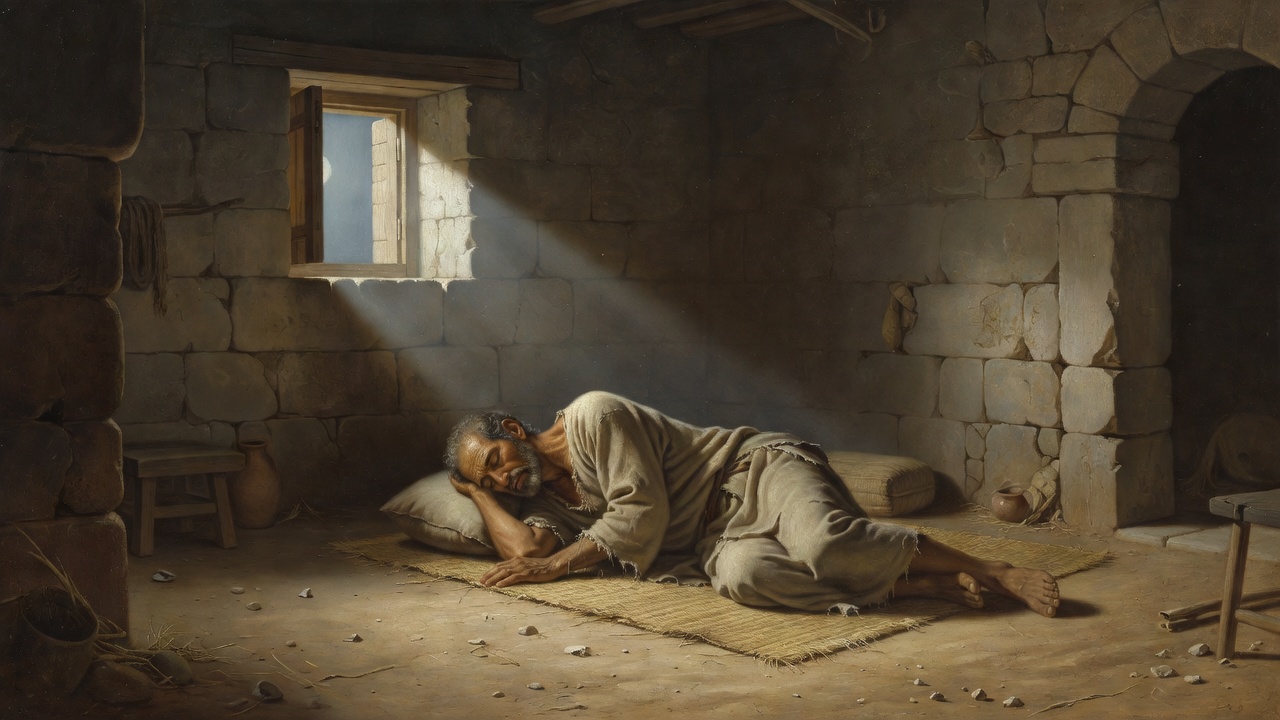
12Sleep is sweet to him that worketh, whether he eat little either much; but the fullness of a rich man suffereth not him to sleep.
13Also another sickness is full evil, which I saw under the sun; riches be kept into the harm of their lord.
14For they perish in the worst torment; he begat a son, that shall be in sovereign neediness.
15As he went naked out of his mother’s womb, so he shall turn again; and he shall take away with him nothing of his travail.
16Utterly it is a wretched sickness; as he came, so he shall turn again. What profiteth it to him, that he travailed into the wind?
17In all the days of his life he ate in darknesses, and in many busynesses, and in neediness, and sorrow.
18Therefore this seemed good to me, that a man eat, and drink, and use gladness of his travail, in which he travailed under the sun, in the number of [the] days of his life, which God gave to him; and this is his part.
19And to each man, to whom God gave riches, and chattel [or substance], and gave power to him to eat of those, and to use his part, and to be glad of his travail; this is the gift of God.
20For he shall not think much on the days of his life, for God occupieth his heart with delights.
Você sabia?
Reverência, justiça e os limites da riqueza
- O autor adverte contra o falar precipitado no culto, lembrando aos adoradores que Deus está nos céus enquanto os mortais estão na terra. Os votos feitos a Deus eram considerados compromissos sérios; o texto adverte que adiar ou deixar de cumprir um voto é insensatez, sendo melhor não votar do que votar e não cumprir.Fontes: o próprio texto bíblico
- Ao abordar a injustiça e a opressão dos pobres em uma província, o autor aponta para a burocracia governamental em camadas, onde cada oficial é vigiado por uma autoridade superior. Apesar dessa hierarquia administrativa, todos os níveis, inclusive o rei, dependem, em última análise, dos frutos da terra.Fontes: o próprio texto bíblico
- O capítulo contrasta a insônia inquieta dos ricos com o sono doce de um trabalhador comum, observando que a busca por riquezas não traz satisfação duradoura. O verdadeiro contentamento surge quando a pessoa aceita sua porção e desfruta de comida, bebida e trabalho honesto como dádivas de Deus.Fontes: o próprio texto bíblico
Notas escritas com auxílio de IA a partir de fontes abertas (Theographic Bible Metadata, CC BY-SA 4.0; Easton’s Bible Dictionary, domínio público) e revisadas antes de publicar.
Créditos e licença desta tradução
Wycliffe's Bible with Modern Spelling
English: Wycliffe's Bible Modern Spelling (with Deuterocanon)
Copyright © 2001,2010,2011,2012,2013,2015 Terry Noble
Language: English
Dialect: Archaic
Translation by: Terry Noble
Wycliffe’s Bible with Modern Spelling, was made in response to requests from readers who wanted my Wycliffe’s Old and New Testaments and Apocrypha in one volume. Printing limitations dictated the number of pages available to me and the letter size. In my previous books, Wycliffe’s Bible, Wycliffe’s Old Testament, Vols. 1 amp 2, Wycliffe’s New Testament, and Wycliffe’s Apocrypha, I have tens of thousands of rewritten verses, presented in parentheses “( )”, to provide help in comprehending the 14th century Middle English vocabulary and grammar. In this present volume, with space at a premium, those “helps” had to be eliminated, to make room for the text of the Apocrypha.
This translation is made available to you under the terms of the
Creative Commons Attribution-Noncommercial-No Derivatives license 4.0.
You may share and redistribute this Bible translation or extracts from it in any format, provided that:
You include the above copyright and source information.
You do not sell this work for a profit.
You do not change any of the words or punctuation of the Scriptures.
Pictures included with Scriptures and other documents on this site are licensed just for use with those Scriptures and documents.
For other uses, please contact the respective copyright owners.
2019-09-26
Títulos de seção adaptados da Berean Standard Bible (domínio público); não fazem parte do texto bíblico desta tradução.
Fonte: http://ebible.org/engwyc2017/ · eBible.org