1 Reis 1
World English Bible Updated · Toque num versículo para ver as referências cruzadas.
Sobre este livro
Sobre 1 Reis
- O Easton's Bible Dictionary (1897) trata como incerta a autoria dos livros de Reis. Uma tradição de que Jeremias os escreveu é, na opinião de Easton, favorecida por trechos quase idênticos a partes de Jeremias e por acontecimentos que Jeremias conhecia pessoalmente; Easton, porém, julga mais provável que Esdras, depois do cativeiro, tenha compilado os livros a partir de documentos anteriores, talvez escritos por Davi, Salomão, Natã, Gade e Ido. Easton data a composição entre 561 a.C., quando Joaquim foi libertado do cativeiro por Evil-Merodaque, e 538 a.C., o decreto de Ciro.Fontes: Easton: Kings, The Books of
- Easton afirma que esses livros contêm os anais do reino desde a ascensão de Salomão até a subjugação por Nabucodonosor e os babilônios, período que ele estima em cerca de 453 anos. 1 Reis começa enquanto Davi está à morte: Adonias, seu quarto filho, que se tornara o herdeiro presuntivo do trono após a morte de Amnom e Absalão, faz-se proclamar rei, mas Natã e Bate-Seba convencem Davi a entronizar Salomão de imediato. Salomão, filho de Davi com Bate-Seba, cuja história é registrada em 1 Reis 1-11, chegou ao trono, sugere Easton, por volta dos dezesseis ou dezoito anos.Fontes: Easton: Kings, The Books of · Adonijah · Solomon
- Nas Escrituras hebraicas, os dois livros de Reis formavam originalmente um só livro; a Septuaginta foi a primeira a dividi-los e, com a Vulgata, os numera como o terceiro e o quarto livros de Reis, sendo os livros de Samuel o primeiro e o segundo. Easton observa que Crônicas dá maior destaque ao ofício sacerdotal ou levítico, enquanto Reis dá maior destaque ao ofício real, e que, na divisão das Escrituras em três partes feita pelos judeus, esses livros são colocados entre os Profetas. A narrativa remete a fontes anteriores: o livro dos atos de Salomão e as crônicas dos reis de Judá e de Israel.Fontes: Easton: Kings, The Books of
- Após a morte de Salomão, as dez tribos se revoltaram e convidaram Jeroboão, filho de Nebate, para ser seu rei; Easton chama Jeroboão de primeiro rei dessas tribos e data seu reinado de 976 a 945 a.C. Ele havia fugido para o Egito sob a proteção de Sisaque I e depois transferiu sua residência de Siquém, sua primeira capital, para Tirza, que continuou sendo a principal residência dos reis de Israel até que Onri comprou de Semer o monte de Shomeron por dois talentos de prata e edificou Samaria. A narrativa posterior inclui Acabe, filho de Onri e sétimo rei de Israel, cuja esposa era Jezabel: ao culto do bezerro introduzido por Jeroboão ele acrescentou o culto de Baal e foi severamente advertido pelo profeta Elias.Fontes: Jeroboam · Tirzah · Samaria · Ahab
Notas escritas com auxílio de IA a partir de fontes abertas (Theographic Bible Metadata, CC BY-SA 4.0; Easton’s Bible Dictionary, domínio público) e revisadas antes de publicar.
Abishag Cares for David
1Now King David was old and advanced in years; and they covered him with clothes, but he couldn’t keep warm. 2Therefore his servants said to him, “Let a young virgin be sought for my lord the king. Let her stand before the king, and cherish him; and let her lie in your bosom, that my lord the king may keep warm.” 3So they sought for a beautiful young lady throughout all the borders of Israel, and found Abishag the Shunammite, and brought her to the king. 4The young lady was very beautiful; and she cherished the king, and served him; but the king didn’t know her intimately.
Adonijah Usurps the Kingdom
5Then Adonijah the son of Haggith exalted himself, saying, “I will be king.” Then he prepared him chariots and horsemen, and fifty men to run before him. 6His father had not displeased him at any time in saying, “Why have you done so?” and he was also a very handsome man; and he was born after Absalom. 7He conferred with Joab the son of Zeruiah and with Abiathar the priest; and they followed Adonijah and helped him. 8But Zadok the priest, Benaiah the son of Jehoiada, Nathan the prophet, Shimei, Rei, and the mighty men who belonged to David, were not with Adonijah.
9Adonijah killed sheep, cattle, and fatlings by the stone of Zoheleth, which is beside En Rogel; and he called all his brothers, the king’s sons, and all the men of Judah, the king’s servants; 10but he didn’t call Nathan the prophet, and Benaiah, and the mighty men, and Solomon his brother.
Nathan and Bathsheba before David
11Then Nathan spoke to Bathsheba the mother of Solomon, saying, “Haven’t you heard that Adonijah the son of Haggith reigns, and David our lord doesn’t know it? 12Now therefore come, please let me give you counsel, that you may save your own life and your son Solomon’s life. 13Go in to King David, and tell him, ‘Didn’t you, my lord the king, swear to your servant, saying, “Assuredly Solomon your son shall reign after me, and he shall sit on my throne”? Why then does Adonijah reign?’ 14Behold, while you are still talking there with the king, I will also come in after you and confirm your words.”
15Bathsheba went in to the king in his room. The king was very old; and Abishag the Shunammite was serving the king. 16Bathsheba bowed and showed respect to the king. The king said, “What would you like?”
17She said to him, “My lord, you swore by the LORD your God to your servant, ‘Assuredly Solomon your son shall reign after me, and he shall sit on my throne.’ 18Now, behold, Adonijah reigns; and you, my lord the king, don’t know it. 19He has slain cattle and fatlings and sheep in abundance, and has called all the sons of the king, Abiathar the priest, and Joab the captain of the army; but he hasn’t called Solomon your servant. 20You, my lord the king, the eyes of all Israel are on you, that you should tell them who will sit on the throne of my lord the king after him. 21Otherwise it will happen, when my lord the king sleeps with his fathers, that I and my son Solomon will be considered criminals.”
22Behold, while she was still talking with the king, Nathan the prophet came in. 23They told the king, saying, “Behold, Nathan the prophet!”
When he had come in before the king, he bowed himself before the king with his face to the ground. 24Nathan said, “My lord, King, have you said, ‘Adonijah shall reign after me, and he shall sit on my throne’? 25For he has gone down today, and has slain cattle, fatlings, and sheep in abundance, and has called all the king’s sons, the captains of the army, and Abiathar the priest. Behold, they are eating and drinking before him, and saying, ‘Long live King Adonijah!’ 26But he hasn’t called me, even me your servant, Zadok the priest, Benaiah the son of Jehoiada, and your servant Solomon. 27Was this thing done by my lord the king, and you haven’t shown to your servants who should sit on the throne of my lord the king after him?”
David Renews His Oath to Bathsheba
28Then King David answered, “Call Bathsheba in to me.” She came into the king’s presence and stood before the king. 29The king vowed and said, “As the LORD lives, who has redeemed my soul out of all adversity, 30most certainly as I swore to you by the LORD, the God of Israel, saying, ‘Assuredly Solomon your son shall reign after me, and he shall sit on my throne in my place;’ I will most certainly do this today.”
31Then Bathsheba bowed with her face to the earth and showed respect to the king, and said, “Let my lord King David live forever!”
Solomon Anointed King
32King David said, “Call to me Zadok the priest, Nathan the prophet, and Benaiah the son of Jehoiada.” They came before the king. 33The king said to them, “Take with you the servants of your lord, and cause Solomon my son to ride on my own mule, and bring him down to Gihon. 34Let Zadok the priest and Nathan the prophet anoint him there king over Israel. Blow the trumpet, and say, ‘Long live King Solomon!’ 35Then come up after him, and he shall come and sit on my throne; for he shall be king in my place. I have appointed him to be prince over Israel and over Judah.”
36Benaiah the son of Jehoiada answered the king, and said, “Amen. May the LORD, the God of my lord the king, say so. 37As the LORD has been with my lord the king, even so may he be with Solomon, and make his throne greater than the throne of my lord King David.”
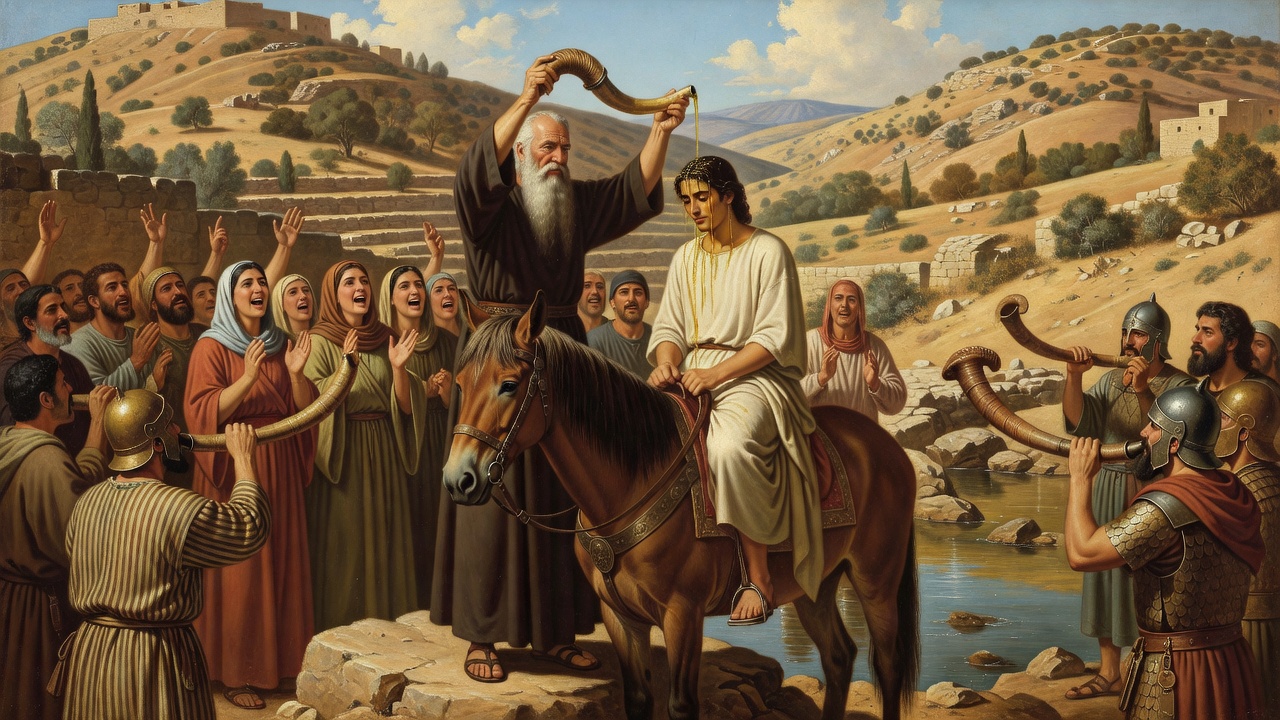
38So Zadok the priest, Nathan the prophet, Benaiah the son of Jehoiada, and the Cherethites and the Pelethites went down and had Solomon ride on King David’s mule, and brought him to Gihon. 39Zadok the priest took the horn of oil from the Tent, and anointed Solomon. They blew the trumpet; and all the people said, “Long live King Solomon!”
40All the people came up after him, and the people piped with pipes, and rejoiced with great joy, so that the earth shook with their sound.
Adonijah Learns of Solomon’s Kingship
41Adonijah and all the guests who were with him heard it as they had finished eating. When Joab heard the sound of the trumpet, he said, “Why is this noise of the city being in an uproar?”
42While he yet spoke, behold, Jonathan the son of Abiathar the priest came; and Adonijah said, “Come in; for you are a worthy man, and bring good news.”
43Jonathan answered Adonijah, “Most certainly our lord King David has made Solomon king. 44The king has sent with him Zadok the priest, Nathan the prophet, Benaiah the son of Jehoiada, and the Cherethites and the Pelethites; and they have caused him to ride on the king’s mule. 45Zadok the priest and Nathan the prophet have anointed him king in Gihon. They have come up from there rejoicing, so that the city rang again. This is the noise that you have heard. 46Also, Solomon sits on the throne of the kingdom. 47Moreover the king’s servants came to bless our lord King David, saying, ‘May your God make the name of Solomon better than your name, and make his throne greater than your throne;’ and the king bowed himself on the bed. 48Also thus said the king, ‘Blessed be the LORD, the God of Israel, who has given one to sit on my throne today, my eyes even seeing it.’”
49All the guests of Adonijah were afraid, and rose up, and each man went his way. 50Adonijah was afraid because of Solomon; and he arose, and went, and hung onto the horns of the altar. 51Solomon was told, “Behold, Adonijah fears King Solomon; for, behold, he is hanging onto the horns of the altar, saying, ‘Let King Solomon swear to me first that he will not kill his servant with the sword.’”
52Solomon said, “If he shows himself a worthy man, not a hair of his shall fall to the earth; but if wickedness is found in him, he shall die.”
53So King Solomon sent, and they brought him down from the altar. He came and bowed down to King Solomon; and Solomon said to him, “Go to your house.”
Você sabia?
A sucessão ao trono de Davi
- Sendo o filho sobrevivente mais velho de Davi após a morte de Amnon e Absalão, Adonias reivindicou o trono com o apoio do comandante militar Joabe e do sacerdote Abiatar. No entanto, Davi escolheu seu filho mais jovem, Salomão, que era apoiado pelo profeta Natã, pelo sacerdote Zadoque e por Benaia.Fontes: Adonijah · Solomon · o próprio texto bíblico
- Montar na própria mula do rei era uma declaração pública decisiva de autoridade real. Por ordem expressa de Davi, Salomão foi conduzido até a fonte de Giom, onde Zadoque o ungiu rei com o azeite do tabernáculo ao som de trombetas e aclamação popular.Fontes: Gihon · Zadok · o próprio texto bíblico
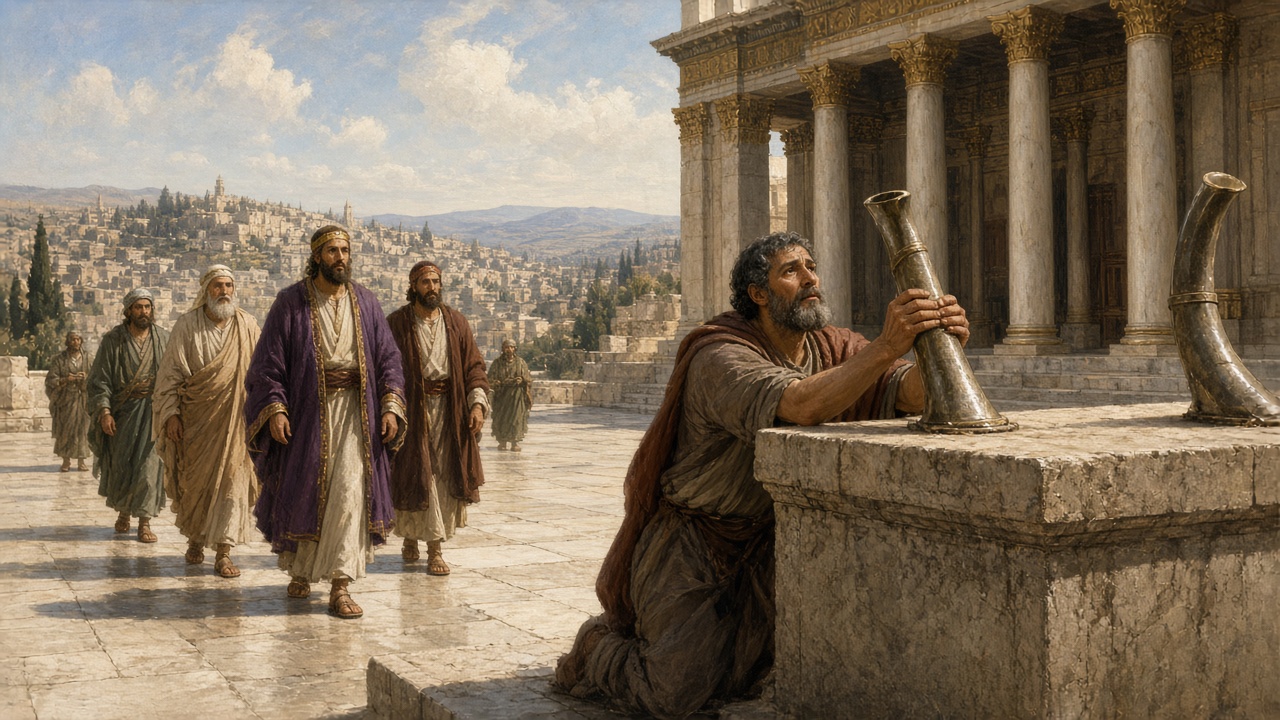
- Ao saber da coroação pública de Salomão, Adonias fugiu apavorado e buscou asilo segurando as pontas do altar de sacrifícios. Salomão concedeu-lhe clemência condicional, poupando sua vida desde que ele provasse ser um homem digno.Fontes: Adonijah · o próprio texto bíblico
Notas escritas com auxílio de IA a partir de fontes abertas (Theographic Bible Metadata, CC BY-SA 4.0; Easton’s Bible Dictionary, domínio público) e revisadas antes de publicar.
Lugares deste capítulo
- Shunem · Hoje: Sulam · 32.606, 35.334 · versículo 3
- Serpent’s Stone · Hoje: within 100 m of Bir Ayub · 31.767, 35.236 · versículo 9
- Gihon · Hoje: Gihon Spring · 31.773, 35.236 · versículos 33, 38, 44, 45
- Jerusalem · 31.777, 35.234 · versículo 40
Só aparecem lugares com identificação de alta confiança (90% ou mais segundo as fontes acadêmicas reunidas pelo OpenBible). Mapa da época: DARE (Digital Atlas of the Roman Empire), CC BY 4.0; mapa atual: © colaboradores do OpenStreetMap; lugares: OpenBible.info (CC BY 4.0).
Créditos e licença desta tradução
The World English Bible
The World English Bible is in the Public Domain. That means that it is not copyrighted. However, "World English Bible" is a Trademark of eBible.org.
You may copy, publish, proclaim, distribute, redistribute, sell, give away, quote, memorize, read publicly, broadcast, transmit, share, back up, post on the Internet, print, reproduce, preach, teach from, and use
the World English Bible as much as you want, and others may also do so. All we ask is that if you CHANGE the actual text of the World English Bible in any way, you not call the result the World English Bible any more.
This is to avoid confusion, not to limit your freedom. The Holy Bible is God's Word. It belongs to God. He gave it to us freely, and we who have worked on this translation freely give it to you by dedicating it to the
Public Domain.
Donations to help with the expenses of this project and thus help others have free access to the Word of God may be made to us, but are not required. Please see
https://MLJohnson.org/partner/ if you are interested in helping to fund this work.
This is the "updated" version of the World English Bible which uses "LORD" or "GOD" in place of "Yahweh" or "Yah" in the Old Testament. Typo corrections and updates, if any, will be posted on https://eBible.org/engwebu/ and at https://WorldEnglish.Bible .
Títulos de seção adaptados da Berean Standard Bible (domínio público); não fazem parte do texto bíblico desta tradução.
Fonte: http://ebible.org/engwebu/ · eBible.org