João 6
Text-Critical English New Testament · Toque num versículo para ver as referências cruzadas.
The Feeding of the Five Thousand
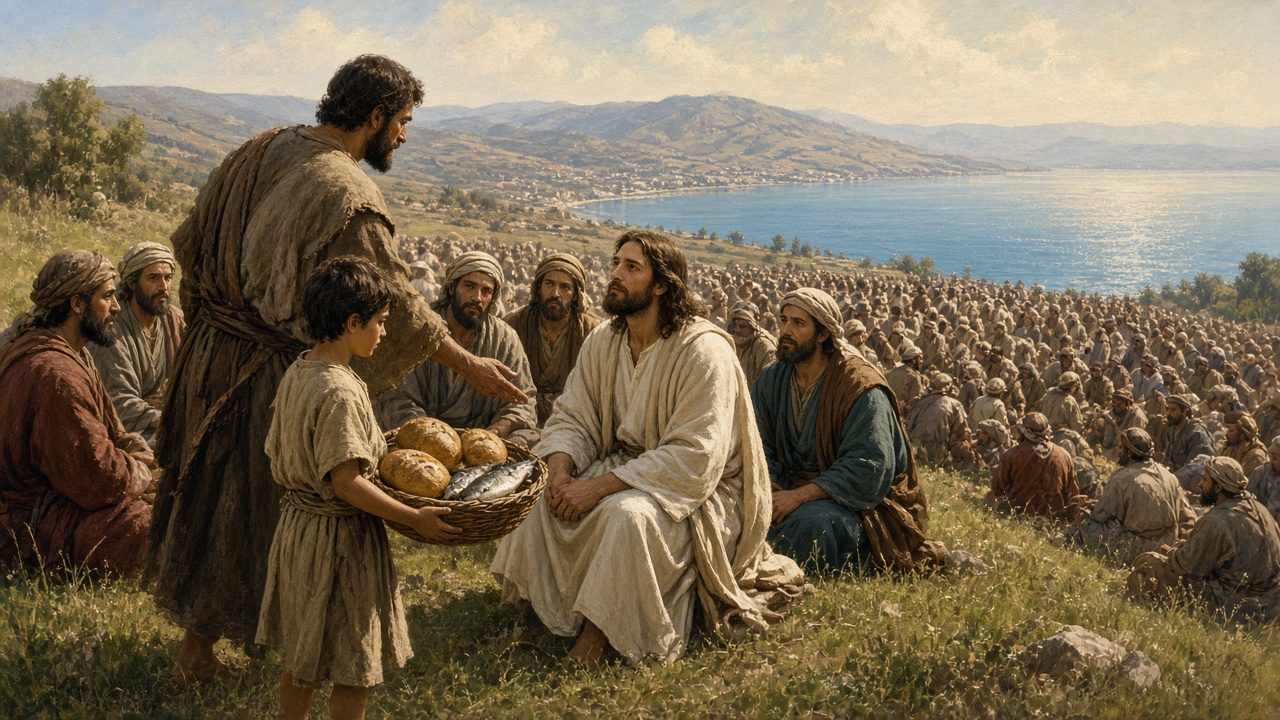
1After this Jesus went away to the other side of the Sea of Galilee (that is, the Sea of Tiberias). 2A large crowd was following him because they saw the miraculous signs he was performing on the sick. 3So Jesus went up on the mountain and sat there with his disciples. 4(Now the Jewish feast of the Passover was near.) 5When Jesus lifted up his eyes and saw that a large crowd was coming to him, he said to Philip, “Where shall we buy bread so that these people may eat?” 6(He said this to test him, for he himself knew what he was about to do.) 7Philip answered him, “Two hundred denarii worth of bread would not be sufficient for each of them to receive a little portion.” 8Then one of his disciples, Andrew, the brother of Simon Peter, said to him, 9“There is a little boy here who has five barley loaves and two fish, but what good are they for so many people?” 10Jesus said, “Have the people sit down.” (Now there was a lot of grass in that place.) So the men sat down, about five thousand in number. 11Then Jesus took the loaves, and after giving thanks, he distributed them to the disciples, and the disciples distributed them to those who were seated. He did the same with the fish, and the people ate as much as they wanted. 12When they were full, Jesus said to his disciples, “Gather together the pieces that are left over so that nothing is wasted.” 13So they gathered them together and filled twelve baskets with the broken pieces from the five barley loaves that were left over by those who had eaten. 14When the people saw the sign that Jesus had done, they said, “This is truly the Prophet who is to come into the world.” 15So Jesus, knowing that they were about to come and take him by force to make him king, withdrew to the mountain by himself.
Jesus Walks on Water
16When evening came, his disciples went down to the sea, 17and after getting into the boat, they started going across the sea to Capernaum. Darkness had already set in, but Jesus had not come to them. 18Then the sea became rough because a strong wind was blowing. 19When they had rowed about three or four miles, they saw Jesus approaching the boat, walking on the sea, and they were afraid. 20But he said to them, “It is I; do not be afraid.” 21Then they were willing to receive him into the boat, and immediately the boat reached the land where they were heading.
I Am the Bread of Life
22On the next day the crowd that had stayed on the other side of the sea realized that there had been no other boat there except the one Jesus' disciples had gotten into, and that Jesus himself had not gotten into the boat with his disciples, but that his disciples had gone away alone. 23Then other boats from Tiberias came near the place where they had eaten the bread after the Lord had given thanks. 24So when the crowd saw that neither Jesus nor his disciples were there, they themselves got into the boats and went to Capernaum, seeking Jesus.
25When they found him on the other side of the sea, they said to him, “Rabbi, when did yoʋ get here?” 26Jesus answered them, “Truly, truly, I say to you, you are seeking me not because you saw signs, but because you ate the loaves and were filled. 27Do not work for food that perishes, but for food that endures to eternal life, which the Son of Man will give you. For on him God the Father has set his seal.” 28Then they said to him, “What must we do to do the works of God?” 29Jesus answered them, “This is the work of God, that you believe in the one he has sent.” 30So they said to him, “What sign then are yoʋ going to perform so that we may see it and believe yoʋ? What will yoʋ do? 31Our fathers ate the manna in the wilderness, just as it is written, ‘He gave them bread from heaven to eat.’ ” 32Jesus said to them, “Truly, truly, I say to you, it was not Moses who gave you the bread from heaven, but my Father gives you the true bread from heaven. 33For the bread of God is that which comes down from heaven and gives life to the world.” 34So they said to him, “Sir, give us this bread always.”
35Jesus said to them, “I am the bread of life; he who comes to me will never hunger, and he who believes in me will never thirst. 36But as I told you, you have seen me and still you do not believe. 37Everyone the Father gives me will come to me, and I will never cast out anyone who comes to me. 38For I have come down from heaven not to do my own will, but the will of him who sent me. 39And this is the will of the Father who sent me, that I should lose none of those he has given me, but should raise them up on the last day. 40And this is the will of him who sent me, that anyone who looks to the Son and believes in him should have eternal life, and I will raise him up on the last day.”
41Then the Jews began to grumble about him because he said, “I am the bread that came down from heaven.” 42They said, “Is this not Jesus, the son of Joseph, whose father and mother we know? How then can he say, ‘I have come down from heaven’?” 43Jesus answered them, “Do not grumble among yourselves. 44No one can come to me unless the Father who sent me draws him, and I will raise him up on the last day. 45It is written in the Prophets, ‘They will all be taught by God.’ Everyone therefore who has heard and learned from the Father comes to me— 46not that anyone has seen the Father, except he who is from God; he has seen the Father. 47Truly, truly, I say to you, whoever believes in me has eternal life. 48I am the bread of life. 49Your fathers ate the manna in the wilderness, and died. 50This is the bread that comes down from heaven, so that anyone may eat of it and not die. 51I am the living bread that has come down from heaven. If anyone eats of this bread, he will live forever. And the bread that I will give for the life of the world is my flesh.”
52Then the Jews began to quarrel with one another, saying, “How can this man give us his flesh to eat?” 53So Jesus said to them, “Truly, truly, I say to you, if you do not eat the flesh of the Son of Man and drink his blood, you have no life in yourselves. 54Anyone who eats my flesh and drinks my blood has eternal life, and I will raise him up on the last day. 55For my flesh is true food, and my blood is true drink. 56Whoever eats my flesh and drinks my blood abides in me, and I in him. 57Just as the living Father sent me, and I live because of the Father, so whoever feeds on me will also live because of me. 58This is the bread that came down from heaven, not as your fathers ate the manna, and died. Whoever eats this bread will live forever.” 59He said these things in a synagogue while teaching in Capernaum.
The Words of Eternal Life
60After hearing this, many of his disciples said, “This teaching is difficult; who can accept it?” 61But Jesus, aware that his disciples were grumbling about this, said to them, “Does this offend you? 62Then what if you see the Son of Man ascending to where he was before? 63It is the Spirit who gives life; the flesh is of no benefit. The words I speak to you are spirit and life. 64But there are some among you who do not believe.” (For Jesus knew from the beginning which of them did not believe and who it was that would betray him.) 65Then he said, “That is why I told you that no one can come to me unless it has been granted to him by my Father.”
66At that point many of his disciples went back and no longer walked with him. 67So Jesus said to the twelve, “Do you also want to go away?” 68Simon Peter answered him, “Lord, to whom shall we go? Yoʋ have the words of eternal life. 69And we have come to believe and to know that yoʋ are the Christ, the Son of the living God.” 70Jesus answered them, “Did I not choose you, the twelve? And yet one of you is a devil.” 71(Now he was speaking about Judas Iscariot, the son of Simon, who was one of the twelve and would later betray him.)
Você sabia?
O pão da vida
- Neste capítulo, João chama o lago de Mar da Galileia e também de Mar de Tiberíades. O Dicionário Bíblico de Easton descreve-o com doze milhas e meia de comprimento e de quatro a sete milhas e meia de largura, e com a superfície 682 pés abaixo do Mediterrâneo. De Tiberíades, na margem ocidental, diz-se que foi fundada por Herodes Antipas no ano 16 d.C. e que recebeu o nome em honra do imperador Tibério; alguns barcos dessa cidade aportaram perto do lugar onde o povo tinha comido o pão.Fontes: o próprio texto bíblico · Sea of Galilee · Tiberias
- Naquela noite, os discípulos partiram de barco rumo a Cafarnaum, e no dia seguinte a multidão atravessou e encontrou Jesus ali. Ele proferiu o ensinamento sobre o pão da vida na sinagoga de Cafarnaum. O Dicionário Bíblico de Easton observa que a cidade, não mencionada no Antigo Testamento, tornou-se a própria cidade de Jesus depois de ele ser expulso de Nazaré e foi cenário de muitos episódios do seu ministério.Fontes: o próprio texto bíblico · Capernaum
- Quando a multidão se aproximava, Jesus perguntou a Filipe onde poderiam comprar pão, pergunta que o relato diz ter sido para pô-lo à prova, pois Jesus já sabia o que ia fazer. Filipe, como André e Pedro, era de Betsaida; respondeu que duzentos denários não comprariam o bastante para cada pessoa receber um pedaço pequeno. André, irmão de Pedro, indicou então um menino com cinco pães de cevada e dois peixes pequenos, e o Dicionário Bíblico de Easton, citando esse diálogo entre outras passagens, diz que Filipe parece ter ocupado um lugar de destaque entre os apóstolos.Fontes: o próprio texto bíblico · Phillip the Apostle · Andrew · Simon Peter
Notas escritas com auxílio de IA a partir de fontes abertas (Theographic Bible Metadata, CC BY-SA 4.0; Easton’s Bible Dictionary, domínio público) e revisadas antes de publicar.
Lugares deste capítulo
Só aparecem lugares com identificação de alta confiança (90% ou mais segundo as fontes acadêmicas reunidas pelo OpenBible). Mapa da época: DARE (Digital Atlas of the Roman Empire), CC BY 4.0; mapa atual: © colaboradores do OpenStreetMap; lugares: OpenBible.info (CC BY 4.0).
Créditos e licença desta tradução
Text-Critical English New Testament
The New Testament based on the Byzantine Text with extensive text-critical footnotes
Copyright © 2022 Robert Adam Boyd
Language: English
"The Text-Critical English New Testament" and "Byzantine Text Version" are trademarks of Robert Adam Boyd. If you adapt, remix, transform, or in any other way change the translation or footnotes, you may not call it "The Text-Critical English New Testament" or "Byzantine Text Version".
This translation is made available to you under the terms of the
Creative Commons Attribution license 4.0.
You may share and redistribute this Bible translation or extracts from it in any format, provided that:
You include the above copyright and source information.
If you make any changes to the text, you must indicate that you did so in a way that makes it clear that the original licensor is not necessarily endorsing your changes.
Pictures included with Scriptures and other documents on this site are licensed just for use with those Scriptures and documents.
For other uses, please contact the respective copyright owners.
Note that in addition to the rules above, revising and adapting God's Word involves a great responsibility to be true to God's Word. See Revelation 22:18-19.
2026-10-02
Fonte: http://ebible.org/engtcent/ · eBible.org