Êxodo 2
One Unity Resource Bible · Toque num versículo para ver as referências cruzadas.
The Birth and Adoption of Moses
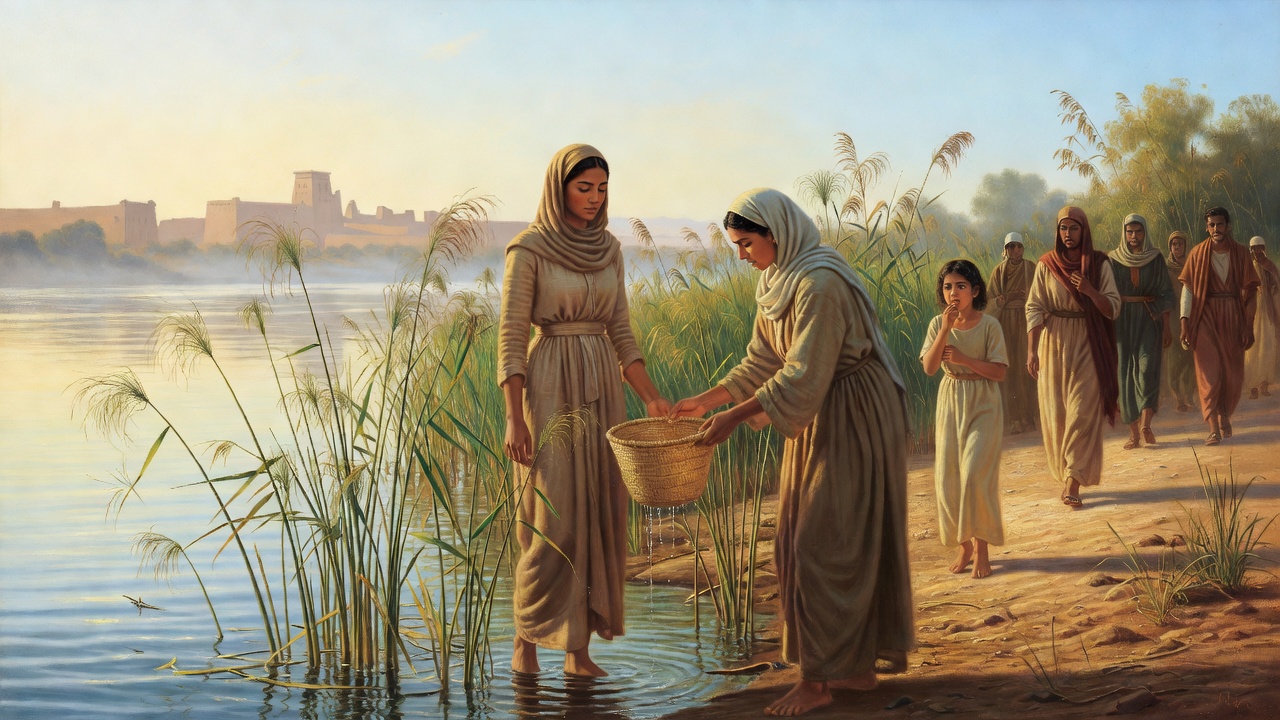
1A man of the house of Levi [United with] went and took a daughter of Levi [United with] as his wife. 2The woman conceived, and bore a son, upon seeing what a fine child he was, she hid him three months. 3When she could no longer hide him, she took a papyrus basket for him, and coated it with tar and with pitch. She put the child in it, and laid it in the reeds by the river’s bank. 4His sister stood far off, to see what would be done to him. 5Pharaoh’s daughter came down to bathe at the river. Her maidens walked along by the riverside. She saw the basket among the reeds, and sent her servant to get it. 6She opened it, and saw the child, and behold, the baby cried. She had compassion on him, and said, “This is one of the Hebrews’ [Immigrants’] children.”
7Then his sister said to Pharaoh’s daughter, “Should I go and call a nurse for you from the Hebrew women, that she may nurse the child for you?”
8Pharaoh’s daughter said to her, “Go.”
The maiden went and called the child’s mother. 9Pharaoh’s daughter said to her, “Take this child away, and nurse him for me, and I will give you your wages.”
The woman took the child, and nursed it. 10The child grew, and she brought him to Pharaoh’s daughter, and he became her son. She named him Moses [Drawn out], and said, “Because I drew him out of the water.”
(3)
The Rejection and Flight of Moses
11In those days, when Moses [Drawn out] had grown up, he went out to his brothers, and looked at their burdens. He saw an Egyptian [person from Abode of slavery] striking a Hebrew [Immigrant], one of his brothers. 12He looked this way and that way, and when he saw that there was no one, he killed the Egyptian [person from Abode of slavery], and hid him in the sand.
13He went out the second day, and behold, two men of the Hebrews [Immigrants] were fighting with each other. He said to him who did the wrong, “Why do you strike your fellow?”
14He said, “Who made you a prince and a judge over us? Do you plan to kill me, as you killed the Egyptian [person from Abode of slavery]?”
Moses [Drawn out] was afraid, and said, “Surely this thing is known.” 15Now when Pharaoh sh'ma ·heard obeyed· this thing, he sought to kill Moses [Drawn out]. But Moses [Drawn out] fled from the face of Pharaoh, and lived in the land of Midian [Strife], and he sat down by a well.
16Now the priest of Midian [Strife] had seven daughters. They came and drew water, and filled the troughs to water their father’s flock. 17The shepherds came and divorced them away; but Moses [Drawn out] stood up and helped them, and watered their flock. 18When they came to Reuel, their father, he said, “How is it that you have returned so early today?”
19They said, “An Egyptian [person from Abode of slavery] delivered us out of the hand of the shepherds, and moreover he drew water for us, and watered the flock.”
20He said to his daughters, “Where is he? Why is it that you have left the man? Call him, that he may eat bread.”
21Moses [Drawn out] was content to dwell with the man. He gave Moses [Drawn out] Zipporah, his daughter. 22She bore a son, and he named him Gershom, for he said, “I have lived as a foreigner in a foreign land.”
God Hears the Cry of the Israelites
23In the course of those many days, the king of Egypt [Abode of slavery] died, and the children of Israel [God prevails] sighed because of the bondage, and they cried, and their cry came up to God because of the bondage. 24God sh'ma ·heard obeyed· their groaning, and God remembered his covenant ·binding contract between two or more parties· with Abraham [Father of a multitude], with Isaac [Laughter], and with Jacob [Supplanter]. 25God saw the children of Israel [God prevails], and God was concerned about them.
Você sabia?
O nascimento e a fuga de Moisés
- A filha do faraó deu ao menino o nome de Moisés e explicou que o havia tirado da água. O Dicionário Bíblico de Easton (1897) liga o nome dele a “tirado”, ou à palavra egípcia mesu, “filho” — o elemento a partir do qual o dicionário também explica Ramsés como “filho real”.Fontes: o próprio texto bíblico · Moses
- Em Êxodo 2, uma filha de Levi esconde o filho por três meses, e a filha do faraó, ao achá-lo entre os juncos do Nilo, reconhece uma criança hebreia. O Dicionário Bíblico de Easton (1897) liga a aflição dos israelitas ao “novo rei que não conhecera a José”, por muito tempo tido como Aahmes I, chamado Amosis por Josefo, embora o dicionário, citando descobertas então recentes, o identifique como Seti. O sofrimento deles, diz a obra, começou depois que os hicsos, senhores do Egito por cerca de cinco séculos, foram expulsos e a antiga dinastia foi restaurada.Fontes: o próprio texto bíblico · Pharaoh
- Depois que o faraó procurou matá-lo, Moisés fugiu para Midiã e sentou-se junto a um poço; mais tarde casou-se com Zípora, uma das sete filhas do sacerdote de Midiã. Os midianitas eram árabes nômades, descendentes de Midiã, o quarto filho de Abraão com Quetura, e pastoreavam seus rebanhos na península do Sinai e no deserto ao norte da península Arábica. Neste capítulo o sacerdote se chama Reuel, a quem o Dicionário Bíblico de Easton (1897) chama Raguel, considerando essa forma seu nome pessoal e Jetro — “excelência” — um título oficial, caso os dois sejam identificados.Fontes: o próprio texto bíblico · Midian · Midian · Jethro
Notas escritas com auxílio de IA a partir de fontes abertas (Theographic Bible Metadata, CC BY-SA 4.0; Easton’s Bible Dictionary, domínio público) e revisadas antes de publicar.
Lugares deste capítulo
- Nile · Hoje: Nile River · 31.465, 30.367 · versículos 3, 5
- Midian · 28.495, 35.012 · versículos 15, 16
- Egypt · 30.129, 31.308 · versículo 23
Só aparecem lugares com identificação de alta confiança (90% ou mais segundo as fontes acadêmicas reunidas pelo OpenBible). Mapa da época: DARE (Digital Atlas of the Roman Empire), CC BY 4.0; mapa atual: © colaboradores do OpenStreetMap; lugares: OpenBible.info (CC BY 4.0).
Créditos e licença desta tradução
One Unity Resource Bible
The One Unity Resource Bible translation of the Holy Bible into American English with some transliterated Hebrew notations
Copyright © 2016,2019 Thomas Robinson
Language: English
Dialect: American
Translation by: Thomas Robinson
This translation is made available to you under the terms of the
Creative Commons Attribution Share-Alike license 4.0.
You have permission to share and redistribute this Bible translation in any format and to make reasonable revisions and adaptations of this translation, provided that:
You include the above copyright and source information.
If you make any changes to the text, you must indicate that you did so in a way that makes it clear that the original licensor is not necessarily endorsing your changes.
If you redistribute this text, you must distribute your contributions under the same license as the original.
Pictures included with Scriptures and other documents on this site are licensed just for use with those Scriptures and documents.
For other uses, please contact the respective copyright owners.
Note that in addition to the rules above, revising and adapting God's Word involves a great responsibility to be true to God's Word. See Revelation 22:18-19.
2024-12-05
Títulos de seção adaptados da Berean Standard Bible (domínio público); não fazem parte do texto bíblico desta tradução.
Fonte: http://ebible.org/engourb/ · eBible.org