Gênesis 37
Targum Onkelos Etheridge · Toque num versículo para ver as referências cruzadas.
Joseph’s Dreams
1And Jakob dwelt in the land of the habitation of his father, in the land of Kenaan.
2These are the generations of Jakob. Joseph was a son of seventeen years; he kept the flock with his brothers; and he had been brought up with the sons of Bilhah, and with the sons of Zilpha, the wives of his father; and Joseph brought their evil report to his father. 3But Israel loved Joseph more than all his sons, because he had in him a wise son, and he made him a variegated robe. 4And his brothers saw that their father loved him better than all his brethren, and they hated him, and were not willing to speak with him peaceably.
5And Joseph dreamed a dream, and showed it to his brothers, and they hated him the more. 6And he said to them, Hear now this dream which I have dreamed: 7Behold, we were binding sheaves in the midst of the field, and lo! My sheaf arose and became upright, and, behold, your sheaves stood around and worshipped my sheaf. 8And his brothers said to him, Is it thy fancy reigning to reign over us? Or a shultan, dost thou think to govern us? And they added yet to hate him for his dreams and for his words. 9And he dreamed yet another dream, and described it to his brothers, saying, Behold, I have dreamed a dream again; and lo, the sun, and the moon, and eleven stars worshipped me. 10And he described it to his father and to his brethren; and his father rebuked him and said to him, What dream is this that thou hast dreamed? Am I and thy mother and thy brothers to come and worship thee on the earth? 11And his brothers envied him; but his father kept the word.
Joseph Sold into Egypt
12And his brothers went to tend the flock of their father in Shekem. 13And Israel said to Joseph, Do not thy brothers tend the flock in Shekem? Come, I will send thee to them. And he said. Behold me. 14And he said to him, Go now, and see the welfare of your brothers and the welfare of the flock, and return me word. And he sent him from the vale of Hebron, and he came to Shekem. 15And a man found him, and, behold, he wandered in the field. And the man inquired of him, saying, Whom seekest thou? 16And he said, I look for my brothers: show me, I beseech thee, where they feed. 17And the man said, They have gone hence; for I heard them say, We will go to Dothan. And Joseph went after his brethren, and found them in Dothan. 18And they saw him from afar; and before he came nigh, they devised against him to kill him. 19And they said, a man to his brother, Behold, this master of dreams cometh. 20And now, come, we will kill him, and cast him into one of the pits; and will say an evil beast hath devoured him, and we shall see what will be the end of his dreams. 21And Reuben heard, and delivered him out of their hands, and said, Let us not slay his life. 22And Reuben said, Do not shed blood; cast him into this pit in the wilderness, but stretch not forth a hand against him, that he might deliver him from their hands to bring him back to his father. 23And it was when Joseph had come to his brethren that they took off his robe, the variegated robe which was upon him, 24And they took him and cast him into the pit; but the pit was empty, no water was in it.
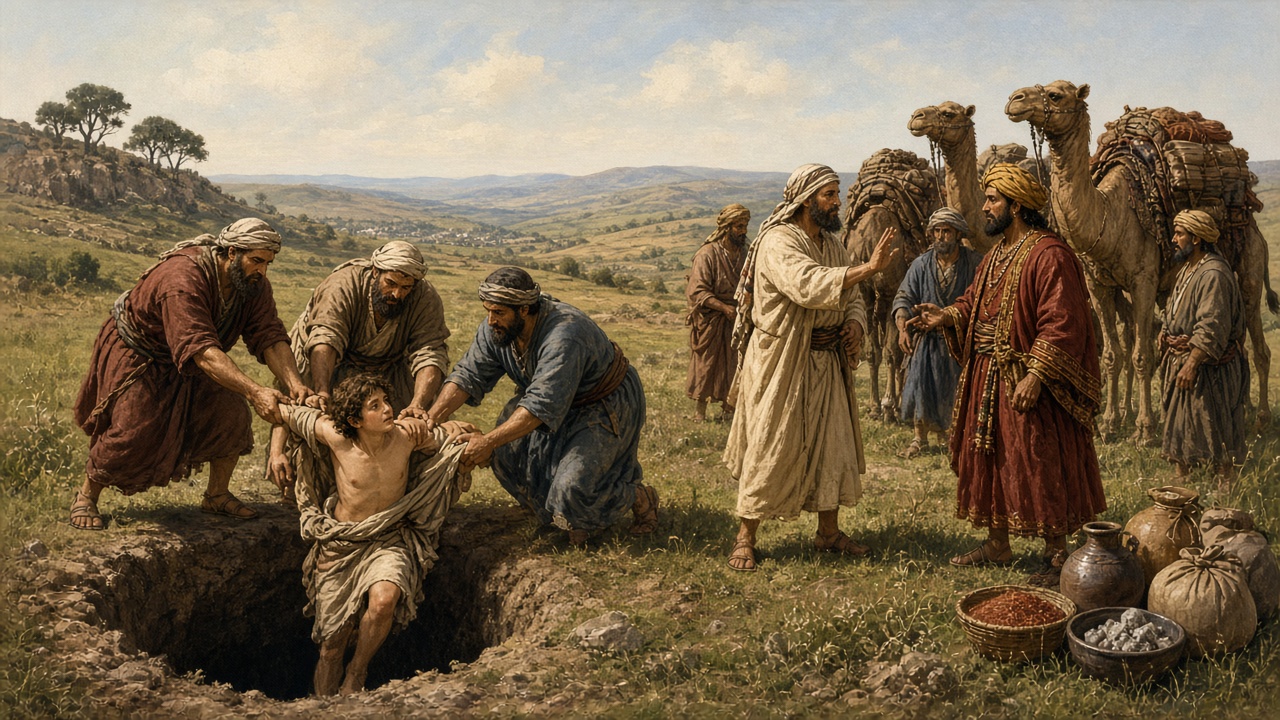
25And they reclined to eat bread. And they lifted up their eyes and looked, and, behold, a band of Arabaee were coming from Gilead, with their camels bearing spices, and resin, and myrrh, to go down to Mizraim. 26And Jehuda said to his brethren, What gain should we have by killing our brother and covering his blood? 27Come, and we will sell him to the Arabaee, and our hand shall not be upon him; for he is our brother, our flesh. And his brethren hearkened to him. 28And there passed by Midianite men, ( gabree Mid-ya-naee,) merchants, and they drew and lifted up Joseph from the pit, and sold Joseph to the Arabaee for twenty of silver; and they brought Joseph into Mizraim.
29And Reuben returned to the pit, and, behold, Joseph was not in the pit. And he rent his clothes, 30And returned to his brethren, and said, The youth is not; and I, whither shall I go?
Jacob Mourns Joseph
31But they took Joseph’s robe, and killed a kid of the goats, and dabbled the robe in the blood. 32And they sent the variegated robe, and they brought to their father, and said, This have we found; know now whether it is the robe of thy son, or not. 33And he knew it, and said, It is my son’s robe; an evil beast hath devoured him: slain, slain is Joseph! 34And Jakob rent his clothes, and wrapped sackcloth upon his loins, and mourned for his son many days. 35And all his sons, and all his house, arose to comfort him; but he refused to take comfort, and said, For I will go down unto my son, mourning into Sheol. And his father wept for him. 36And the Midianites sold him in Mizraim to Potiphar, a prince of Pharoh, chief of the killers.
Você sabia?
José vendido pelos irmãos
- Israel amava José mais do que os outros filhos, porque ele era o filho da sua velhice, e fez para ele uma túnica de muitas cores. O Easton's Bible Dictionary (1897) lê o hebraico de Gênesis 37:3 como uma veste longa e ampla, com mangas, do tipo usado pelos filhos dos nobres. Quando os irmãos viram esse favor, passaram a odiá-lo e não conseguiam dirigir-lhe uma palavra amável.Fontes: Joseph (son of Jacob) · o próprio texto bíblico
- Jacó enviou José, aos dezessete anos, do vale de Hebrom para ver como estavam os irmãos e os rebanhos; eles tinham apascentado perto de Siquém e depois seguido para Dotã. O Easton's Bible Dictionary (1897) chama Dotã de famoso campo de pastagem com dois poços, identificado com o moderno Tell-Dothan, cerca de doze milhas ao norte de Samaria, entre as colinas de Gilboa, e diz que é mencionado em monumentos de 1600 a.C. Ali os irmãos viram uma caravana de ismaelitas que vinha de Gileade, cujos camelos levavam especiarias, bálsamo e mirra a caminho do Egito.Fontes: Dothan · Gilead · o próprio texto bíblico
- Rúben, o filho mais velho de Jacó com Lia, tentou salvar José da morte e planejava devolvê-lo ao pai. Judá então persuadiu os irmãos a vender José aos ismaelitas, em vez de derramar o sangue dele. No Egito, os midianitas o venderam a Potifar, oficial do faraó e capitão da guarda; o Easton's Bible Dictionary (1897) explica esse nome como 'dedicado a Rá', o deus-sol, e entende o título, provavelmente, como chefe da polícia do Estado, com a leitura marginal 'chefe dos carrascos'.Fontes: Reuben · Judah (patriarch) · Potiphar · o próprio texto bíblico
Notas escritas com auxílio de IA a partir de fontes abertas (Theographic Bible Metadata, CC BY-SA 4.0; Easton’s Bible Dictionary, domínio público) e revisadas antes de publicar.
Lugares deste capítulo
- Canaan · 32.767, 35.333 · versículo 1
- Shechem · Hoje: Tell Balatah · 32.214, 35.282 · versículos 12, 13, 14
- Valley of Hebron · 31.525, 35.102 · versículo 14
- Egypt · 30.129, 31.308 · versículos 25, 28, 36
- Gilead · Hoje: Gilead 1 · 32.187, 35.692 · versículo 25
Só aparecem lugares com identificação de alta confiança (90% ou mais segundo as fontes acadêmicas reunidas pelo OpenBible). Mapa da época: DARE (Digital Atlas of the Roman Empire), CC BY 4.0; mapa atual: © colaboradores do OpenStreetMap; lugares: OpenBible.info (CC BY 4.0).
Créditos e licença desta tradução
Targum Onkelos Etheridge
The Targums of Onkelos and Jonathan Ben Uzziel On the Pentateuch With The Fragments of the Jerusalem Targum From the Chaldee by J. W. Etheridge, M.A. First Published 1862-65.
Public Domain
Language: English
2020-12-20
Títulos de seção adaptados da Berean Standard Bible (domínio público); não fazem parte do texto bíblico desta tradução.
Fonte: http://ebible.org/engoke/ · eBible.org