Gênesis 26
Targum Onkelos Etheridge · Toque num versículo para ver as referências cruzadas.
God’s Promise to Isaac
1And there was a famine in the land, besides the former famine that was in the days of Abraham; and Izhak went to Abimelek, king of the Philistaee, to Gerar. 2And the Lord appeared to him and said, Go not down into Mizraim, remain in the land as I have told thee; 3Dwell in this land, and My Word shall be to thee for a helper; and I will bless thee. For to thee and to thy son will I give all these lands; and I will confirm the oath that I have sworn to Abraham thy father; 4And I will multiply thy son as the stars of heaven, and will give thy son all these lands, and through thy son shall all the peoples of the earth be blessed, 5because Abraham obeyed My word, and kept the keeping of My word, My commandments, My covenant, and My law.
Isaac Deceives Abimelech
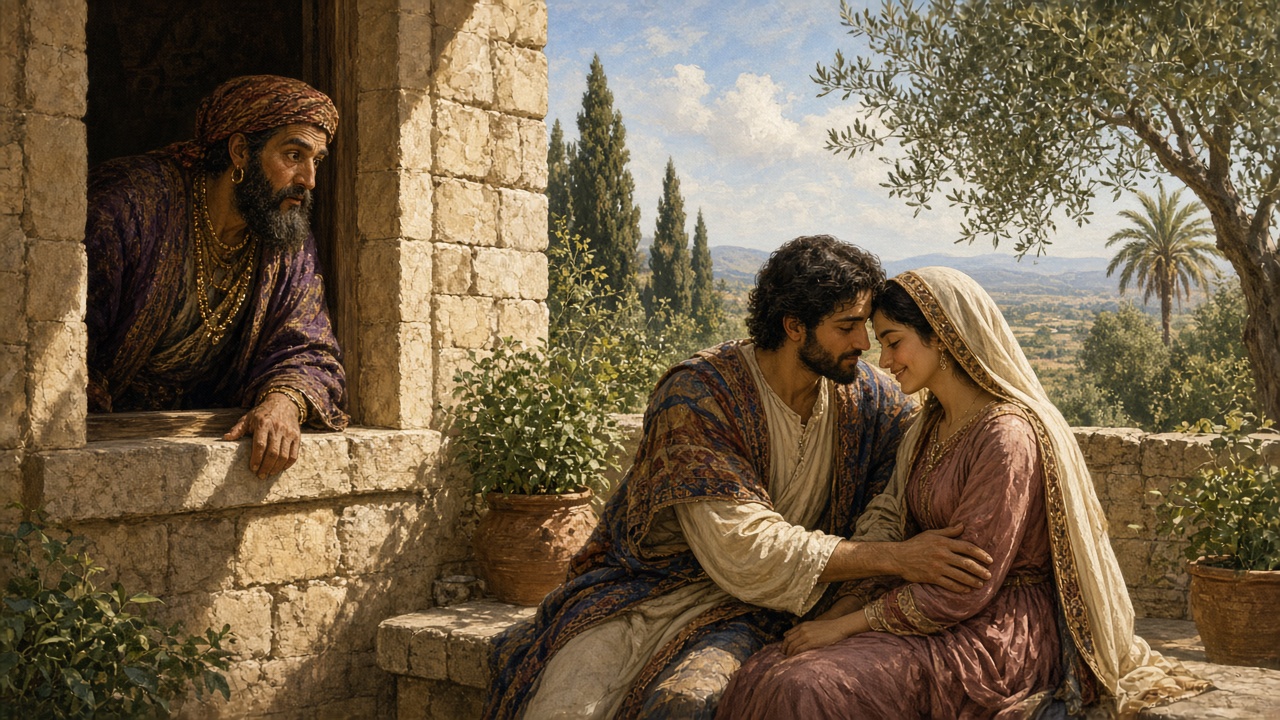
6And Izhak dwelt at Gerar; 7and the men of the place asked respecting his wife. And he said, She is my sister; for he feared to say, My wife, lest the men of the place should kill him on account of Revekah; for she was of beautiful aspect. 8And it was when be had been there many days that Abimelek the king of the Philistaee looked from a window, and, behold, Izhak was sporting with Revekah his wife. 9And Abimelek called Izhak and said, Nevertheless, behold, she is thy wife: why then hast thou said, She is my sister? And Izhak said to him, Because I said, Lest I be killed on account of her. 10And Abimelek said, What is this that thou hast done to us? It might have been that some one of the people had lain with thy wife, and thou wouldst have brought upon us the guilt. 11And Abimelek commanded all the people saying, Whoever injureth this man shall surely be put to death.
Isaac’s Prosperity
12And Izhak sowed in the land, and found in that year a hundred fold on that which he had expended, (or estimated,) and the Lord blessed him; 13And the man increased, and went on multiplying and increasing, until he had increased greatly. 14And he had flocks of sheep, and herds of cattle, and many servants; and the Philistaee were envious of him. 15And all the wells that the servants of his father had digged in the days of Abraham the Philistaee stopped up, and filled with dust. 16And Abimelek said to Izhak, Go from us; for thou art much stronger than we.
17And Izhak went thence, and sojourned in the vale of Gerar, and dwelt there. 18And Izhak returned, and digged the well of water which they had digged in the days of Abraham his father, and which the Philistaee had stopped after the death of Abraham; and he called their names after the names by which his father had called them. 19And the servants of Izhak digged in the valley, and found there a well of flowing waters. 20And the shepherds of Gerar strove with the shepherds of Izhak, saying, The water is ours; and he called the name of the well Contention, because they had contended with him. 21And they digged another well, and they strove also on account of it, and he called the name of it Hatred. 22And he went up from thence, and digged another well; and for that they strove not: and he called the name of it Spaciousness. For he said, Because now hath the Lord enlarged us, and we shall spread abroad in the land.
23And he went up from thence to Beer Shava; 24and the Lord appeared to him in the night, and said, I am the God of Abraham thy father; fear not: for in thy help is My Word; and I will bless thee, and will multiply thy sons for the sake of Abraham My servant. 25And he builded there an altar, and prayed in the name of the Lord. And he spread there his tabernacle; and the servants of Izhak digged there a well.
Isaac’s Covenant with Abimelech
26And Abimelek came to him from Gerar, and a company of his friends, and Phikol the chief of his host. 27And Izhak said to him, Why have you come to me, when you have hated me, and sent me from you? 28And they said, Seeing we have seen that the Word of the Lord is for thy help; and we have said, Let the oath which was between our fathers be now confirmed between us and thee, and let us enter into a covenant with thee, 29that thou do us no evil, as we have not injured thee, and as we have done thee only good, and we will leave thee in peace; thou art now blessed of the Lord. 30And he made them a feast, and they ate and drank. 31And they arose in the morning and covenanted, each man with his brother; and Izhak dismissed them, and they went from him in peace. 32And it was in that day that the servants of Izhak came and showed him concerning the well that they had digged. And they said to him, We have found water. 33And he called it Sheva, (the swearing). Wherefore the name of the city is Beer-sheva unto this day.
Esau’s Wives
34And Esau was the son of forty years, and he took to wife Jehudith, daughter of Beeri the Hittite, and Basemath, daughter of Elon the Hittite; 35And they were rebels and irritators against the word of Izhak and Revekah.
Você sabia?
Isaque em Gerar
- Durante uma fome, Isaque buscou refúgio junto a Abimeleque, rei de Gerar, antiga cidade e distrito na fronteira sul da Palestina. O Easton's Bible Dictionary (1897) observa que Isaque agiu com sua esposa Rebeca de modo muito parecido com o de seu pai Abraão em relação a Sara naquele lugar: disse que ela era sua irmã. Abimeleque depois o repreendeu, quando o engano foi descoberto.Fontes: Abimelech (King of Gerar) · Gerar · o próprio texto bíblico
- Os nomes dos poços no vale de Gerar recordam as disputas por eles. Eseque significa “contenda”, porque os pastores de Gerar reivindicaram a água, e Sitna significa “conflito”. Isaque também reabriu poços que os servos de seu pai Abraão haviam cavado e que os filisteus tinham tampado, e deu-lhes os mesmos nomes que seu pai lhes dera.Fontes: Esek · Sitnah · o próprio texto bíblico
- Berseba significa “poço do juramento” ou “poço dos sete”. Segundo o Easton's Bible Dictionary (1897), Abraão cavou ali um poço e lhe deu esse nome após um acordo com Abimeleque, e Isaque lhe deu o mesmo nome ao reabri-lo. O dicionário também identifica Ficol — “grande” — como capitão-chefe do exército de Abimeleque e diz que ele participou da aliança de Abraão acerca desse poço.Fontes: Beersheba · Phichol · o próprio texto bíblico
Notas escritas com auxílio de IA a partir de fontes abertas (Theographic Bible Metadata, CC BY-SA 4.0; Easton’s Bible Dictionary, domínio público) e revisadas antes de publicar.
Lugares deste capítulo
- Egypt · 30.129, 31.308 · versículo 2
- Valley of Gerar · Hoje: about 3 km around Tel Haror · 31.382, 34.606 · versículos 17, 19
Só aparecem lugares com identificação de alta confiança (90% ou mais segundo as fontes acadêmicas reunidas pelo OpenBible). Mapa da época: DARE (Digital Atlas of the Roman Empire), CC BY 4.0; mapa atual: © colaboradores do OpenStreetMap; lugares: OpenBible.info (CC BY 4.0).
Créditos e licença desta tradução
Targum Onkelos Etheridge
The Targums of Onkelos and Jonathan Ben Uzziel On the Pentateuch With The Fragments of the Jerusalem Targum From the Chaldee by J. W. Etheridge, M.A. First Published 1862-65.
Public Domain
Language: English
2020-12-20
Títulos de seção adaptados da Berean Standard Bible (domínio público); não fazem parte do texto bíblico desta tradução.
Fonte: http://ebible.org/engoke/ · eBible.org